
Tangent Line and Hyperplane: Definitions & Circle Example
Table of Contents
Definition / Summary
Informal idea
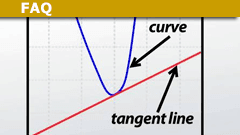
The tangent to a curve in a plane at a particular point has the same gradient as the curve at that point.
Generalization
More generally, the (n−1)-dimensional tangent hyperplane to an (n−1)-dimensional surface in n-dimensional space at a particular point has the same gradient (the same first-order linear approximation) as the surface at that point.
Implicit surface: tangent hyperplane
Let A = (a1, a2, …, an) be a point on a surface defined implicitly by F(x1, x2, …, xn) = 0. The tangent hyperplane to the surface at A is:
Tangent hyperplane equation
(∂F/∂x1)|A · (x1 − a1) + (∂F/∂x2)|A · (x2 − a2) + … + (∂F/∂xn)|A · (xn − an) = 0.
Parametric curve: tangent line
If a curve in n dimensions is defined by a parameter t as A(t) = (a1(t), a2(t), …, an(t)), then the tangent line at t0 is given in vector form by
Vector form
x = A(t0) + s · A'(t0),
where A'(t0) = (da1/dt, da2/dt, …, dan/dt) evaluated at t0 and s is a scalar parameter.
Component ratios
Equivalently (when none of the components of A'(t0) are zero) you can write the component ratios
(x1 − a1(t0)) / a1′(t0) = (x2 − a2(t0)) / a2′(t0) = … = (xn − an(t0)) / an'(t0).
Circle example
Implicit form and partial derivatives
Circle equation
For example, let A = (x0, y0) lie on the circle with center (p, q) and radius r, defined by
F(x, y) = (x − p)2 + (y − q)2 − r2 = 0. (1)
Partial derivatives
The partial derivatives at A are
(∂F/∂x)|A = 2(x0 − p),
(∂F/∂y)|A = 2(y0 − q).
Equation of the tangent (implicit form)
Using tangent hyperplane
Using the tangent hyperplane formula, the tangent line at A is
(x0 − p)(x − x0) + (y0 − q)(y − y0) = 0. (2)
Parametric form of the circle and tangent
Parametrization
The same circle can be parameterized by A(θ) = (p + r cos θ, q + r sin θ). The tangent at A(θ) can be written (assuming r ≠ 0) as
Tangent ratios
(x − p − r cos θ)/(−r sin θ) = (y − q − r sin θ)/(r cos θ).
Derivation: an alternate, memorable form
Point on circle
Let M = (x1, y1) be a point on the circle K. Then M satisfies the circle equation
(x1 − p)2 + (y1 − q)2 = r2. (3)
Tangent at M
The tangent at M (from (2)) is
(x1 − p)(x − x1) + (y1 − q)(y − y1) = 0.
Combine equations
If you add (3) to that tangent equation you obtain
(x1 − p)(x − x1) + (y1 − q)(y − y1) + (x1 − p)2 + (y1 − q)2 = r2,
Final form
which simplifies to
(x1 − p)(x − p) + (y1 − q)(y − q) = r2. (4)
Equation (4) is an alternate form of the tangent line at M(x1, y1) ∈ K that is often convenient for algebraic manipulations.
Special case: circle centered at the origin
If the circle K has center (0, 0) so it is x2 + y2 = r2, then p = q = 0 and (4) becomes the compact form
x1·x + y1·y = r2.
Further reading
References
See also https://www.physicsforums.com/insights/the-pantheon-of-derivatives-i/ and the list at the beginning of https://www.physicsforums.com/insights/journey-manifold-su2mathbbc-part/ where different views of the derivative are discussed — the slope isn’t even among them in that survey.
This article was authored by several Physics Forums members with PhDs in physics or mathematics.






Leave a Reply
Want to join the discussion?Feel free to contribute!