
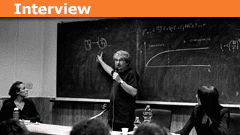
Carlo Rovelli Interview: Insights on Physics & Life
Table of Contents
Please give us a bit of background on your life and professional experience
 Life: Born and educated in Italy; I then spent 10 years in the United States and 15 in France. I came to physics late: before that I was more into hippie dreams and even trying to overthrow the Italian government.
Professional: In my third university year I fell in love with the problem of quantum gravity. I drew a large colourful picture with 10^-33 at the center (the Planck length in centimetres), posted it on the wall of my room, and decided that the rest of my life would be devoted to understanding what happens down there, where space and time are no more.
What was your inspiration for writing your recently published book “Seven Brief Lessons on Physics“?
None. I was asked to do it. I had written three articles for the cultural supplement of an Italian newspaper, and the most prestigious Italian publisher asked me to turn them into a small book. At first I thought it was a silly idea, but then I liked it.
The book is NOT what it is advertised to be: it is not a condensed summary of contemporary physics. Not at all — it is a very personal take on physics. Most people who have read the book do not realise this, but the Physics Forum readers certainly would. I describe general relativity, quantum theory, and so on, as I see them, which is not exactly how they are usually taught.
If there were an 8th lesson to your book “Seven Brief Lessons on Physics” what would it be and why?
About the brain. But I need to study another century before being able to write it…
What do you think about supersymmetry, and do you expect it to be found soon (and if yes, where)?
Look: I was 30 when I was first told that we were going to certainly see supersymmetry very soon. Now I am 60. For 30 years I have been told we were certainly going to see supersymmetry very soon. Isn’t it time to mostly give up? I think so.
Do you feel it is time for physics to give up on the “uni” in “universe”?
Not at all. There are speculations, and I respect them. But I haven’t seen a single reasonable idea on how to actually test multiverse speculations, and without empirical test we are not doing science. Maybe such tests will come; I do not know. For the moment, we remain well within the “uni”.
What indications, if any, do you see that the natural world is simple and unique—even if different from today’s understanding of it?
Very strong indications! We have discovered that the fantastic complexity of things largely follows very simple laws that we can write. If we find evidence against the project of expressing nature through simple laws, we will change course — but there isn’t any evidence requiring that change, for now.
What would you say are three physics insights that would make the greatest difference if they were assimilated into how we generally understand and think of the world?
(1) That there is no “time” in the fundamental description of the world.
(2) That “space” is not a container of things.
(3) That there is nothing outside the natural world.
What three future (as yet undetermined) insights or conceptual developments could make the greatest difference to theoretical physicists?
Well, if I knew… But I can try: we will need more clarity about the physical notion of “information.” We are confused about it because the word “information” has many different meanings and we often mix them up. With more clarity, I think it might move us a good step forward.
Should we adjust our philosophy of science (e.g. the criterion of falsifiability) regarding the last few decades of theoretical developments?
Look: the very last thing we should do is adjust our best tools just to cover our failures. If there are theories that are not falsifiable, we should discard them. A scientific theory cannot become a house of cards that delivers nothing but university positions. If it does — and we are not far from that — we are doing something seriously wrong, which we will all pay for.
If so, does it make sense to criticize string theory based on methodological grounds when the theory suggests altering these grounds?
String theory was honest in the ’80s when it set clear aims: compute the parameters of the standard model from first principles, explain why three generations, tell what happens at the center of a black hole, and so on. If it has failed those objectives, it is time to say so — not to pretend we do not care.
Your 60th birthday is being celebrated by a “carlofest”. How do you feel about this event and what are you excited for?
I was not supposed to know about it: it was meant to be a surprise. But of course I do. When I was younger, I thought I would never want something like that. Now I discover that I am actually very happy about it — very happy to see people coming to my fest and expressing affection. Maybe the young people think of me the same bad things I used to think about people being celebrated…
Away from science — what are some of your hobbies, favorite movies, books, places you’ve traveled?
I love reading everything, especially philosophy, neurobiology and anthropology, and old classic novels. I love Joseph Conrad.
Who were your heroes growing up and why?
Allen Ginsberg, Alexander the Great, Spinoza and Che Guevara — because they all thought the opposite of what people around them were thinking.
Further reading
To learn more about Carlo Rovelli please visit his webpage or his Wikipedia entry. If you are interested in his new book, check it out on Amazon.
Read another PF interview with theoretical physicist Sabine Hossenfelder.
I have a BS in Information Sciences from UW-Milwaukee. I’ve helped manage Physics Forums for over 22 years. I enjoy learning and discussing new scientific developments. STEM communication and policy are big interests as well. Currently a Sr. SEO Specialist at Shopify and writer at importsem.com








Great interview and beautiful book!
I guess I should give the link:http://www.amazon.com/Seven-Brief-Lessons-Physics-Rovelli/dp/0399184414/ref=zg_bs_13449_1I wonder if any of Hawking's books, or Kaku's ever placed that high.
Just now I checked to the Amazon page for Rovelli's book. it www #9 among all the books Amazon sells:==quote==Amazon Best Sellers Rank: #9 in Books (See Top 100 in Books)#1 in Books > Science & Math > Physics#1 in Books > Science & Math > Astronomy & Space Science > Cosmology#1 in Books > Textbooks > Science & Mathematics > Physics==endquote==I've never seen a physics book rank that high. It's phenomenal! Surely some congratulations are in order. Great going Carlo!
Happy Birthday!
Great interview!Thanks, Greg. It goes right to the heart of things I think Rovelli cares about and gives a sense of what he's like. You get a good idea of his views on some of the foremost issues facing science (in particular, physics) today.
What a complete waste. Don't you have any desire to ask him about, I don't know, his own ideas? Or any kind of substantive question at all, instead of just his competitors?I don't understand the desire to keep waging this battle against string theory, supersymmetry and every other idea other than what Rovelli works on. Surely nobody is illuminated by the entirely negative message, let alone convinced. Surely nobody is laboring under the misimpression that Rovelli's approaches have been any more successful at making unique predictions or being experimentally observed than his competitors – quite the opposite if anything.One is left with the impression that Rovelli's thoughts on physics are defined by what he is against rather than for, though I'm sure that has much to do with the terrible job by the interviewer. One also gets the impression the interviewer hasn't heard of anything interesting happening in theoretical physics over the past decade besides arguments about string wars and multiverses. I'm sorry if that's the case.