
Suanpan & Soroban: History, Design, and Usage Guide
Table of Contents
Introduction
Overview
Abacuses are commonly seen in ancient civilizations around the world as a convenient tool for simple calculations. In this article we focus on the traditional Chinese and Japanese abacuses—suanpans (China) and sorobans (Japan)—their history, design differences, and how to read and use them.
Abacus Etymology
Names and meanings
The Chinese word 「算盤」, pronounced “suanpan,” literally means “calculating tray” or “calculating disk.” In Chinese it is sometimes used metaphorically to mean planning or calculating matters.
The Japanese word 「そろばん」, pronounced “soroban,” is a borrowing and adaptation of the Chinese term.
Suanpans in China
Origins
Prototypes of the suanpan began appearing during the Han dynasty (206 BC–220 AD). Early designs resembled modern suanpans, with one bead above and four beads below the beam. Scholars believe the design was influenced by devices such as the Roman hand abacus, exchanged through trade and cultural contact.
The Roman hand abacus was a calculating tray with grooved slots and sliding metal ball bearings. The suanpan innovation was to use beads on rods, which were cheaper and easier to manufacture in bamboo.
Evidence in Art
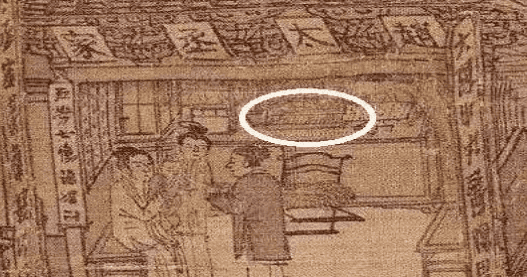
Visual evidence of suanpan use appears in the famous Song Dynasty painting “Along the River During the Qingming Festival.” It is likely the suanpan shown in the painting was used to calculate prices for goods such as Chinese medicine powders.
Design changes
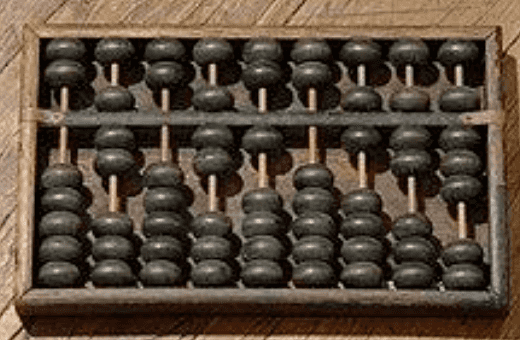
The suanpan design changed in the Ming and Qing dynasties (1368–1912) to a 2:5 bead configuration (two beads above and five below the beam). That 2:5 layout reflected the hexadecimal weight units used in some calculations at the time and is the version many Westerners now recognize as the suanpan.
Sorobans in Japan
Adaptation and simplification
During Japan’s Muromachi period (around the 14th century), the 2:5 suanpan design arrived from Ming China through trade. Japanese users considered the 2:5 layout unnecessarily complex and simplified it to a 1:4 bead design (one bead above, four below), which matched earlier Chinese designs. The simplified Japanese version is called the soroban.
Modern Suanpans and Sorobans
Current status
Suanpans largely faded from everyday use in China after the adoption of metric units and the rise of electronic calculators. Today they are mostly found in museums and antique shops.
Modern designs
Sorobans, however, remain in common use in several Asian regions because their 1:4 decimal layout maps directly to base-10 arithmetic. Many elementary schools in Japan, Taiwan, and parts of China include soroban training or clubs.
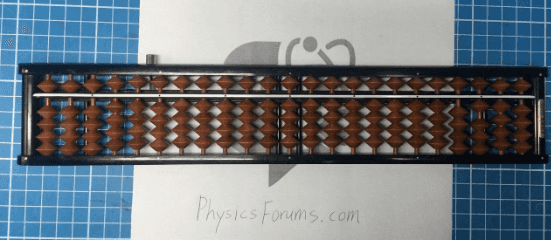
Modern sorobans typically use a 23-column design for decimal calculations and are sold in wood or plastic. Some manufacturers add a clearing mechanism for convenience.
Appearance and Features
Visual elements
A modern 23-column soroban can represent large numbers and even handle two distinct calculations simultaneously by using different column groups.
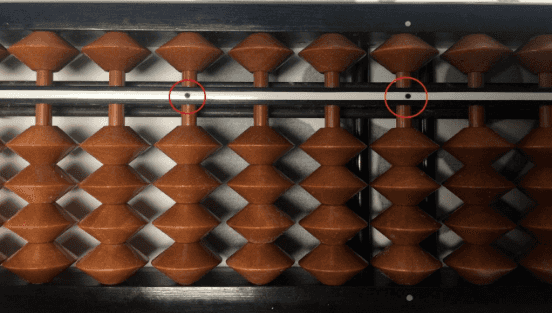
Separators and buttons
The small dots on some sorobans act like thousands or decimal separators on a numeric display (for example, the commas in 1,000,000).
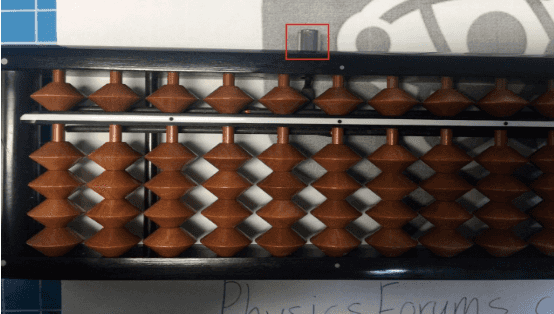
Some sorobans include a clearing button at the top that zeros all columns instantly:
How to Express Numbers on a Soroban
Digit encoding (bi-quinary)
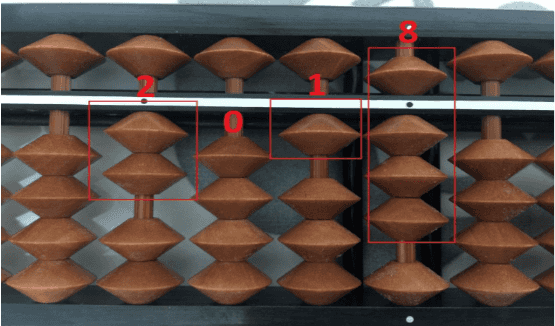
Sorobans use a bi-quinary (two-base-5) encoding to represent each decimal digit. Each column stores one decimal digit using one upper bead (value 5) and four lower beads (each value 1).
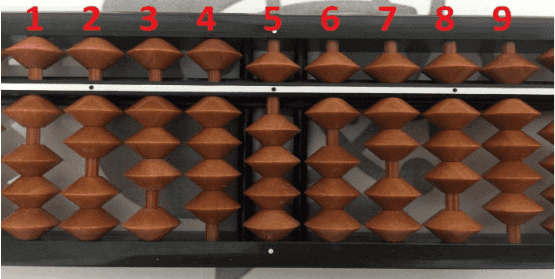
Read numbers left to right across columns. For example:
Clearing the Soroban
Methods to clear
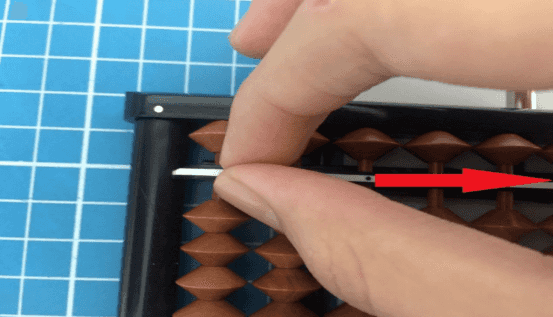
If your soroban has a clearing button, press it to reset all beads. If it doesn’t, clear by hand: place your thumb and index finger on the beam and sweep across to move all beads to their cleared positions.
Other Cool Facts
Anecdotes and uses
- Suanpans (the 2:5 bead design) have been used to play checkers—see the abacus checkers page for rules and history.
- In 1947, a soroban was entered into a calculation contest against an electronic calculator in Japan; the soroban won four out of five rounds, losing one multiplication round.
- Beyond basic arithmetic, sorobans can be used to compute square roots, cube roots, and higher-degree roots (often using algorithms such as Newton’s method).
Advanced operations and references
- Square roots: Square root on the abacus
- Cube roots: Cube root method (PDF)
- Higher-degree roots (Newton’s method): Math StackExchange discussion
Final Thoughts
Why learn the abacus?
Suanpans and sorobans have been primary accounting tools for centuries and remain in active use in many Asian countries. Learning to use a soroban can be an engaging way to improve arithmetic skills and teach children about numbers—while also reducing reliance on battery-powered calculators.
Further Resources
Links and reading
- Online soroban/suanpan emulator: Marburg University abacus demo
- Addition on soroban: Arithmetic on the abacus (addition)
- Multiplication on soroban: Using the abacus (multiplication)
- Division on soroban: Division on the abacus — division can also be done digit-by-digit, which many find faster.
- News article on the soroban vs. calculator contest: Wired: Abacus beats calculator
- General abacus history and resources: Abacus history and Abacus index

From Taipei Taiwan interested in Quantum Mechanics, String theory, Chemistry, Biology, Astro physics, Calculus







Well, we usually do that like the… ah, what is this method called in English?
      2 3
   x  4 6
   ----------
    1 3 8
    9 2
---------------
  1 0 5 8
(That looks a bit odd cause the spacing can't display properly after I submitted this post, I don't know why)
where we process it digit by digit, but from the left to the right, unlike the method I shown above, which is right to the left.
thus your peoblem will be done in 12 steps:
Just make sure the calculations are placed on the right column.Yes, it was done like that; I can recall some of it. But visualising so many columns was (and still is) a difficult job for me. I can correctly visualise upto three columns on the abacus board currently; and anything more than that generally leads to an error. Maybe you can blame the calculator to some extent :wink:
I fixed the spacing using code tags which preserve the leading spaces and uses a mono spaced font.
(like 987×6598),Well, we usually do that like the… ah, what is this method called in English?
      2 3
   x  4 6
   ----------
    1 3 8
    9 2
---------------
  1 0 5 8
(That looks a bit odd cause the spacing can't display properly after I submitted this post, I don't know why)
where we process it digit by digit, but from the left to the right, unlike the method I shown above, which is right to the left.
thus your peoblem will be done in 12 steps:
Just make sure the calculations are placed on the right column.
Nice first insight. Congratulations!
I learnt abacus when I was of @YoungPhysicist's age. Though I have forgotten how to do the larger calculations (like 987×6598), while doing simple arithmetic, the technique of abacus now comes naturally. It was of great help in increasing concentration when I was learning.Yeah, It really does, and also a great advantge on tests and calculations to calculate quickly(though almost everyone classmate of mine also take abacus courses with me, so the edge is not that obvious.:rolleyes:
Nice first insight. Congratulations!
I learnt abacus when I was of @YoungPhysicist's age. Though I have forgotten how to do the larger calculations (like 987×6598), while doing simple arithmetic, the technique of abacus now comes naturally. It was of great help in increasing concentration when I was learning.
Great job! Congratulations!
Ya! My first insight! Can’t believe it!