
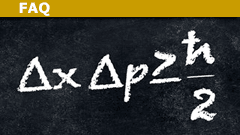
Does Heisenberg’s Uncertainty Principle Break Energy Conservation?
Direct answer: No, the Heisenberg time-energy uncertainty relation does not violate conservation of energy in quantum mechanics. The relation describes limits on how precisely energy can be measured within a given time interval, or how much energy a measurement interaction can transfer to a system. It does not permit energy to appear from nowhere or vanish without trace.
Table of Contents
Key Takeaways
- A quantum state with a precisely defined energy is an eigenstate of the Hamiltonian, and it stays that way indefinitely under unitary time evolution, aside from an overall phase factor.
- The expectation value of energy, written <ψ|H|ψ>, stays constant over time even when a system is in a superposition of energy states rather than a single eigenstate.
- The time-energy uncertainty relation states that measuring energy to a precision of ΔE requires an interaction lasting at least a time Δt.
- Short-lived phenomena such as particle resonances can be created in a superposition of energy eigenstates spread over a range ΔE, so a later precise measurement simply selects one eigenstate rather than breaking conservation.
- If a precise energy measurement is made faster than the time Δt permits, the measuring apparatus itself can transfer energy of roughly ΔE to the system, accounting for any apparent shift.
How is energy conservation expressed in quantum theory?
Quantum theory expresses conservation of energy in two compatible ways. The first concerns individual energy eigenstates: a state with a precisely known energy is an eigenstate of the Hamiltonian operator, the operator representing total energy in quantum mechanics. Because such an eigenstate is stationary under unitary evolution, the system remains in that same eigenstate indefinitely, up to a phase factor.
The second way concerns expectation values, the statistical average of a quantity taken over many repeated measurements. For a quantum state written as ψ, the expectation value of energy is <ψ|H|ψ>, and this quantity stays constant during time evolution regardless of whether the state is a single eigenstate or a superposition of several. If a system’s energy was never precisely defined to begin with, only its expectation value was, then there is no meaningful sense in which conservation could be violated. The average energy is conserved by construction.
What does the time-energy uncertainty relation actually say?
The time-energy uncertainty relation states that measuring energy to a precision of ΔE requires the measuring apparatus to interact with the system for a duration of at least Δt. This is a relationship between measurement precision and measurement duration, not a statement that energy can be temporarily created or destroyed.
When a system is probed for a time shorter than Δt, there is no operational difference between two physically distinct situations: a stationary state with a single precise energy E, and a superposition of stationary states whose energy eigenvalues all fall within ΔE of E. Each term in that superposition picks up a phase factor of exp(-i E t / ħ) under the Schrödinger equation, and below the time Δt these phases have not evolved far enough apart to produce a measurable interference pattern. The observer simply cannot distinguish the two cases in that short window.
Because of this, the uncertainty is really about one of two things: whether the system was actually prepared in a pure energy eigenstate to begin with, or how much energy the measurement interaction itself transferred to the system. Neither interpretation involves energy appearing “from nowhere.”
What happens in short-lived systems, like particle resonances?
Particle resonances and other short-lived phenomena illustrate the first case directly. If a system is created during a short time interval Δt, nothing requires that it be created in a single pure energy eigenstate. Instead it can be created in a superposition of eigenstates with energies spread across a range ΔE.
A subsequent precise energy measurement on such a system simply projects that superposition onto one of its constituent eigenstates. Whichever value is measured was already one of the possibilities present in the original superposition, so no violation of energy conservation occurs.
What happens if a system is measured too quickly after preparation?
The second case applies when a system is prepared in a precise energy eigenstate and then measured within a time shorter than Δt. Here the interaction between the system and the measuring apparatus can itself transfer energy of order ΔE to the system.
Any measured energy that differs from the originally prepared value, within the range ΔE, is a direct consequence of the perturbation introduced by the measurement apparatus. It is not evidence that energy was created or destroyed. Averaged across many repeated trials, the expectation value of energy is always recovered, confirming that no net energy is gained or lost.
Frequently Asked Questions
Does the Heisenberg uncertainty principle allow energy to be created from nothing?
No. The time-energy uncertainty relation governs the relationship between measurement precision and measurement duration, or describes energy transfer during a measurement interaction. It does not permit energy to be created or destroyed outside these accounted-for mechanisms.
What is an energy eigenstate?
An energy eigenstate is a quantum state with a precisely defined energy value. It is an eigenstate of the Hamiltonian operator, meaning it remains unchanged, aside from an overall phase factor, as it evolves forward in time under unitary evolution.
Why can virtual particles seem to violate energy conservation over short times?
Short-lived phenomena, including particle resonances, can be created in a superposition of energy eigenstates spread over a range ΔE during a brief creation interval Δt. A later precise measurement selects one eigenvalue from that existing spread, so no energy is actually created beyond what the superposition already contained.
Does measuring a system’s energy change that energy?
It can, if the measurement is performed faster than the time Δt required for a precision of ΔE. In that case the measuring apparatus can transfer energy of roughly that same magnitude to the system during the interaction, which explains any observed shift from the originally prepared value.
Is the expectation value of energy always conserved?
Yes. The expectation value <ψ|H|ψ> remains constant under time evolution regardless of whether the system is in a single energy eigenstate or a superposition of several. This holds even when individual measurements on identically prepared systems yield a spread of different results.
Read the full discussion and comments on Physics Forums

This article was authored by several Physics Forums members with PhDs in physics or mathematics.






“Actually, full credit for this entry should be given solely to vanesch. I merely reposted what he wrote for the original FAQ.
Zz.”
Thanks, corrected
Actually, full credit for this entry should be given solely to vanesch. I merely reposted what he wrote for the original FAQ.
Zz.