
Solar System Imaging: Telescope, Camera & Filters Guide
Table of Contents
Introduction
Some of the most visible features in our sky are solar system objects: the Sun, the Moon, and the planets. These objects are generally much brighter than most deep-sky targets and, in the case of planets, appear relatively small in angular size. Those two facts have encouraged amateur astronomers to develop specialized imaging techniques to capture solar system objects in high detail.
Background
Goals of SSO imaging
When imaging solar system objects (SSOs) the primary goal is high resolution and sharp detail. This differs from deep-sky imaging, where the goal is usually to collect as much light as possible. Unlike many deep-sky objects (DSOs), which can be extremely faint, SSOs are bright. That brightness means exposure times for SSOs are drastically shorter than those used for nebulae or galaxies, letting you focus on resolution rather than raw signal.
Limits on resolution: telescope and atmosphere
Two main factors limit the resolution you can achieve: the telescope’s diffraction limit and the Earth’s atmosphere. The atmosphere is usually the dominant limiting factor. Water vapor, dust, light pollution, and atmospheric turbulence blur and wash out fine detail.
Atmospheric effects
Light pollution can only be avoided by choosing a darker site. Other conditions vary night-to-night: transparency (how clear the air is, affected by water vapor and dust) and seeing (atmospheric turbulence) change with weather and location. Transparency is typically better in cool, dry climates; seeing tends to be better where the atmosphere is stable.
Checking conditions
Choose nights when seeing and transparency are above average. A good resource for forecasts is ClearDarkSky. Picking moments of good seeing can be the difference between a blurry sphere and an image with textbook-level planetary detail. For inspiration, see community galleries such as AstroBin.
When to Image
Timing matters. Planets go through phases like the Moon, and you generally want to image them when they are most fully illuminated from Earth. For example, outer planets and Mars are brightest near opposition, while inner planets are brightest near inferior conjunction (when they appear on the same side of the Sun as Earth). The gas giants show less obvious phases but must still be on the Earth-facing side of the Sun to be imaged well. Dates for these events are available from astronomy websites and amateur astronomy magazines.
The Moon is most interesting during waxing or waning phases because the low Sun angle near the terminator casts long shadows across craters and mountains, emphasizing three-dimensional surface relief.
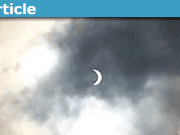
The Sun can be imaged any clear day, but the most compelling solar details appear when solar activity is high. The Sun follows an ≈11-year solar cycle; near cycle maximum you’ll see more sunspots, active regions, and flares.
Choosing a Telescope
While a telephoto lens or DSLR can be used for solar system imaging, a telescope usually gives dramatically better resolution thanks to larger aperture and a tighter diffraction limit. The diffraction limit (using the first node of the Airy disk) is:
Diffraction limit formula
$$theta=frac{1.22lambda}{d}$$
where ##theta## is angular resolution,lambda## is wavelength, and ##d## is aperture diameter.
Diffraction-limit examples
Example 1 — a 58 mm telephoto lens in green light (##lambda=500text{nm}##):
$$theta=frac{(1.22)(500times 10^{-6}text{mm})}{58text{mm}}=1.1times 10^{-5}=2.2;text{arcseconds}$$
That resolution is acceptable for solar imaging (individual sunspots can be many arcseconds across) but is marginal for detailed planetary imaging. For instance, Saturn varies from about 15 to 21 arcseconds in apparent diameter. A 2.2 arcsecond diffraction limit means features smaller than about 1/10 of the planet’s diameter would be unresolved.
Example 2 — a large 355 mm reflector in green light:
$$theta=frac{(1.22)(500times 10^{-6}text{mm})}{355text{mm}}=1.7times 10^{-6}=0.35;text{arcseconds}$$
This is roughly a six-fold improvement over the telephoto lens. Keep in mind these are order-of-magnitude estimates: atmospheric seeing and optical quality (telephoto lenses typically are not diffraction-limited) will often make practical performance worse than the ideal numbers suggest.
In short: if your aim is sharp planetary detail, a telescope with larger aperture is preferable to a telephoto lens.
Focal Length and Pixel Size
The focal length of the optical system and the pixel size of your camera set a hard sampling limit. A camera cannot resolve features smaller than the angular size subtended by a single pixel. If ##W## is pixel width in ##mutext{m}## and ##L## is focal length in ##text{mm}##, the angular sampling per pixel in arcseconds is approximately
Angular sampling per pixel
$$theta=frac{206.2W}{L}$$
Use this to choose either a camera with suitably small pixels or a longer effective focal length so pixels adequately sample the telescope’s diffraction limit.
Worked example
For the 355 mm telescope above the diffraction limit was about ##0.35;text{arcseconds}##. With an ASI120-style camera (pixel width ##W=3.75mutext{m}##):
$$L=frac{206.2 W}{theta}=frac{(206.2text{mm}/mutext{m}) (3.75mutext{m})}{(0.35;text{arcseconds})}approx 2210text{mm}$$
A 355 mm Schmidt–Cassegrain often has a native focal length just under 4,000 mm, so this setup can be diffraction-limited. If you use a camera with larger pixels (e.g., Nikon Df, ##W=7.3mutext{m}##) you get:
$$L=frac{(206.2text{mm}/mutext{m}) (7.3mutext{m})}{(0.35;text{arcseconds})}approx 4300text{mm}$$
Many 355 mm Schmidt–Cassegrains will be short of that focal length, so a Barlow lens (e.g., 1.5x, 2x) is commonly used to increase effective focal length. It’s generally better to err on the side of slightly too much focal length: a bit of oversampling can sometimes let processing software extract extra detail.
Rule of thumb: for most solar system imaging many users aim for effective focal ratios between about f/15 and f/25, though for full-disk Sun or Moon imaging you may choose a shorter focal ratio.
Filters
Filter safety
Safety first: when imaging the Sun always use appropriate solar filters. Never point an unfiltered telescope at the Sun — doing so risks instant blindness and equipment damage. Attach filters with the telescope pointed away from the Sun and confirm the filter is secure before looking through the eyepiece or camera.
Solar filters
There are two broad categories: energy-rejection (white-light) filters and narrowband filters. Energy-rejection filters are dark neutral-density filters that reduce sunlight to safe levels; they reveal sunspots and are relatively inexpensive. Narrowband filters are used in addition to a high-quality energy-rejection filter to show different solar features:
- H-alpha (Ha) — passes light around 656 nm (the hydrogen n=3 → n=2 transition). Useful for prominences, filaments, and chromospheric detail.
- Ca-K — passes around 393 nm (Ca II). Useful for revealing certain surface and chromospheric structures.
Moon and planetary filters
The Moon is very bright and large-aperture or highly sensitive cameras may benefit from neutral density filters to avoid washed-out detail. Colored planetary filters can help increase contrast for certain features on planets or the Moon — common examples include #8 (yellow), #21 (orange), and #80A (blue). Their usefulness depends on target and personal preference; consult manufacturer filter tables for suggested uses.
Choosing a Camera
Camera selection
Almost any digital camera capable of taking many successive short exposures can be used for solar system imaging. Some amateurs use modified webcams or compact cameras at the eyepiece and get respectable results. For dedicated planetary work you will often prefer a camera with small pixels to sample fine detail.
Monochrome vs color
If you image through narrowband filters, a monochrome camera is usually best because only one color channel is used at a time; monochrome cameras also give you greater control over final color during processing. For solar imaging you may choose colors in post-processing to highlight flares vs. surface detail.
“Lucky” Imaging
How lucky imaging works
Lucky imaging is a practical technique for overcoming atmospheric seeing. Turbulence causes rapid distortions, but during brief moments the atmosphere can be relatively calm. By taking many short exposures (often hundreds or thousands), you increase the chance that some frames capture those moments of near-perfect seeing.
Frame selection and stacking
Specialized software (RegiStax and similar tools) can select the best frames, align them, and stack them to produce a final image with much higher effective resolution than a single long exposure. This technique is one of the main reasons amateur astronomers can produce near-professional planetary images.
Bringing It All Together
For the best solar system imaging results, combine a large-aperture telescope, a camera with small pixels (preferably monochrome if you use filters), the appropriate filters, and lucky-imaging capture and stacking software. Consider practical integration details such as backfocus, camera weight, and mount stability — Newtonians can have limited backfocus, for example.
Practical integration tips
Great results are achievable even without a perfect setup. Treat equipment and technique as things to refine over time. With patience and steady improvement you’ll produce planetary, lunar, and solar images that stand out in the community.
Education: Graduate student in physics; specializing in biophysics and non-linear dynamics.
Hobbies: Astrophotography, Electronics, and Mineral collecting

I think it's interesting how time of day/night and date all factor in when the optimal time to photograph something in the sky. I wouldn't have thought to factor it.
Great first Insight @NFuller!
overall good :smile:
well done
just a couple of comments
When to Image:
Some times are better than others for capturing images of SSOs. The planets go through phases like the moon and you will want to image them when they are fully illuminated. This occurs at opposition for Mars and the outer planets and near conjunction for the inner planets.
Reference https://www.physicsforums.com/insights/getting-started-solar-system-imaging/You could make your above statement a little clearer.
The outer planets don't go through significant phases like the inner planets and the moon do
A changing from gibbous to full phase can reasonably easily be detected for Mars but for Jupiter and beyond
most observers wouldn't see any change
The Sun’s activity goes through 10 year cycles called solar cycles.
Reference https://www.physicsforums.com/insights/getting-started-solar-system-imaging/the small solar cycle is 11 years :smile:
(the full one is 22 years)
Dave
Thanks davenn for pointing this out! I will fix and clarify these points.