
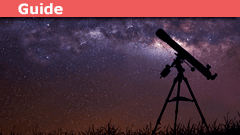
Beginner Telescope Guide: Choose the Right First Scope
Table of Contents
What telescope should a beginner buy?
Overview for beginners
People often ask what telescope an aspiring amateur astronomer should buy. There isn’t a single “correct” answer — it depends on expectations, budget, storage, transport, and observing goals. This guide consolidates the common advice I give so it can be a reference for newcomers on the astronomy forum.
Join a local astronomy club first
Before you spend a dime, find a local amateur astronomy club.
Attend meetings as a guest and arrive early to mingle. Tell members you’re new and open to equipment suggestions. Then attend a club star party (many are public outreach events). These steps let you:
Benefits of club membership
- See how different telescopes and mounts are transported and stored.
- Observe setup complexity and required time for various rigs.
- Look through many instruments to learn their strengths and weaknesses.
Manage expectations about astrophotography
One important benefit: star-party observing helps temper expectations shaped by marketing. Advertisements show bright, colorful nebulae and galaxies created by long-exposure astrophotography; visually you will usually see shades of gray-green in faint deep-sky objects. You can see color in bright stars and planets through modest scopes, but cameras can integrate light over long exposures in ways the human eye cannot.
Finding used equipment
Another advantage: club members are often gear collectors. You may find used telescopes for sale that are gathering dust — a great way to buy after trying the scope in person.
Do you really need a telescope?
Consider binoculars
Many beginners get a lot of enjoyment from binoculars and charts. A good pair of no-frills binoculars from a reputable optics company gives wide-field views, makes learning the sky easier, and is highly portable. A classic recommendation is 7×50 binoculars (7× magnification, 50 mm objective lenses). I use binoculars at nearly every observing session for quick looks and star-hopping.
If you do want a telescope: basic options
Compare common designs
Newtonian reflectors (Dobsonians)
Alt-azimuth-mounted Newtonian (Dobsonian) telescopes deliver the best aperture per dollar. You can get large mirrors and bright views for reasonable money. Dobsonians are simple to use, easy to transport compared with a similarly sized tube on an equatorial mount, and are popular with beginners for that reason.
German equatorial and other mounts
Newtonian tubes can also be mounted on German equatorial mounts. Optically they are similar, but equatorial mounts add complexity and cost because they allow polar alignment and motorized tracking for long-exposure astrophotography.
Catadioptric telescopes
Catadioptric designs (Schmidt–Cassegrain, Maksutov–Cassegrain) fold the light path, making fairly compact telescopes with longer focal lengths. They are more portable than large Newtonians of comparable aperture but generally have slower focal ratios (longer focal lengths) so the image surface can appear dimmer than a faster Newtonian at the same aperture.
Refractors
High-quality refractors (not the cheap department-store types) use well-corrected lens systems and often expensive glass to produce very high-contrast views. Because they lack a central obstruction, they can deliver excellent planetary and double-star performance. They tend to be more costly per inch of aperture than reflectors.
Learn the basics of optics
Why mirror quality matters
Some inexpensive Newtonians reduce costs by using poorer mirror figures. Cheap tubes may use spherical or poorly-figured mirrors that introduce aberrations. If you search “spherical aberration” you will see why paying a bit more for a properly figured parabolic primary mirror is usually worthwhile for reflectors.
Mounts, automation, and reliability
Choosing a mount
There is a wide range of mounts and automation options. Dobsonians can be fitted with electronic encoders; German equatorial and fork mounts may include computerized “goto” systems preloaded with tens of thousands of objects. These systems are attractive, but consider long-term serviceability: encoders or hand controllers can fail, firmware can become corrupted, and older manufacturers may not have replacement parts.
Practical recommendation
My recommendation is practical: choose an optical tube assembly that meets your needs and pair it with a mount that is no more complex or automated than necessary. Quality optics on a simple, sturdy mount will give many years of reliable use. Learning star-hopping and reading charts builds lasting navigation skills; you won’t be dependent on a computer to know “what’s that star?”
Accessories: what to buy first
Start slowly
Don’t rush to buy many eyepieces immediately. Use your club to test eyepieces and discover what works well with your telescope. Experienced amateurs usually bring a selection of popular eyepieces to share so you can compare performance before spending money.
Eyepieces and Barlow lenses
Be aware that some hobbyists use exotic eyepieces that cost more than an entire beginner scope; be courteous if someone hesitates to hand over an expensive eyepiece. For many telescopes, classic Plössl eyepieces perform very well. Short focal-length, fast reflectors sometimes benefit from higher-end wide-field eyepieces, but those can be costly.
Buying strategy
Buy eyepieces with a plan. You’ll want a range of focal lengths rather than duplicates. A high-quality Barlow lens is often the best single eyepiece purchase because it multiplies the usefulness of your longer, more comfortable eyepieces. For example, if you own 10 mm and 20 mm eyepieces and a 2× Barlow, you’ll only create one additional unique magnification — so choose focal lengths to give a useful spread.
Consider Barlows of 2×, 2.5×, or 3× and map out magnifications in a simple spreadsheet to avoid unnecessary purchases. A good Barlow is used more than you might expect, so invest wisely.
Final tips
Quick final advice
Buy what you’ll use, learn basic optics and sky navigation, and leverage local club resources. Try before you buy, prioritize solid optics and a mount you can handle, and plan eyepiece purchases sensibly. Good luck, no matter how you proceed.

Здесь размещена актуальная и практичная информация по разнообразным вопросам.
Читатели могут обнаружить ответы на важные темы.
Материалы размещаются регулярно, чтобы вы могли получать новую информацию.
Интуитивная навигация сайта помогает быстро отыскать нужные разделы.
порно смотреть
Большое количество рубрикаторов делает ресурс полезным для всех читателей.
Каждый сможет выбрать материалы, которые подходят именно ей.
Присутствие доступных подсказок делает сайт ещё более полезным.
Таким образом, данный сайт — это удобный проводник важной информации для любого пользователей.
I'm well jell (as my daughter would say).I had a hint of that too when I saw what awesome images other guys have been producing with the SW ESPRIT 100 or 120mm
Tho I had been having good success with the Canon camera and top end telephoto zoom lenses, I really desired a decent scope
on an equally decent tracking mount so that I could get exposures of more than 30 sec. The 100mm scope and the HEQ5 Pro mount
will achieve this goal.
SW work to a price and where would we be without them? The extra that you have to pay to ensure no inadequate bits follows a fairly high order Inverse Power Law,That's so true. This scope is leaps and bounds above that AU$525 scope that I pictured on the previous page of this thread
I would have loved to get the 120mm version but it is AU$1000 more expensive – just affordable. But on top of that, with its extra weight,
I would have to go to the next mount up, the HEQ6-R with a 20kg max load ( for astrophotography) higher if you are just observing.
But that is AU$2400 and that put the whole BIG upgrade out of range.
The 100mm scope is 5.5kg plus another 2-3kg of camera gear etc gives around 8.5kg on a 13kg mount and that is about the right
ratio ( gear weight ~ 2/3 max load rating of the mount when doing astrophotography.
On the same lines, I bought a seriously chunky and firm camera tripod some years ago. Using it with my 250mm Pentax Zoom has revealed an increasing slop in the neck, under the mount. Everything is built big enough but the plug / spigot that fits into the top of the vertical tube is held in place by a single 4mm pin through the tube and the spigot which is the weak link. How did that creep into the design? Design costs are cut long before advertising costs. I can, at least fix it. I am cinsidering welding!!!
One wonders, huh … I even see silly things like that in the top end GPS gear I deal with every day. Another WTF moment haha
So often shaking my head wondering what the hell the designer was thinking of when he/she "put pen to paper"
I have purchased several el cheapo <AU$100 camera tripods over the years. And yeah, their performance leaves a lot to be desired :rolleyes:
When I lashed out of the Canon 5D3 and 6D cameras around – 5 -6 yrs ago, I also finally got a decent Manfrotto tripod. Never regretted that expense.
Dave
I am very impressedI'm well jell (as my daughter would say).
SW work to a price and where would we be without them? The extra that you have to pay to ensure no inadequate bits follows a fairly high order Inverse Power Law,
On the same lines, I bought a seriously chunky and firm camera tripod some years ago. Using it with my 250mm Pentax Zoom has revealed an increasing slop in the neck, under the mount. Everything is built big enough but the plug / spigot that fits into the top of the vertical tube is held in place by a single 4mm pin through the tube and the spigot which is the weak link. How did that creep into the design? Design costs are cut long before advertising costs. I can, at least fix it. I am cinsidering welding!!!
Skywatcher are OK scopes …. I have one myself, a 120mm x 1000 mm refractor,
I know what you meant and I was not actually quoting you – just making sure that a less informed reader could be taking your summing up in a more extreme way than you meant it. I know well that SW mechanics is 'only just good enough'. They have some 'terrible' design features in the NEQ6 but those are built to a price. No one would suggest that a first time scope should be high end because the formula of their first choice would almost certainly eventually not suit their needs.
I am aware of quality in mechanical, electronic and optical devices and I tend
Well time has moved on and a couple of weeks ago and I added a top end refractor to my collection
Strangely enough, it is a Skywatcher. This came after looking at a number of refractor scopes at around the 100 – 120mm
objective size and what I was able to afford. Also my existing HEQ5 PRO had to be able to handle it. After talking to a number
of guys using either the 100mm or the 120mm. Their comments have been very encouraging with their high praise of the optics
particularly when used for astrophotography. One of them is a local guy whom I caught up with in person at a local club night under the stars
I present the Skywatcher 100mm ED ESPRIT …. AU$3500 ( that is just the scope and some accessories that come in the box)
https://www.bintel.com.au/product/s…be-assembly-triplet-refractor/?v=6cc98ba2045f
my one in the box … and what a solid box it is aluminium outer covering with dense foam lining
View attachment 240188
I am very impressed and cant wait to do some astrophotography with it … now only if we could get some cloudless nites
Those truly into astronomy will be well aware of the curse of "If you buy a new scope … cloudy nights are sure to immediately follow"
view the www page for all the spec's … the only thing not mentioned on that page is that it also has a 11:1 fine focussing
The scope tube and mechanics are very solidly built
I think I'm in love :smile:
Dave
I'll give you that one ::smile:If you were having this conversation a few hundred years ago, the visually observable numbers would probably be higher. A rich person would have time to sit in the dark all night (no distractions) and with much less air and light pollution and loads of practice, there would probably be many more faint but visible objects.
I would like to add M33
I'll give you that one ::smile:
To be specific, there are only 4 naked eye visible galaxies
1) The Milky Way
2,3) the Large and Small Magellanic Clouds
4) Andromeda Galaxy
All others require a telescopeI would like to add M33 – The Triangulum Galaxy. I have glimpsed this very sparse and wide fuzzy from the Santa Crus Mountains outside of Boulder Creek. It is very difficult and you must know where to look.
Wikipedia is listing some more: https://en.wikipedia.org/wiki/List_of_galaxies#Naked-eye_galaxies
To be honest, without a telescope or binos, I've seen only Andromeda (not counting the Milky Way :wink:). But if you have really dark sky and eyes fully adapted, I can imagine that Triangulum and Bode's galaxy could be detectable.Triangulum Galaxy (M33, NGC 598) 5.7 2.9 Mly (900 kpc) Triangulum Being a diffuse object, its visibility is strongly affected by even small amounts of light pollution, ranging from easily visible in direct vision in truly dark skies to a difficult averted vision object in rural/suburban skies.[12]
Centaurus A (NGC 5128) 6.84 13.7 Mly (4.2 Mpc) Centaurus Centaurus A has been spotted with the naked eye by Stephen James O'Meara.[13]
Bode's Galaxy (M81, NGC 3031) 6.94 12 Mly (3.6 Mpc) Ursa Major Highly experienced amateur astronomers may be able to see Messier 81 under exceptional observing conditions.[14][15][16]
Messier 83 (NGC 5236) 8.2 14.7 Mly (4.5 Mpc) Hydra M83 has reportedly been seen with the naked eye.[17]
Those would all be exceptional eyesight under exceptionally good conditions …… the avg person wouldn't have a chance .
Most people with reasonable eyesight can see down to around 5.5 – 6.0 …. anything fainter than M6.0 would fall into the exceptional conditions
M31 is an easy naked eye object, even for us southern hemisphere dwellers where it is low on the horizon.
Doesn't get more than around 10 – 15 deg for me in Sydney
I'm pretty sure I have never naked eye seen M33 in Triangulum. It's higher in the sky than M31 by another 5 – 10 deg
I did photo it a couple of weeks ago for the first time
Dave
To be specific, there are only 4 naked eye visible galaxies
1) The Milky Way
2,3) the Large and Small Magellanic Clouds
4) Andromeda Galaxy
All others require a telescopeWikipedia is listing some more: https://en.wikipedia.org/wiki/List_of_galaxies#Naked-eye_galaxies
To be honest, without a telescope or binos, I've seen only Andromeda (not counting the Milky Way :wink:). But if you have really dark sky and eyes fully adapted, I can imagine that Triangulum and Bode's galaxy could be detectable.
now, now, now …. don't misquote me/put words in my mouth :wink:I know what you meant and I was not actually quoting you – just making sure that a less informed reader could be taking your summing up in a more extreme way than you meant it. I know well that SW mechanics is 'only just good enough'. They have some 'terrible' design features in the NEQ6 but those are built to a price. No one would suggest that a first time scope should be high end because the formula of their first choice would almost certainly eventually not suit their needs.
I am aware of quality in mechanical, electronic and optical devices and I tend to go in at a higher level so you could say that I don't always practice what I preach.
There are a few ground rules – which have been mentioned somewhere back ups this thread. Never buy stuff from a 'store' or new, off eBay. Read up about things and hold off before committing to any expenditure. Find someone local who knows about these things etc. etc.
SW are good value , not rubbish
now, now, now …. don't misquote me/put words in my mouth :wink:
I didn't say they were not good value, and I definitely didn't say they were rubbish
Skywatcher are OK scopes …. I have one myself, a 120mm x 1000 mm refractor,
View attachment 237126
am not overly impressed with the chromatic and spherical aberration around the outer 1/4 of the field of view
but for AU$525, you cannot expect high quality optics
The Skywatcher mounts as in the pic above, the HEQ5 PRO is quite respectable and I would well recommend
them, as I have already done so. That mount on it's own cost me AU$1250. It was purchased separately from the scope,
around 4 years ago. Where the scope was purchased about a year ago.
Dave
As I said earlier …. if you want quality, you have to pay for itImo, you need experience before the quality differences are relevant. SW are good value , not rubbish and, let's face it, being able to see objects that are bright and sparkly in the eyepiece is the most likely thing to turn a first-timer into an enthusiast.
The second hand telescope equipment market is well worth while investigating. Amateur astronomers all seem to take care of their stuff and they will mostly be more critical of the scope they are offering you than a first-timer buyer will be.
But Astronomy is more likely to reward a beginner if they get in contact with and join a local Astro Society. Hands-on experience of equipment at night, with some friendly advice is much better than what you will get in a 'shop' that wants your money.
@davenn
I am comparing the The SkyWatcher with the Celestron NexStar.
The SkyWatcher seems better to me .. it has larger aperture of 8 inch (vs 6 inch for Celestron) and comes at half price $378 (vs 750$ for Celestron).
In general should I aim for the largest aperture when deciding which telescope to buy?
In general Skywatcher scopes are not as good quality as Celestron, Meade or Orion. Hence why they are cheaper :wink:
As I said earlier …. if you want quality, you have to pay for it
There are few galaxies you can see with a naked if the sky is dark enough, like M31 Andromeda.
To be specific, there are only 4 naked eye visible galaxies
1) The Milky Way
2,3) the Large and Small Magellanic Clouds
4) Andromeda Galaxy
All others require a telescope
So I'm thinking one of those eyepieces that sends the image to a laptop (or maybe her phone! lol) would be a practical "whistle wetter". I've measured the diameter of the eyepiece and it is a rather standard size for cheapos (1.25") so can anybody either say "No. Not a good idea" or recommend one that would be appropriate? FWIW we live in the rural mountains and have pretty decent viewing situation.Tough to say. If you do end up buying one, I'd say go for a good quality one that allows the adjustment of the gain, exposure time, etc.
I had been saving up to buy a decent telescope for my adult Son when someone bought him a cheapo (I think under $150 USD) as a gift. I don't think it's actually bad but it doesn't solve my two-pronged plan to get my prodigious grand-daughter interested as well as the height at which the tripod suits adults is still too tall for her. I'd still like to get a "real telescope" but I suppose it's wise to see if she develops any serious interest before I actually spend $300-400 USD. So I'm thinking one of those eyepieces that sends the image to a laptop (or maybe her phone! lol) would be a practical "whistle wetter". I've measured the diameter of the eyepiece and it is a rather standard size for cheapos (1.25") so can anybody either say "No. Not a good idea" or recommend one that would be appropriate? FWIW we live in the rural mountains and have pretty decent viewing situation.
Astronomy, as a hobby will eat up checkbooks as much as any hobbyOh yesssss! And all your time, too. The family may forget what you look like if you spend too much time outside at night. The final straw that breaks the camel's back is when you decide to instal an Observatory in your garden. :smile: There are more of these around than you could ever imagine. If you can find a neighbour with one (via local Astro Society) then you may have a cheaper way into the business, although it's not quite 'the same' as having your own gear.
When I was 12 (1958 or so), a schoolmate of mine (much smarter than me) had a quality 6" Newtonian telescope that his doting father bought him. One night while I was over at his house (in a Bay Area suburb with a lot of light pollution) he showed me the Andromeda Galaxy. I was absolutely taken with the view; being able to discern the arms and also one of the companion galaxies.
1978 rolls around and a friend of my wife, a PhD physicist was over dinner and I mentioned my earlier view of Andromeda and he mentioned he had an 8" f/4 Newtonian that he had ground the mirror and assembled the OTA himself and would I like it – well, yeah! I purchased a basic equatorial mount and the fire was lit.
2010 rolls around and $40,000 later.
Astronomy, as a hobby will eat up checkbooks as much as any hobby so be careful. I no longer have a complete telescope rig but my final rig consisted of a:
Paramount ME Equatorial mount (the best in its size)
QSI 683 full-frame 8.3 megapixel CCD camera with filter wheel
SBIG ST-4 Autoguider
Astronomy software
Way too many eyepieces
I shot the Soap Bubble Nebula from my San Jose, CA backyard 30 days after discovery.
You don't need aperture, you need quality and patience.
I remember reading a short story about a boy who spent nights laying on the roof of his house, looking at the moon. He started to hallucinate that he was looking down at and was falling towards the moon. High magnification through a 'good' scope can make you think in terms of a 'landscape' and the features that you can discern may only be as big as a large city.
PS Never spend long looking at the Moon without a Neutral Density Filter or you will think you have gone blind in one eye when you look away. An ND filter should perhaps be the first filter you ever buy!
This is what sucked me in.
Went to a local star party, and they had a pair of binocs pointed at Jupiter.
It looked like it was hovering over the buildings! And its moons were right there!I love looking at Jupiter's moons.
There is so much history behind those moons. Galileo was able to use observations of the 4 moons (which he discovered) to help prove that Earth isn't at the center of the Universe.
Also, the first realistic measurement of the speed of light (about 2/3 of the currently accepted value–but only because of faulty measurements of Jupiter's distance from the Earth. The mathematical reasoning was impeccable) came from studying Jupiter's 4 largest moons.
It makes me feel a sense of connectedness with all that history when I look at Jupiter's moons. It's probably silly to feel this way, but I do.
OTOH, the first glimpse of Jupiter and moons, even in a cheapy scope, could be stunningThis is what sucked me in.
Went to a local star party, and they had a pair of binocs pointed at Jupiter.
It looked like it was hovering over the buildings! And its moons were right there!
A favorite target for me are the Pleiades.Fairyland!
Absolutely and you have given a useful and pretty comprehensive list of facts. Unfortunately, newbies will not know what they actually want to do. The only way to find out that is by using someone else's equipment at least once. Astro societies are usually very happy to arrange to give people a go and show them a thing or two.
Also, you miss out the one important thing for beginners. It is that what they will actually see in a home telescope (whatever you spend on it) will be nothing like the Hubble Pictures in magazines. That simple thing can make a first timer very disappointed. I don't know the size of amateur telescope that will give more than a hint of the colours that Astrophotography will produce.
OTOH, the first glimpse of Jupiter and moons, even in a cheapy scope, could be stunning IFFFFF the viewing conditions are half decent. And the Orion Nebula will be memorable (and easy to find too) :smile:I agree.
A favorite target for me are the Pleiades. They are beautiful in a small, home telescope and–to me–seem to resemble diamonds spread across black velvet.
Another good target are the stars in the handle of the Big Dipper (Ursa major). There, one can see a binary star in a low-power home telescope.
What kind of telescope to get depends upon what you want to do, as different telescopes may be good for different goals.Absolutely and you have given a useful and pretty comprehensive list of facts. Unfortunately, newbies will not know what they actually want to do. The only way to find out that is by using someone else's equipment at least once. Astro societies are usually very happy to arrange to give people a go and show them a thing or two.
Also, you miss out the one important thing for beginners. It is that what they will actually see in a home telescope (whatever you spend on it) will be nothing like the Hubble Pictures in magazines. That simple thing can make a first timer very disappointed. I don't know the size of amateur telescope that will give more than a hint of the colours that Astrophotography will produce.
OTOH, the first glimpse of Jupiter and moons, even in a cheapy scope, could be stunning IFFFFF the viewing conditions are half decent. And the Orion Nebula will be memorable (and easy to find too) :smile:
Great article.
What kind of telescope to get depends upon what you want to do, as different telescopes may be good for different goals.
When trying to decide, keep in mind how different types of telescopes work, and you should become familiar with the ideas behind abberation, and the rules that dictate how abberation works.
For example, there is chromatic abberation, spherical abberation, curvature of field, coma, and astigmatism.
All abberations tend to be less toward the center of the image, and become more pronounced as you move toward the edge of the image.
All abberations tend to become less noticable as the focal length increases, and more noticable as the focal length decreases. This is usually given as an f-stop.
The focal length is usually indicated as an "f" number. An example might be an f-8 or an f-10.
The f-stop number usually means the focal length over the diameter of the mirror (or lens), also sometimes defined as the focal length over the aperature (opening) of the telescope. Since most telescopes (there are exceptions) don't have an adjustable opening, the f-stop is defined by the focal length over the mirror (or lens) diameter.
There are hybrid telescopes (called catadioptic) that use both lenses and mirrors.
An example is a Schmidt-Cassegrain telescope, which uses a special kind of lens at the aperature, and a Cassegrain focus telescope for the rest of the instrument.
Become familiar with the Cassegrain focus, Newtonian focus, Prime focus, and off-axis focus. There are other variations like the Gregorian focus, Hershelian focus, and so on . . . but are not as relevant to amatuer astronomers except as a historical intetest.
Catadioptic telescopes manipulate the light path to try and reach various compromises between the different limitations of the different designs.
A good Schmidt-Cassegrain telescope made by Celestron or Meade will provide excellent opportunities for astrophotography, and some come with computer-guided mounts that will precisely track a specific part of the sky (as the Earth rotates), and allow for long time exposures that will show the intricate and exquisite details of galaxies, nebulae, and so on that are invisible to the eye.
Another good design for amature astronomers is the Maksutov-Cassegrain, which uses a different kind of correcting lens at the aperature than a Schmidt-Cass, but still gives stellar (pun intended) results.
Get a subscription to Sky and Telescope, and follow the different things that are happening in the sky. You'll see charts that help you find and identify the 4 large moons of Jupiter, how many Messier objects you can spot at a specific time, and so on.
Some of the places where amatuer astronomers can make scientific contributions include comet hunting (actually best done with large binoculars on tripods) and observing the Moon for different phenomena (sometimes mysterious plumes are reported, which may be from pockets of gas or water), and so on.
Become familiar with the conventions for pinpointing objects in the sky . . . usually given as declination and right ascension. These intimidating-sounding technical terms are actually quite simple to understand, but beyond the scope (did you get the pun?) of a forum post. Look them up in a Google search.
In conclusion, a few safety issues with telescopes need to be brought up.
Observing the Sun requires specialized equipment and training. Trying to observe the sun in any telescope without the know-how and proper equipment may not only damage your instrument . . . but also your eyes. Note that Gallileo discovered sunspots, and lost a lot of his vision in the process.
Also, make sure your telescope is used in context. People have called the police and/or their burly, ape-like biker neighbors with baseball bats to take care of the pervert peeping Tom who likes to look in peoples' windows.
So, invite your neighbors and their children to share your interest in astronomy with pizza and beer (or maybe wine and cheese, or an ice cream party if there are kids). You may make some new friends, inspire young people to science, and–at the same time–avoid a trip to the hospital by sidestepping a dangerous misunderstanding that you're a pervert.
Maybe i shoulda started one in the DIY thread.That was a classic @jim hardy post and I enjoyed it. :wink:
Interestingly, (well, to me at least) I just purchased a half decent model (mini) lathe and the first real job I have done was to make a mount for some non-standard filters that @Andy Resnick sent me. Not a bad piece of lathe work, if I may say so, and it involved putting a 47mm X 0.75mm on the barrel. Thanks Andy – I have actually done something about that interesting package you sent me!! I will be doing more DIY astronomy construction shortly.
PS The problem with DIYing scopes is more to do with the focusser than an eyepiece, I think. It would be quite a challenge to mount a gash lens onto a Newtonian reflector though my lathe could help . . . . .
There are some very entertaining descriptions of building a Dobsonian to be found with a Google search.
"department"? I couldn't think what work the spellcheck substituted in order to get department. :smile:OOPS i meant "Department Store" telescope.
Some actually have a decent mirror but they come with ridiculous eyepieces and flimsy tripods..
Since power sells they'll come with eyepieces having way too short focal length to be practical. Just try to hold a 400X 'scope still let alone find something with it.
One can take apart a thrown away "Point & Shoot" film camera and get a decent lens around 35 mm focal length. Such cameras bring just a couple bucks around here.
With some whittling and glue he can fashion a wood eyepiece from an old sewing spool,
and get surprising views of our and Jupiter's moons at 15 to 30X on a 'department store' scope. For probably under twenty bucks.
It's a cheap and fun way to get started.
And it might make a good finder for your serious 'big telescope' later on .
now i'll fix that post.. old jim
PS sorry for digression. Maybe i shoulda started one in the DIY thread.
"department"? I couldn't think what work the spellcheck substituted in order to get department. :smile:
A dobsonian has many advantages in that is a very simple arrangement.And it lends itself to fabrication at home with just basic tools. One might buy a secondhand EDIT department department store scope for very litt;e and make himself a decent mount for it.
Another thought – i have a friend who's an avid shooter. His inexpensive spotting scope does a great job on Saturn's rings .
I acquired a Telrad for free, quite recently.It really does the job – especially when looking for nice bright alignment stars. You are viewing with no magnification so the brain needn't work quite so hard. The image is also the right way up! I think one should have two on a scope to reduce the Yoga aspect of Astronomy, though.
A right angle finder scope is on my 'must have' list for a newt or dob..Also Telrad finder on my dob is pretty useful, I like it a lot. Since I use it, I do spend less time finding the objects, and more time observing them. But indeed, it often requires some physical exercise, especially for the targets near zenit :smile:
A right angle finder scope is on my 'must have' list for a newt or dob..It's a 'must' – and it's something I bought PDQ, but you still need to 'sight' along the telescope barrel to get an initial pointing direction. No problem for a youngster without a 'bad' neck and back. I resorted to putting the scope on a firm table – then having to get up on a chair so that I could see through the scope (amusing to watch, I expect!!). But the views through my Dobs were really cracking at times. You can't beat a light bucket for low cost visual.
A right angle finder scope is on my 'must have' list for a newt or dob..
Also I would like to see some stars and galaxies I am not sure if that will be possible under this budget.I guess you are aware of that, but better to emphasize it: except the Sun, you won't be able to resolve any other individual star as "a disc". They all appear as a point-like sources in any amateur scope.
Regarding galaxies, the most important is to have dark sky – light pollution is a serious obstacle. And as mentioned in many posts above, bigger aperture is better, especially for deep-sky objects like galaxies. There are few galaxies you can see with a naked if the sky is dark enough, like M31 Andromeda.
on the other hand, if you want to do away with all the drive abilities, you could go with a dobsonian like thisA dobsonian has many advantages in that is a very simple arrangement. The mounts are often totally manual so you very rapidly find how to locate the objects you want to observe by 'star hopping'. (Starting with a well known star and then hopping between less well known stars, following the instructions you can find in books like "Turn Left at Orion") That's the way all amateur astronomers used to observe. If you buy a 'Go To' mount, that can take up most of a limited budget, before you even start paying for optics. Admittedly, you can be up and running quicker with a goto – but you still have to align the mount before you can point to most objects.
The first telescope I bought was an 8" Dobs and I was staggered by the view it gave. I compared it with smaller, go-to systems and I was more than pleased with my decision. You very quickly learn how to collimate a newtonian telescope and that's pretty much the limit of where a Dobs can go wrong. If your budget is limited, you will probably need to pay someone to sort out any problem with the mount and that could mean waiting till you have more money.
I got rid of my Dobs because my joints couldn't cope with the antics involved in kneeling on the ground and squinting through the finder scope. That's just a problem with age!!
I would agree with the comments about binoculars, though. Even a modest pair will reveal so many objects. You would need a fairly steady tripod, though, and binoculars with a thread for mounting to a tripod. Afaiaa, any decent bins (reasonable birding binoculars) will be suitable.
As Drak said your priority should be as much aperture as you can manage. The purpose of a scope is to gather light and the more you can gather the better so long as you can manage to prepare it for a viewing session. There is no accessory at any price that can increase the amount of light your scope can collect. Personally, i prefer an equatorial mount, but, I am old and lazy – so only needing to move the thing in one direction [along a single axis] to keep something in view appeals to me. It also vastly simplifies finding a new target at the same declination or right ascension.
In general should I aim for the largest aperture when deciding which telescope to buy?If the additional weight isn't a problem, then yes. You should usually aim for a larger aperture over a smaller aperture for a general purpose telescope (one that you aren't using specifically for something like astrophotography or something).
@davenn
I am comparing the The SkyWatcher with the Celestron NexStar.
The SkyWatcher seems better to me .. it has larger aperture of 8 inch (vs 6 inch for Celestron) and comes at half price $378 (vs 750$ for Celestron).
In general should I aim for the largest aperture when deciding which telescope to buy?
Nice list, Dave. The F! has enough aperture to actually see some interesting things. If computer control is not a 'must', the Meade Polaris is virtually the same scope on a much nicer mount at half the price.
I'm not sure I agree that you need to spend upwards of US$500 to get a 'stable' scope.
That's why I said "around" … not overly familiar with American pricing without delving into it
My budget is $600 max, so what technical specs should I aim for under this budget?OK I don't know what country you are in ? …. here at B&H as an example …..
This would be an excellent start
https://www.bhphotovideo.com/c/product/1248233-REG/celestron_22203_astro_fi_130mm_f_5.html
a good quality brand … I own a Celestron myself …. a bit bigger than that one :wink:
that one is well within your budget and I see it has ports on it for handheld controller and auto guider ( if you wanted to get into that at a later date
It is very important that the mount is solid else you will still be plagued with vibrations every time you touch it to do focussing etc
if you could push your budget a little bit more, you could aim for something like this …..
https://www.bhphotovideo.com/c/product/440825-REG/Celestron_11068_NexStar_6_SE_6_0_150mm.html
on the other hand, if you want to do away with all the drive abilities, you could go with a dobsonian like this
https://www.bhphotovideo.com/c/product/1141702-REG/sky_watcher_s11610_8_traditional_dobsonian.html
I have also owned similar in recent years
There's some thoughts for you
cheers
Dave
Thanks all for your valuable advices..
My budget is $600 max, so what technical specs should I aim for under this budget?
Also I would like to see some stars and galaxies I am not sure if that will be possible under this budget.
So, what sort of budget do you have ? and keep in mind that something stable is going to cost
~ US$500 and up. Buying something less that ~ US$500 is going to give you all the same problems
that you had with that first scopeI'm not sure I agree that you need to spend upwards of US$500 to get a 'stable' scope. As long as you avoid the extremely low end of the price spectrum, under 100-150 USD, I think you can get a decent starter scope. Obviously it wont be nearly as stable in wind as my 8-inch reflector on my Orion Atlas mount and tripod, but it also doesn't weigh 70+ pounds and it doesn't need to be as stable anyways. I believe I spent somewhere between $150 and $250 to get a small computerized reflector on an alt-az mount that worked great for me. It was light enough to easily take outside, and sturdy enough to not be blown about by the slightest breeze.
long time ago I had small telescope with max 40x magnification but I was not satisfied by it, mainly because it was very unstable where the least wind causes shaking and everything I see through it was very blurry including nearby planets like Mars and Venus.well that is what happens with a cheap scope and mount
Quality cost money
again I aim you at the thread V50 posted where all this is discussed
https://www.physicsforums.com/threads/planning-to-buy-a-first-telescope.391086/
So, what sort of budget do you have ? and keep in mind that something stable is going to cost
~ US$500 and up. Buying something less that ~ US$500 is going to give you all the same problems
that you had with that first scope
Dave
Aperture is a word frequently mentioned by telescope reviewers. In a nutshell you want the most aperture available at your price point A 6 inch anything is going to offer way more ROI than a 3 inch anything else. The finest optics and accessories cannot compensate for the light gathering power of larger aperture. This is why you see tons of 12 inch reflectors and hardly ever see even a 6 inch refractor. Unarguably, a refractor is optically superior to a reflector . Unfortunately it is also many times more expensive and comparatively enormous at the same aperture. Portability is also a vital consideration. Unless you have an observatory, a beastly scope is simply impractical The awe of the view is rapidly outweighed by the labor and nuisance of setting up a viewing session. I would suggest a compromise and settle for the biggest aperture you can afford and still physically manage. To that end I would suggest a short F reflector. They are readily available, affordable and easy to set up and use. Cat'[hybrid reflector/refractor] scopes are also popular, but, most people are much better off getting some experience with a simple reflector before taking the Cat plunge. I own a fancy 8" Cat with all the bells and whistles, but, still prefer the view offered by my venerable [and much cheaper] 10" f4 newtonian when seeing is good.
It's a sticky at the top of this page. https://www.physicsforums.com/threads/planning-to-buy-a-first-telescope.391086/
ah good, it is there again :) If I good remember, it was unstuck for a longer period…Yes, I had to dig it up earlier and I asked the mentors to sticky it again. :wink:
As an example of Russ's comments about "seeing', I tell my non-astro friends that, because of movement of the Earth's atmosphere, under too high a magnification, the Moon's surface looks like it is "boiling"; see 1:05 to 1:11 in the following video.
And for majority of amateur astronomers, I believe, the Jupiter is the top (including the four Gallilean moons) among the planets.Before I got my scope (an 8-inch SCT) in 2009, I knew I wanted to look at Jupiter, but I didn't realise how endlessly fascinating I would find observing Jupiter: cloud belts; Great Red Spot; shadow transits; moons disappearing into Jupiter's shadow; moons reappearing from Jupiter's shadow.
One early evening a few of months ago, I took the scope out early to look at the Moon, which easily took high magnification. Since the seeing was excellent, I checked a magazine, saw that Jupiter's Great Red Spot was going to be near the meridian in a few hours, and decided to leave the scope out until it got dark. (At 54 north, total darkness hardly happens in spring/summer.) When I took a look, not only was the GRS clearly visible, so too was a very small dark spot on Jupiter. A shadow transit (the shadow of a moon is visible on the "surface" of Jupiter) was in progress, which was a nice surprise, as I had not looked into this before observing.
The cool thing about observing Venus with a scope is that, like the Moon, Venus goes through phases. Right now, Venus is almost first-quarter, but I have lost it behind a large hill that is just to the west of me.
And for majority of amateur astronomers, I believe, the Jupiter is the top (including the four Gallilean moons) among the planets.Yes, Jupiter is so big and bright that a moderately skilled amateur with reasonable equipment can take near magazine-worthy photos. :wink:
I want to try to head off a potential expectations gap though. Right now there are 4 good viewable planets, which is a rariaty, but because it is summer all are very low in the sky. That means the "seeing" is very poor and even with my equipment, the atmospheric distortion is noticable at 180x.
Also, I've only looked at Venus a few times, but since it is basically a flat white cloud, there isn't much to see. Mars, Jupiter and Saturn are the ones to be most interested in.I totally agree. And for majority of amateur astronomers, I believe, the Jupiter is the top (including the four Gallilean moons) among the planets.
It's a sticky at the top of this page. https://www.physicsforums.com/threads/planning-to-buy-a-first-telescope.391086/ah good, it is there again :) If I good remember, it was unstuck for a longer period…
I am looking to buy a telescope, what is cheapest telescope I can buy with highest magnification possible?
I dont have solid background about astronomy, but I have general interest in it since I was a child, long time ago I had small telescope with max 40x magnification but I was not satisfied by it, mainly because it was very unstable where the least wind causes shaking and everything I see through it was very blurry including nearby planets like Mars and Venus.A quick note on magnification itself, since others have done a good job addressing it; I have a fairly large and good quality telescope for an amateur, and my sweet spot for planetary viewing is about 180x magnification. I sometimes go higher, but "seeing" needs to be exceptional for it to be useful.
I want to try to head off a potential expectations gap though. Right now there are 4 good viewable planets, which is a rariaty, but because it is summer all are very low in the sky. That means the "seeing" is very poor and even with my equipment, the atmospheric distortion is noticable at 180x.
Also, I've only looked at Venus a few times, but since it is basically a flat white cloud, there isn't much to see. Mars, Jupiter and Saturn are the ones to be most interested in.
This topic was discussed many times on this forum, so I recommend to search a little bitIt's a sticky at the top of this page. https://www.physicsforums.com/threads/planning-to-buy-a-first-telescope.391086/
I am looking to buy a telescope, what is cheapest telescope I can buy with highest magnification possible?This topic was discussed many times on this forum, so I recommend to search a little bit, I am sure you will find a lot of helpful inputs. In my opinion, one of the best hints is to begin with decent binoculars and a good sky atlas. It is the best investment you can do at the beginning, because both of them you will find helpful even in the case you already have a bigger telescope. Once you are sure this hobby is the right one, you can buy the telescope. Moreover at the time, you will probably know what kind of objects are the most interesting to you so you will know what kind of scope to buy (+ depending on the observational conditions in your area of course).
I had small telescope with max 40x magnification but I was not satisfied by it, mainly because it was very unstable where the least wind causes shaking and everything I see through it was very blurrySurely, the problem was with a cheap unstable mount, not the optics I believe.
I am looking to buy a telescope, what is cheapest telescope I can buy with highest magnification possible?Except in the case of very small telescopes, your magnification* is often limited more by turbulence in the upper atmosphere than by the telescope itself. Not only that, you don't actually want maximum magnification for about 95% of targets. High magnification causes the image to dim and makes it harder to keep the image stable and to find targets in the first place. I often get a 'better' view of the planets with a relatively low power eyepiece instead of one that gives me the highest possible magnification I can get. My high-mag eyepieces often just make the image a dim, blurry mess. And this is with an $1500 8-inch reflector on a mount that costs just as much.
As for price, I would set a minimum price at around $100 USD (or even $200). Anything less than this and you will almost certainly be buying a very poor quality telescope. Even if the optics of this scope are average, or even good, the quality of the mount, the tube assembly, and the accessories will likely be poor and make the telescope frustrating to use.
Trust me when I say that saving up a little extra to buy a more expensive telescope is well worth the delay.
*Note that a telescope doesn't have a single magnification. Instead the magnification depends on the focal length of the primary optics (the big piece of glass at the front or the big mirror inside) combined with the focal length of the eyepiece you are using. Buying a couple of eyepieces of different focal lengths gives you a good range of magnifications to suit your needs. Many telescopes come with at least 2, one for low-mag and one for high-mag, if I remember correctly.
I had small telescope with max 40x magnification but I was not satisfied by it, mainly because it was very unstable where the least wind causes shaking and everything I see through it was very blurry including nearby planets like Mars and Venus.This is most likely because you had a cheap telescope with a light, flimsy mount. I had one as a kid that broke the first night I had it thanks to flimsy plastic threads between the tube assembly and the focuser.
In regards to a specific telescope you should buy, I'm afraid I can't recommend a specific one. There's a saying in amateur astronomy: "The best telescope is the one that you will use." I stand buy that statement. If your nearest viewing location is four flights of stairs down and three blocks away on foot, then you probably don't want a 8-inch dobsonian that you'd need to make two trips for. If you are in a situation similar to this, a good pair of 5-7 inch binoculars might suit you best.
Try looking through this thread for more information: https://www.physicsforums.com/threads/planning-to-buy-a-first-telescope.391086/
I am looking to buy a telescope, what is cheapest telescope I can buy with highest magnification possible?
I dont have solid background about astronomy, but I have general interest in it since I was a child, long time ago I had small telescope with max 40x magnification but I was not satisfied by it, mainly because it was very unstable where the least wind causes shaking and everything I see through it was very blurry including nearby planets like Mars and Venus.
@sophiecentaur
That post was chock full of good, useful information.
:partytime:
Thanks!
most likely made for viewing the sunAs you cannot see anything else through them, I guess they must be, lol.
It would be interesting to see if the filter gets warm. It may not matter for an inexpensive scope but thermal effects can really spoil the high image quality in a high quality scope. People say you should leave a telescope for some while when you take it outside on a cold night so that it can equalise the temperature all over and get back to good collimation. Heating it up from the Sun could spoil the picture – try experimenting and see if it gets worse after ten minutes or so.
Your right angle viewer is useful, particularly for looking high in the sky. If you are not very careful with the mirror, you can easily scratch the weak reflecting surface and leave it worse than it is now. A bit of dust will only decrease the contrast but a scratch can leave every star with identifiable lines going across it (like windscreen wiper tracks and street lamps). Many people say you should stay well away from such tinkering. But, of course, care and skill are all you need to do any of those jobs. Google "Cleaning Telescope Mirrors" and there are several interesting videos.
That 2X barrel sound like a Barlow lens, which doubles the magnification of your scope. Try with and without. I have a cheap one and I'm not sure that the bigger image actually improves matters – for a start, the image is dimmer. It all depends
Standard practice for smallish solar scopes is to use what they call a Solar Wedge. It consists of a mirror at 45degrees with a dichroic reflecting surface which just reflects visible wavelengths into the eyepiece. The rest passes through and heats up a large heat sink, avoiding any localised high temperatures. A filter upstream of the eyepiece would be in a position where a fairly small diffuse image of the Sun would heat up a small area of it. It's only at the objective end that the power is easy to deal with.
You can set fire to paper with 70mm lens!So if I understand you correctly….
You think that the dark lenses I have, and that came with this (cheap, probably bought at K-Mart 20 or more years ago) telescope are most likely made for viewing the sun… or did I misunderstand?
Some further description:
My eyepieces fit into a palm-sized piece that makes a right angle between the scope and the viewer. (…Which fits into a barrel marked "2X", which then fits into the telescope…) The mirror inside looks like it bisects that angle, making two 135 degree angles where the edges of the tiny mirror are attached to the inside of the body of the angled piece. I can not see anything else remarkable about the piece, other than 2 tiny screws on the outside, on what looks like a removable panel, presumably designed for allowing access to service the mirror… I have not attempted to open it, yet, but I may have to, in order to get the mirror clean, as it has collected a lot of large dust particles.
(Did I describe that well enough?…)
~ Thanks
However, this is a small telescope, having a lens just about 2-1/2 inches in diameter.Standard practice for smallish solar scopes is to use what they call a Solar Wedge. It consists of a mirror at 45degrees with a dichroic reflecting surface which just reflects visible wavelengths into the eyepiece. The rest passes through and heats up a large heat sink, avoiding any localised high temperatures. A filter upstream of the eyepiece would be in a position where a fairly small diffuse image of the Sun would heat up a small area of it. It's only at the objective end that the power is easy to deal with.
You can set fire to paper with 70mm lens!
How "nearly black"? Can you see anything through them? A solar filter is so dark you literally can't see anything but the sun or a bare filament on a clear light bulb. Anything more and it isn't safe for solar viewing.
Also, the filters are almost always placed over the objective, where they intercept all of the light spread out instead of focused.So dark, that the only way I can see anything is to point it at the sun. I did it on a cloudy day. The only thing I could see was a circle of clouds, barely larger than the sun, moving past the circle. Once a cloud passed the bright sun, it was no longer visible. Looking at a light across the room did not allow me to see the light, but then, we use low wattage bulbs here. I did not try getting close to a lightbulb to test it.
The whole idea of the eyepiece heating up makes complete sense to me. However, this is a small telescope, having a lens just about 2-1/2 inches in diameter. Still, you have me concerned, so next clear night when I am awake, and the moon is out, I will point it sky-ward, and see if this wasn't intended to be filtered for moonlight, rather than solar. Can I assume that if these eyepieces are lunar filtered that I will be able to see the moon well, and if they are not lunar filtered, that the moon will not be easy to view? I really don't know a better way to test them.
Thank you for helping me care for my eyes – It would kinda suck to damage my (or anyone else's) vision, just because we wanted to check out the eclipse, up closer.
I've seen metal covers with just a little hole in the center to go over an objective lens , blocking probably more than 99% of the light.The resolution is poor then – back to the pinhole camera problem. The objective cover on Newtonians often has a 40mm (approx) hole for lunar viewing but I think the resolution could suffer a bit.
It is pretty important to have the filter over the objective of a large diameter reflector (an expensive solution, unfortunately) If you try to get way with a high density filter at the eyepiece end, the power from the sun on the secondary reflector can overheat it. There are cheapish solar filter mylar films ( less than £20 for 200mm diameter) which are easy to mount on a cardboard support. You could do what I did and used a cheap round baking tin with the bottom cut out which fits over the end of the tube of an 8" Newtonian.
But solar observations can be a big disappointment unless you use extremely expensive narrow band etalon filters. The are what you have to use if you want to see those very impressive pictures of solar features that people publish. But sunspots are quite impressive and well worth looking at on a big sharp image of the Sun.
I have to give the statutory warning against ever ever trying to look directly at the Sun through a telescope. 10W of light, focussed on your retina will totally fry the nerves. So any filter must be fixed well and the observations have to be well supervised by a competent adult!!!
Also, the filters are almost always placed over the objective, where they intercept all of the light spread out instead of focused.good point, i tend to forget details.
Think about the energy collected by the objective lens. Ever burn paper with a magnifying glass? Galileo wrecked his eyes.
You don't want all the light gathered by the objective to get absorbed as heat in your little eyepiece, it'll likely crack.
I've seen metal covers with just a little hole in the center to go over an objective lens , blocking probably more than 99% of the light.
@jim hardy
By "Blacked out", I guess I mean they look like the lenses used in welding goggles. The glass is very dark, nearly black.How "nearly black"? Can you see anything through them? A solar filter is so dark you literally can't see anything but the sun or a bare filament on a clear light bulb. Anything more and it isn't safe for solar viewing.
Also, the filters are almost always placed over the objective, where they intercept all of the light spread out instead of focused.
I have a question about my Celestron 130EQ reflector. Previously I had a 70mm refractor and I remember being astounded at the sharpness and contrast of edge on views of the ridges on the moon that it gave. The 130 pulls in a lot more light; it is uncomfortably bright when looking at a full moon with the scope unrestricted but it's images don't seem to be nearly as well focused as the 70mm was at what I think is about the same magnification.A lunar filter is a must for just about any telescope. I have an adjustible (two opposing polarized filters) and a stand alone that I think is 10% transmittance.
Otherwise, for a reflector on a wide field view of the moon, it really should be sharp. I'd check the collimation.
I have a question about my Celestron 130EQ reflector. Previously I had a 70mm refractor and I remember being astounded at the sharpness and contrast of edge on views of the ridges on the moon that it gave. The 130 pulls in a lot more light; it is uncomfortably bright when looking at a full moon with the scope unrestricted but it's images don't seem to be nearly as well focused as the 70mm was at what I think is about the same magnification.
Makes me wonder what the process for making the 5 inch mirror is, but thus far I haven't really checked close enough to actually tell. Everything about the 130 is well made and works good, but I am a bit disappointed about the blurriness of the view.
DCDo you know the f-number of both scopes? Reflectors tend to have lower f-numbers than refractors (except the really expensive apochromatic ones) if I recall, which can exacerbate any aberrations inherent in the mirror shape.
For a mid 80's partial in Florida our clever secretary at work taped her makeup mirror to a windowsill and reflected an image onto back wall of the office.Clever, indeed!
I am loathe to spend money for adapters and such, ilook into pinhole camera and projection ideas.
For a mid 80's partial in Florida our clever secretary at work taped her makeup mirror to a windowsill and reflected an image onto back wall of the office.