

Mutual Inductance: When k≠1 and Two Coupling Coefficients
Table of Contents
Mutual inductance and the coupling coefficient
A commonly used formula for mutual inductance M between two nearby coils L1 and L2 is M = k√(L1*L2). This formula, however, assumes equal percentage flux linkages between the two coils. That requirement is often omitted in several references.
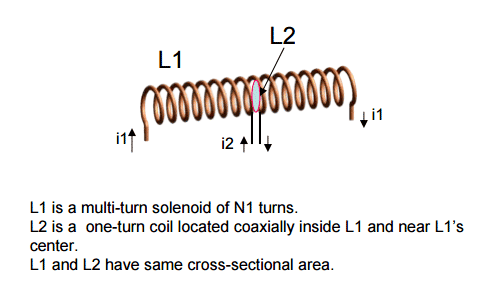
Example: single-turn coil inside a long solenoid (Fig. 1)
This requirement is not necessarily met, as shown in Fig. 1. Consider a single-turn coil L2 embedded within a long solenoid L1 with N1 turns. Flux from L1 essentially completely links L2, whereas flux from L2 couples only partially into L1.
Some nomenclature:
- φ11 = flux generated by L1 coupling into itself;
- φ21 = flux generated by L1 coupling into L2;
- φ12 = flux generated by L2 coupling into L1;
- φ22 = flux generated by L2 coupling into itself.
Nomenclature and basic relations
So mutual inductance M21 = φ21/i1 (N2 = 1 here); and M12 = N1φ12/i2.
L1 = N1φ11/i1
L2 = φ22/i2.
Symmetry and a common fallacy
As is well known, M21 = M12 = M. (The proof is nontrivial; Feynman uses the magnetic vector potential while Skilling invokes an energy argument.)
The following fallacious reasoning can ensue — I speak from experience. Since M can be computed either way above, it seems easier to use M21 because φ21 = φ11. I won’t derive the result here; in vacuum one finds M = μ0A/l, where A is the common cross-sectional area and l is the length of L1.
From that you might conclude there is 100% flux coupling between L1 and L2, set k = 1, and write M = k√(L1L2). This conclusion is incorrect.
Why k = 1 is not generally valid
If that reasoning were valid, we could deduce L2 from known L1 and M alone. But L2 actually depends on both the common area A and the wire radius R and generally requires evaluating a specialized integral. The fallacious computation would imply that L2 is a function of L1 even when i1 = 0, and would ignore physical realities such as L2 → ∞ as R → 0.
Two distinct coupling coefficients
The resolution is that there are really two coupling coefficients. Define
- k1 = φ21/φ11
- k2 = φ12/φ22
With the relations above one finds
M = √(k1k2L1L2).
The bottom line is that we typically know k1 (for example, from the solenoid flux linking the small coil) and L1 but not k2 or L2. There is a single coupling coefficient k = k1 = k2 if and only if the fraction of flux from one coil coupling into the other is the same for both coils.
When both coils are solenoids
Even if the single-turn coil were replaced by another long solenoid L2, but of different length and wrapped on top of L1 so that A is the same for both, there are still two different coupling coefficients involved. In that case the familiar relation L2/L1 = (N2/N1)2 does not generally hold.
Further reading
Read my next article: https://www.physicsforums.com/insights/brachistochrone-subway/
AB Engineering and Applied Physics
MSEE
Aerospace electronics career
Used to hike; classical music, esp. contemporary; Agatha Christie mysteries.




“How does a coil work with matching box in an ion source chamber when producing a beam or making plasma,i am all confused as i am a student?”
I am not sure what you mean by a “matching box” and “making plasma”; could you give me a link that describes this setup?
“Nice work [USER=350494]@rude man[/USER]”
Thank you!
Nice work [USER=350494]@rude man[/USER]
How does a coil work with matching box in an ion source chamber when producing a beam or making plasma,i am all confused as i am a student?