
Physics Forums Insights
  • Physics
    • Physics Articles
    • Physics Tutorials
    • Physics Guides
    • Physics FAQs
  • Math
    • Math Articles
    • Math Tutorials
    • Math Guides
    • Math FAQs
  • Bio/Chem/Tech
    • Bio/Chem Articles
    • Computer Science Tutorials
    • Technology Guides
  • Education
    • Education Articles
    • Education Guides
  • Interviews
  • Quizzes
  • Forums
  • Click to open the search input field Click to open the search input field Search
  • Menu Menu
electrical wire

Mutual Inductance: When k≠1 and Two Coupling Coefficients

May 9, 2015/4 Comments/in Physics Tutorials/by rude man
📖Read Time: 3 minutes
📊Readability: Accessible (Clear & approachable)
🔖Core Topics: couplingfluxcoilcoilssingle

Table of Contents

  • Mutual inductance and the coupling coefficient
    • Example: single-turn coil inside a long solenoid (Fig. 1)
    • Nomenclature and basic relations
  • Symmetry and a common fallacy
  • Why k = 1 is not generally valid
  • Two distinct coupling coefficients
  • When both coils are solenoids
  • Further reading
    • More Related Articles

Mutual inductance and the coupling coefficient

Solenoid

A commonly used formula for mutual inductance M between two nearby coils L1 and L2 is M = k√(L1*L2). This formula, however, assumes equal percentage flux linkages between the two coils. That requirement is often omitted in several references.

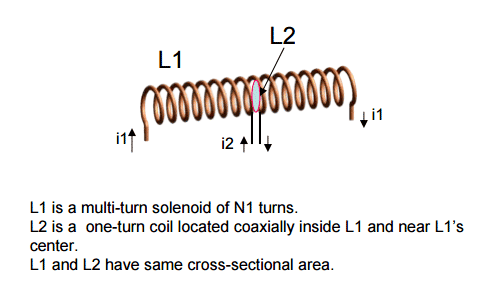
Example: single-turn coil inside a long solenoid (Fig. 1)

This requirement is not necessarily met, as shown in Fig. 1. Consider a single-turn coil L2 embedded within a long solenoid L1 with N1 turns. Flux from L1 essentially completely links L2, whereas flux from L2 couples only partially into L1.

Some nomenclature:

  • φ11 = flux generated by L1 coupling into itself;
  • φ21 = flux generated by L1 coupling into L2;
  • φ12 = flux generated by L2 coupling into L1;
  • φ22 = flux generated by L2 coupling into itself.

Nomenclature and basic relations

So mutual inductance M21 = φ21/i1 (N2 = 1 here); and M12 = N1φ12/i2.

L1 = N1φ11/i1

L2 = φ22/i2.

Symmetry and a common fallacy

As is well known, M21 = M12 = M. (The proof is nontrivial; Feynman uses the magnetic vector potential while Skilling invokes an energy argument.)

The following fallacious reasoning can ensue — I speak from experience. Since M can be computed either way above, it seems easier to use M21 because φ21 = φ11. I won’t derive the result here; in vacuum one finds M = μ0A/l, where A is the common cross-sectional area and l is the length of L1.

From that you might conclude there is 100% flux coupling between L1 and L2, set k = 1, and write M = k√(L1L2). This conclusion is incorrect.

Why k = 1 is not generally valid

If that reasoning were valid, we could deduce L2 from known L1 and M alone. But L2 actually depends on both the common area A and the wire radius R and generally requires evaluating a specialized integral. The fallacious computation would imply that L2 is a function of L1 even when i1 = 0, and would ignore physical realities such as L2 → ∞ as R → 0.

Two distinct coupling coefficients

The resolution is that there are really two coupling coefficients. Define

  • k1 = φ21/φ11
  • k2 = φ12/φ22

With the relations above one finds

M = √(k1k2L1L2).

The bottom line is that we typically know k1 (for example, from the solenoid flux linking the small coil) and L1 but not k2 or L2. There is a single coupling coefficient k = k1 = k2 if and only if the fraction of flux from one coil coupling into the other is the same for both coils.


When both coils are solenoids

Even if the single-turn coil were replaced by another long solenoid L2, but of different length and wrapped on top of L1 so that A is the same for both, there are still two different coupling coefficients involved. In that case the familiar relation L2/L1 = (N2/N1)2 does not generally hold.

Further reading

Read my next article: https://www.physicsforums.com/insights/brachistochrone-subway/

rude man

AB Engineering and Applied Physics
MSEE
Aerospace electronics career
Used to hike; classical music, esp. contemporary; Agatha Christie mysteries.

More Related Articles

  • All About the Einstein Field Equations
    Tags: electromagnetism
    Share this entry
    • Share on Facebook
    • Share on X
    • Share on WhatsApp
    • Share on LinkedIn
    • Share on Reddit
    • Share by Mail
    https://www.physicsforums.com/insights/wp-content/uploads/2015/05/electricalwire.png 135 240 rude man https://www.physicsforums.com/insights/wp-content/uploads/2019/02/Physics_Forums_Insights_logo.png rude man2015-05-09 16:22:012026-02-16 15:37:14Mutual Inductance: When k≠1 and Two Coupling Coefficients
    You might also like
    gauss law misconceptions A Physics Misconception with Gauss’ Law
    Magnetic Field Lines Are Magnetic Field Lines Real?
    model magnet How to Model a Magnet Falling Through a Conducting Pipe
    Split Electric Fields Es vs Em Fields in Electrodynamics: Capacitor & Antenna
    electrostaticfield1 Learn About Energy Gained by Charge in an Electrostatic Field
    How to Recognize Split Electric Fields
    4 replies
    1. rude man says:
      May 19, 2016 at 3:47 pm

      “How does a coil work with matching box in an ion source chamber when producing a beam or making plasma,i am all confused as i am a student?”
      I am not sure what you mean by a “matching box” and “making plasma”; could you give me a link that describes this setup?

      Log in to Reply
    2. rude man says:
      May 19, 2016 at 3:47 pm

      “Nice work [USER=350494]@rude man[/USER]”
      Thank you!

      Log in to Reply
    3. Greg Bernhardt says:
      May 19, 2016 at 3:47 pm

      Nice work [USER=350494]@rude man[/USER]

      Log in to Reply
    4. Lebogang says:
      July 30, 2015 at 9:40 am

      How does a coil work  with matching box in an ion source chamber when producing a beam or making plasma,i am all confused as i am a student?

      Log in to Reply

    Leave a Reply

    Want to join the discussion?
    Feel free to contribute!

    Leave a Reply Cancel reply

    You must be logged in to post a comment.

    Trending Articles

    • Animal Speed Scaling: Body-Lengths per Second Across Sizes
    • Can We See an Atom?
    • How to Solve a Multi-Atwood Machine Assembly
    • What Planck Length Is and It’s Common Misconceptions
    • Particle in a Box: 1D & 2D Quantum Visualizations
    • Yardsticks to Metric Tensor Fields
    • Balloon Analogy Explained: Cosmology, Expansion & Limits
    • What Thermodynamics and Entropy Means
    • Why Entangled Photon-Polarization Qubits Violate Bell’s Inequality per Quantum Information Theory
    • Top Misconceptions about Virtual Particles

    Physics Forums

    • Classical Physics
    • Atomic and Condensed Matter
    • Quantum Physics
    • Special and General Relativity
    • Beyond the Standard Model
    • High Energy, Nuclear, Particle Physics
    • Astronomy and Astrophysics
    • Cosmology
    • Other Physics Topics

    Receive Insights Articles to Your Inbox

    Enter your email address:

    Blog Information

    • Become a Member!
    • Write for Us!
    • Table of Contents
    • Blog Author List

    Popular Topics

    astronomy (17) black holes (17) classical physics (35) cosmology (16) education (23) electromagnetism (19) general relativity (19) gravity (24) interview (21) mathematics (39) mathematics self-study (21) Physicist (26) programming (18) Quantum Field Theory (31) quantum mechanics (36) quantum physics (24) relativity (40) Special Relativity (16) technology (19) universe (21)
    2026 © Physics Forums, ALL RIGHTS RESERVED - Contact Us - Privacy Policy - About PF Insights
    • Link to X
    • Link to Facebook
    • Link to LinkedIn
    • Link to Youtube
    Link to: Learn About the Greenberger-Horne-Zeilinger Experiment Link to: Learn About the Greenberger-Horne-Zeilinger Experiment Learn About the Greenberger-Horne-Zeilinger ExperimentredlightsLink to: Quantum Renormalisation Made Easy Link to: Quantum Renormalisation Made Easy renormalizationQuantum Renormalisation Made Easy
    Scroll to top Scroll to top Scroll to top