
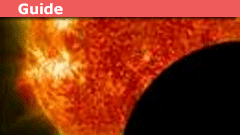
Solar Eclipse Viewing & Safety Guide — What to Expect
Table of Contents
Eclipse Viewing Key Points
- Never view the Sun with the naked eye for any length of time; doing so can cause irreversible eye damage or blindness.
- Only totality during a total solar eclipse is safe to view with the naked eye. All other phases must be viewed using proper solar filters or an indirect method.
- To make a simple safe projector: use two pieces of cardboard. Punch a small hole (pinhole) in one piece, place the other piece on a flat surface, then with your back to the Sun let the pinhole-projecting cardboard cast an image of the Sun onto the second piece.
- During totality the Moon completely covers the Sun, making it briefly safe to view without filters.
- During totality you may see Bailey’s Beads, the Diamond Ring effect, and the Sun’s corona and prominences.
- Totality can last up to 7 minutes and 40 seconds but is generally much shorter. As soon as any part of the Sun reappears, stop naked-eye viewing and immediately use a solar filter again.
Eclipse Safety Information
Before attempting to view a solar eclipse, understand the risks and follow safe viewing practices.
Never look directly at the Sun during any phase of an eclipse except totality. Looking at the Sun without proper protection can cause permanent retinal damage or blindness.
Solar filters and eclipse glasses vary in quality and availability across countries. Purchase from reputable telescope or astronomy retailers. When possible, choose products that meet recognized safety standards (for example, ISO 12312-2 for eclipse eyewear).
Use filters only as directed and inspect them before each use for scratches or damage.
For safe, indirect viewing, use a pinhole projector as described above or another approved projection method. Never look at the Sun through binoculars, a telescope, or a camera without a proper solar filter fitted over the objective; unfiltered optical devices concentrate sunlight and will cause severe eye injury.
Read more safety information from NASA
What is a solar eclipse and what can I expect to see?
A solar eclipse occurs when a body passes between an observer and the Sun, blocking some or all of the Sun’s light. On Earth the most common and interesting events are caused by the Moon passing between the observer and the Sun.
From Earth the Moon and the Sun have very similar apparent sizes, so the Moon can sometimes completely cover the Sun. When the Moon fully covers the Sun and the observer is positioned within the narrow path of totality, a total solar eclipse occurs.
Because the Moon’s orbit is elliptical, a total eclipse does not happen every lunar transit. If the Moon is near apogee (its furthest point from Earth) it may not fully cover the Sun and an annular eclipse occurs, leaving a bright ring of sunlight. If the alignment is not exact, an observer may see only a partial eclipse.
What you may see around totality
- Bailey’s Beads — Points of sunlight visible through lunar valleys and craters as the Moon almost covers the Sun.
- Diamond Ring — A bright spot of photosphere combined with the corona, resembling a ring with a bright diamond just before or after totality.
- Totality — The Moon fully covers the Sun. The corona becomes visible (appearing bluish-white), and prominences or solar flares may appear as reddish features. Totality is brief; as soon as the photosphere reappears you must resume using solar filters.
Total Solar Eclipse — (South Australia)
I traveled to South Australia to view the December 4, 2002 total solar eclipse. I decided against going to Ceduna on the coast because cloud cover there was a concern.
Instead I drove into the Outback where the chance of cloud was much lower.
The centerline horizon was ideal — flat as a pancake from horizon to horizon — and the Sun was only about 6° above the horizon at totality. The wind was gale force during the day and eased only slightly during the eclipse, but this didn’t affect naked-eye viewing during totality.
It took roughly one hour from first contact to totality. One large sunspot was visible during the partial phases.
Five to ten minutes before totality the heat dropped noticeably, although the Sun remained very bright; shadows lengthened as if sunset were approaching, even though the Sun was still 6° above the horizon.
In the seconds before totality the lunar shadow raced across the Outback at about 27,000 km/h and then — suddenly — the Sun went out. A ghostly bluish-white corona appeared, and a few prominences on the lower-left limb showed up as deep red. The view through my camera lens was spectacular.
Thirty seconds later the photosphere began to reappear through deep lunar valleys. The diamond ring effect was brief; solar filters were quickly returned to cameras and telescopes. It was worth the trip across Australia to witness that 30-second moment.
I hope you get to view this amazing event someday — but please remember the safety tips above.
FAQ
What is a solar eclipse?
A solar eclipse is an event in which the Moon passes between the Earth and the Sun, blocking some or all of the Sun’s light and casting a shadow on the Earth’s surface.
How can I safely view a solar eclipse?
Do not look directly at the Sun without proper protection except during the brief period of totality. Use certified eclipse glasses or a proper solar filter for binoculars, cameras or telescopes. Alternatively, use an indirect method such as a pinhole projector.
What should I wear when viewing a solar eclipse?
Dress for the weather and wear comfortable, protective clothing as needed — for example, a hat, long pants, and a long-sleeved shirt if you’ll be exposed to sun or wind for an extended time.
What other safety precautions should I take?
The American Astronomical Society and other professional bodies advise never to use binoculars, telescopes, or cameras to view the Sun without a proper solar filter fitted over the objective. Inspect filters before use and never use scratched or damaged filters.
I have a BS in Information Sciences from UW-Milwaukee. I’ve helped manage Physics Forums for over 22 years. I enjoy learning and discussing new scientific developments. STEM communication and policy are big interests as well. Currently a Sr. SEO Specialist at Shopify and writer at importsem.com

Leave a Reply
Want to join the discussion?Feel free to contribute!