
Calculate Sgr A* Spin from QPOs — Kerr Metric Derivation
Table of Contents
Introduction
This Insight explains how it is possible to calculate the spin of Sagittarius A* — the supermassive black hole at the center of the Milky Way — using a small set of observations and a few equations derived from the Kerr metric. The calculation described below follows the approach in the source paper:
Spin and mass of the nearest supermassive black hole by V. I. Dokuchaev
https://arxiv.org/abs/1306.2033
Selected extracts from the abstract
“Quasi-Periodic Oscillations (QPOs) of the hot plasma spots or clumps orbiting an accreting black hole contain information on the black hole mass and spin.”
“The promising observational signatures for the measurement of black hole mass and spin are the latitudinal oscillation frequency of the bright spots in the accretion flow and the frequency of black hole event horizon rotation…”
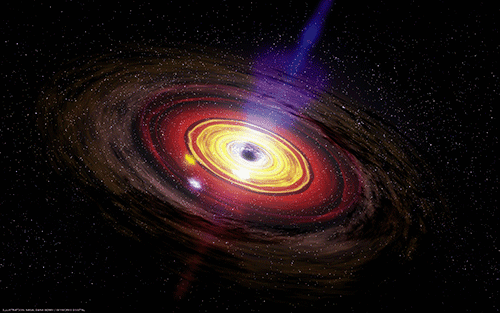
Interpretation of the known QPO data by dint of a signal modulation from the hot spots in the accreting plasma reveals the Kerr metric rotation parameter, a = 0.65 ± 0.05, and mass, M = (4.2 ± 0.2)×10⁶ M[itex]_⊙[/itex], of the supermassive black hole in the Galactic center. At the same time, the observed 11.5 min QPO period is identified with a period of the black hole event horizon rotation, and, respectively, the 19 min period is identified with a latitudinal oscillation period of hot spots in the accretion flow.”
Why this is interesting
I was particularly interested because this paper infers the spin of the black hole at the Galactic center (Sgr A*, ≈26,000 light-years away) from a few observed periods and simple equations derived from the Kerr metric. The black hole mass used in these calculations comes independently from the orbits of nearby stars; the QPOs supply timing signatures that constrain the spin.
Kerr metric (common form)
One of the most common expressions for the Kerr metric is:
[tex]\begin{align*} -c^{2} d\tau^{2} = ds^{2}
= & -\left( 1 – \frac{2M r}{\rho^2} \right) c^{2} dt^{2} + \frac{\rho^2}{\Delta} dr^{2} + \rho^2\, d\theta^{2} \\
& + \left( r^{2} + a^{2} + \frac{2M r a^{2}}{ \rho^2} \sin^{2} \theta \right) \sin^{2} \theta \ d\phi^{2}
– \frac{4M ra \sin^{2} \theta }{\rho^2} \, c \, dt \, d\phi \end{align*}[/tex]
where [itex]\rho^2=r^2+a^2 \cos^2 \theta[/itex] and [itex]\Delta=r^2 – 2Mr + a^2[/itex]. Here [itex]\tau[/itex] is proper (local) time, s is the spacetime interval, t is coordinate (infinity) time, M is the gravitational radius (geometric mass unit) with M = Gm/c², and a is the spin parameter (geometric spin unit) with a = J/mc.
Condensed form and frame-dragging
The metric can also be written in a condensed form (setting c = 1):
[tex]-d\tau^2=-\alpha dt^2+\frac{\rho^2}{\Delta}dr^2+\rho^2 d\theta^2+\varpi^2(d\phi-\omega dt)^2[/tex]
Here the frame-dragging angular velocity ω (the rate spacetime is dragged around the black hole as seen from infinity) and the lapse or reduction factor α are:
[tex]\omega=\frac{2Mra}{\Sigma^2}\ \ \ \ \ \ \ \ \ \ \
\alpha=\sqrt{\Delta}\frac\rho\Sigma[/tex]
Note: multiply ω by c to obtain SI units (rad/s). The lapse function α describes redshift and time dilation at radius r including frame-dragging: the local proper frame-dragging rate is ω/α while ω is the rate seen at infinity. Other geometric functions used below are:
[tex]\Sigma^2=(r^2+a^2)^2-a^2\Delta \sin^2\theta\ \ \ \ \ \ \ \ \ \ \ \varpi=\frac\Sigma\rho\sin \theta[/tex]
where ϖ (varpi) is the reduced circumference (the proper coordinate radius that accounts for frame dragging).
Event horizons and orbital angular velocities
The black hole’s event horizons (outer and inner) are given by:
[tex] r_{h\pm}=M\pm\sqrt{M^2-a^2}[/tex]
where + denotes the outer horizon and − the inner horizon. The angular velocity of the horizons (as observed from infinity) is:
[tex]\Omega_{h\pm}=\frac{a}{r_{h\pm}+a^2}[/tex]
For stable equatorial circular orbits at radius r, the angular velocity is:
[tex]\Omega_{\phi\pm}=\frac{\pm\sqrt{M}}{r^{3/2}\pm a\sqrt{M}}[/tex]
Here + denotes a prograde orbit (co-rotating with frame-dragging) and − a retrograde orbit (counter-rotating). Allowing for latitudinal oscillation (the small up-and-down motion of a near-circular orbit in a curved spacetime), the latitudinal angular velocity is:
[tex]\Omega_{\theta \pm}=\Omega_{\phi \pm}\sqrt{1\mp4a_*x^{3/2}+3a_*^2x^{-2}}[/tex]
where [itex]a_*=a/M[/itex] and [itex]x=r/M[/itex]. Ωθ describes the latitudinal oscillation of a hot spot in a thin accretion disk. Close to the black hole Ωθ is slightly less than Ωφ, because Ωφ is the exact equatorial orbital angular velocity while Ωθ includes the small latitude motion (see fig. 6 in the paper).
Marginally stable orbit (MSCO / ISCO)
The brightest hot spots are assumed to be near the inner edge of the accretion disk, at the radius of the marginally stable circular orbit:
[tex]r_{ms\pm}\ =\ M\left(3+Z_2 \mp \sqrt{(3-Z_1)(3+Z_1+2Z_2)}\right)[/tex]
where
[tex]Z_1=1+\left(1-x^2\right)^{1/3}\left(\left(1+x\right)^{1/3}+\left(1-x\right)^{1/3}\right)[/tex]
and
[tex]Z_2=\sqrt{3x^2+Z_1^2}[/tex]
The marginally stable orbit is at 6M for a non-rotating (Schwarzschild) black hole and decreases with increasing spin, reaching M for a maximally rotating hole (a = M). Thus the spin parameter can be deduced from the radius of the marginally stable orbit.
Relating QPOs to the spin of Sgr A*
Dokuchaev interprets two observed QPO periods as follows (using the outer horizon and a prograde orbit at r = rms):
[tex]T_h=\frac{2\pi}{\Omega_h}\approx 11.5 \text{ mins}[/tex]
[tex]T_\theta=\frac{2\pi}{\Omega_\theta}\approx 19 \text{ mins}[/tex]
Here rms is used to compute Ωθ. Matching those observed periods yields a spin parameter a/M ≈ 0.65 (see fig. 8 in the paper). The period equation used is circumference over tangential velocity, with circumference = 2πϖ and v = Ωϖ (ϖ replaces the usual r to account for frame dragging).
Other QPO signals exist, but the most significant for spin estimates are the shortest stable orbital period in X-rays (identifying the MSCO/ISCO) and the shortest near-infrared period (associated with matter near the event horizon). Locally the infall is effectively instantaneous, but because of strong gravitational time dilation the emission appears to orbit the horizon in near-infrared before shifting to longer wavelengths (radio). The inferred spin a ≃ 0.65 is consistent with independent millimetre VLBI estimates of a ≃ 0–0.6 for Sgr A*.
Other useful Kerr-metric quantities
Below are additional formulas that are helpful when working with Kerr geometry.
The proper velocity required for a stable equatorial orbit (where + is prograde and − is retrograde):
[tex]v_{s\pm}=\frac{r^2+a^2\mp 2a\sqrt{Mr}}{\sqrt{\Delta} \left[a\pm r\sqrt{r/M}\right]}[/tex]
which is equivalent to:
[tex]v_{s\pm}=(\Omega_{\phi \pm}-\omega)\frac{\varpi}{\alpha}[/tex]
Ergoregion boundaries (outer and inner; the inner lies within the inner horizon):
[tex] r_{e\pm}=M\pm\sqrt{M^2-a^2\cos^2\theta}[/tex]
Photon sphere (more accurately the photon circle in the equatorial plane; 3M for a non-rotating hole):
[tex]r_{ph\pm}=2M\left[1+\cos\left(\frac{2}{3}\cos^{-1}\mp \frac{|a|}{M}\right)\right][/tex]
Marginally bound circular orbit (unstable; 4M for a non-rotating hole):
[tex]r_{mb\pm}=\left(\sqrt{M}+\sqrt{M\mp a}\right)^2=2M\mp a+2\sqrt{M(M\mp a)}[/tex]

Early life spent working and studying in York UK, 3 year architecture degree at Oxford polytechnic, 2 year architecture diploma at Oxford polytechnic, part-time in US. Worked in both York and London within architectural profession.



I am interested in the topic, but unfortunately I could not read the equations. Is there someway for me to get the equations' text translated into something readable?
ADDED
I see that the equations became readable when I clicked on the tutorial icon in this thread.
It was unreadable in the Insight text.
I'm curious if the Event Horizon Telescope will have sufficient time resolution to contribute to this directly – or do they have to take a long-term average to see anything? A resolved observation of the accretion disk and its surroundings should help to check these models.
Thanks for the thread! This is an automated courtesy bump. Sorry you aren't generating responses at the moment. Do you have any further information, come to any new conclusions or is it possible to reword the post? The more details the better.