
A Trick to Memorizing Trig Special Angle Values Table
In calculus classes when you are asked to evaluate a trig function at a specific angle, it’s 99.9% of the time at one of the so-called special angles we use in our chart. Since you are likely to have learned degrees first I’ll include degree angles in the first chart, but after that, it’s gonna be radian only.
Begin by setting up the table on scratch paper as follows:
$$\begin{array}{ l| |c|c|c|c|c } \theta & 0 = 0º & \tfrac{\pi}{6} = 30º & \tfrac{\pi}{4}=45º & \tfrac{\pi}{3}=60º & \tfrac{\pi}{2}=90º \\ \hline\hline \sin\theta & & & & & \\ \hline \cos\theta & & & & & \\ \hline \tan\theta & & & & & \\ \hline \end{array} $$
Then remember ##\sin\theta## starts at zero, fill in the pattern
$$\begin{array}{ l| |c|c|c|c|c } \theta & 0 & \tfrac{\pi}{6} & \tfrac{\pi}{4} & \tfrac{\pi}{3} & \tfrac{\pi}{2} \\ \hline\hline\sin\theta & \tfrac{\sqrt{0}}{2} & \tfrac{\sqrt{1}}{2} & \tfrac{\sqrt{2}}{2} & \tfrac{\sqrt{3}}{2} & \tfrac{\sqrt{4}}{2} \\ \hline\cos\theta & & & & & \\ \hline \tan\theta & & & & & \\ \hline \end{array}$$
Then remember that ##\cos\theta## starts at 1 and fill in the pattern
$$\begin{array}{ l| |c|c|c|c|c } \theta & 0 & \tfrac{\pi}{6} & \tfrac{\pi}{4} & \tfrac{\pi}{3} & \tfrac{\pi}{2} \\ \hline\hline \sin\theta & \tfrac{\sqrt{0}}{2} & \tfrac{\sqrt{1}}{2} & \tfrac{\sqrt{2}}{2} & \tfrac{\sqrt{3}}{2} & \tfrac{\sqrt{4}}{2} \\ \hline\cos\theta & \tfrac{\sqrt{4}}{2} & \tfrac{\sqrt{3}}{2} & \tfrac{\sqrt{2}}{2} & \tfrac{\sqrt{1}}{2} & \tfrac{\sqrt{0}}{2} \\ \hline\tan\theta & & & & & \\ \hline \end{array}$$
Then remember the ratio identity ##\tan\theta = \tfrac{\sin\theta}{\cos\theta}## and divide entries in the top row (##\sin\theta##) by entries in the second row (##\cos\theta##) remember the ##\tfrac{1}{2}## cancels to get
$$\begin{array}{ l| |c|c|c|c|c } \theta & 0 & \tfrac{\pi}{6} & \tfrac{\pi}{4} & \tfrac{\pi}{3} & \tfrac{\pi}{2} \\ \hline\hline\sin\theta & \tfrac{\sqrt{0}}{2} & \tfrac{\sqrt{1}}{2} & \tfrac{\sqrt{2}}{2} & \tfrac{\sqrt{3}}{2} & \tfrac{\sqrt{4}}{2} \\ \hline \cos\theta & \tfrac{\sqrt{4}}{2} & \tfrac{\sqrt{3}}{2} & \tfrac{\sqrt{2}}{2} & \tfrac{\sqrt{1}}{2} & \tfrac{\sqrt{0}}{2} \\ \hline \tan\theta & \tfrac{\sqrt{0}}{\sqrt{4}} & \tfrac{\sqrt{1}}{\sqrt{3}} & \tfrac{\sqrt{2}}{\sqrt{2}} & \tfrac{\sqrt{3}}{\sqrt{1}} & \tfrac{\sqrt{4}}{\sqrt{0}} \\ \hline \end{array}$$
Now simplify,
$$\begin{array}{ l| |c|c|c|c|c } \theta & 0 & \tfrac{\pi}{6} & \tfrac{\pi}{4} & \tfrac{\pi}{3} & \tfrac{\pi}{2} \\ \hline\hline \sin\theta & \tfrac{\sqrt{0}}{2}=0 & \tfrac{\sqrt{1}}{2}=\tfrac{1}{2} & \tfrac{\sqrt{2}}{2} & \tfrac{\sqrt{3}}{2} & \tfrac{\sqrt{4}}{2}=1 \\ \hline\cos\theta & \tfrac{\sqrt{4}}{2}=1 & \tfrac{\sqrt{3}}{2} & \tfrac{\sqrt{2}}{2} & \tfrac{\sqrt{1}}{2}=\tfrac{1}{2} & \tfrac{\sqrt{0}}{2} =0 \\ \hline\tan\theta & \tfrac{\sqrt{0}}{\sqrt{4}} =0& \tfrac{\sqrt{1}}{\sqrt{3}}=\tfrac{1}{\sqrt{3}} & \tfrac{\sqrt{2}}{\sqrt{2}} =1 & \tfrac{\sqrt{3}}{\sqrt{1}}=\sqrt{3} & \tfrac{\sqrt{4}}{\sqrt{0}} = \text{ und. } \\ \hline \end{array}$$
where und. mean undefined (division by zero).
If you’re asked for the value of one of the other three trig functions, remember the reciprocal identities (co-functions pair with non-co-functions)
$$\csc\theta =\tfrac{1}{\sin\theta}, \quad \sec\theta = \tfrac{1}{\cos\theta}, \quad \cot\theta = \tfrac{1}{\tan\theta}$$
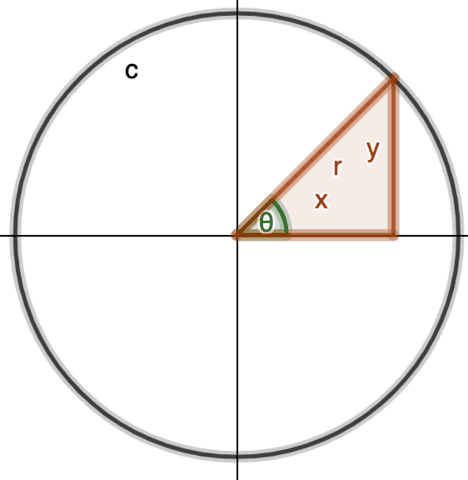
Diagram for Pythagorean Identities
It is convenient to memorize the x, y, r definitions of the trig functions, namely (and thinking of the above diagram):
$$\cos\theta = \tfrac{x}{r}, \quad \sin\theta = \tfrac{y}{r}, \quad \tan\theta = \tfrac{y}{x}$$
$$\sec\theta = \tfrac{r}{x}, \quad \csc\theta = \tfrac{r}{y}, \quad \cot\theta = \tfrac{x}{y}$$
We know that the Pythagorean theorem hold for this right triangle, hence ##x^2+y^2=r^2## and we will use this equation to generate the Pythagorean identities for the trig functions:
a) divide through by ##r^2##:
##\left(\tfrac{x}{r}\right) ^2+\left(\tfrac{y}{r}\right) ^2=1 \Rightarrow \cos ^2\theta +\sin ^2\theta = 1##
b) divide through by ##x^2##:
##1+\left(\tfrac{y}{x}\right) ^2=\left(\tfrac{r}{x}\right) ^2\Rightarrow 1 +\tan ^2\theta = \sec ^2\theta##
c) divide through by ##y^2##:
##\left(\tfrac{x}{y}\right) ^2+1=\left(\tfrac{r}{y}\right) ^2\Rightarrow \cot ^2\theta +1 = \csc ^2\theta##
It’s alway best to derive this Table of Trig Values from the kernel of memory, only storing in your brain:
- ##\sin\theta## starts at 0 and the pattern of fractions starting at ##\tfrac{\sqrt{0}}{2}## and ending at ##\tfrac{\sqrt{4}}{2}##
- ##\cos\theta## starts at 1 and the same pattern of fraction as 1) only backwards
- ##\tan\theta = \tfrac{\sin\theta}{\cos\theta} ## and you divide the roots from 1) by the roots from 2) (the ##\tfrac{1}{2}## cancels remember)

Senior math major by units. Tutor. Special interest in Special Functions, Infinite products, Classical Analysis.







I had the correct LaTeX in the insight article for that table, I was assuming the comments page which has the preview of the first part of the article which was just code being displayed (the part you fixed) was doing so bc it had only “viewed” part of the LaTeX command, I figure it displayed code bc it was incomplete, but IDK will try your fix if I can.
Edit: I just copy pasted the full code for that array from my completed article, it had cut off the code and replace it with an ellipsis (…).
In our junior classes, we learnt it in a similar way:
[CENTER][/CENTER]
[TABLE]
[TR]
[TD][CENTER]##\theta~\rightarrow##[/CENTER][/TD]
[TD][CENTER]0° = 0[/CENTER][/TD]
[TD][CENTER]30° = ##\dfrac{\pi}{6}##[/CENTER][/TD]
[TD][CENTER]45° = ##\dfrac{\pi}{4}##[/CENTER][/TD]
[TD][CENTER]60° = ##\dfrac{\pi}{3}##[/CENTER][/TD]
[TD][CENTER]90° = ##\dfrac{\pi}{2}##[/CENTER][/TD]
[/TR]
[TR]
[TD][CENTER]##\sin \theta##[/CENTER][/TD]
[TD][CENTER]##\sqrt{\dfrac{0}{4}}##[/CENTER][/TD]
[TD][CENTER]##\sqrt{\dfrac{1}{4}}##[/CENTER][/TD]
[TD][CENTER]##\sqrt{\dfrac{2}{4}}##[/CENTER][/TD]
[TD][CENTER]##\sqrt{\dfrac{3}{4}}##[/CENTER][/TD]
[TD][CENTER]##\sqrt{\dfrac{4}{4}}##[/CENTER][/TD]
[/TR]
[TR]
[TD][CENTER]##\cos \theta##[/CENTER][/TD]
[TD][CENTER]##\sqrt{\dfrac{4}{4}}##[/CENTER][/TD]
[TD][CENTER]##\sqrt{\dfrac{3}{4}}##[/CENTER][/TD]
[TD][CENTER]##\sqrt{\dfrac{2}{4}}##[/CENTER][/TD]
[TD][CENTER]##\sqrt{\dfrac{1}{4}}##[/CENTER][/TD]
[TD][CENTER]##\sqrt{\dfrac{0}{4}}##[/CENTER][/TD]
[/TR]
[TR]
[TD][CENTER]##\tan \theta##[/CENTER][/TD]
[TD][CENTER]##\sqrt{\dfrac{0}{4 – 0}}##[/CENTER][/TD]
[TD][CENTER]##\sqrt{\dfrac{1}{4 – 1}}##[/CENTER][/TD]
[TD][CENTER]##\sqrt{\dfrac{2}{4 – 2}}##[/CENTER][/TD]
[TD][CENTER]##\sqrt{\dfrac{3}{4 – 3}}##[/CENTER][/TD]
[TD][CENTER]##\sqrt{\dfrac{4}{4 – 4}}##[/CENTER][/TD]
[/TR]
[/TABLE]
I think I’ll make this compulsory reading for my Maths students!