Physics Forums Insights
  • Physics
    • Physics Articles
    • Physics Tutorials
    • Physics Guides
    • Physics FAQs
  • Math
    • Math Articles
    • Math Tutorials
    • Math Guides
    • Math FAQs
  • Bio/Chem/Tech
    • Bio/Chem Articles
    • Computer Science Tutorials
    • Technology Guides
  • Education
    • Education Articles
    • Education Guides
  • Interviews
  • Quizzes
  • Forums
  • Click to open the search input field Click to open the search input field Search
  • Menu Menu
impossible triangles

Ambiguous SSA Case in Triangles — Law of Sines Explained

January 28, 2021/0 Comments/in Mathematics Tutorials/by Jameson
📖Read Time: 3 minutes
📊Readability: Advanced 📐 (Technical knowledge needed)
🔖Core Topics: anglesidegivenssatriangle

Table of Contents

  • What is the ambiguous case?
    • Side–Side–Angle (SSA) Triangles
  • How to analyze an SSA (ambiguous) case
    • Procedure
    • SSA triangle example
      • Given values
      • Drawings
      • Applying the Law of Sines
      • Why no triangle exists
  • Key points
    • More Related Articles

What is the ambiguous case?

In U.S. high schools, students are often introduced to geometric proofs for the first time. A common task is to use a small set of rules to show two triangles are congruent — that is, they have the same side lengths and the same angles. Acronyms such as SAS (side-angle-side) and AAS (angle-angle-side) may sound familiar.

This topic is polarizing: it quickly separates “I love geometry!” students from those who think “I miss algebra!” All of these acronyms simply describe the information given about a triangle. The order of that information matters. For instance, SAS and SSA both involve one angle and two sides, but SSA is not generally sufficient to prove triangles congruent.

Side–Side–Angle (SSA) Triangles

One problematic case is side–side–angle (SSA), sometimes jokingly called “angle–side–side.” When you are given SSA information, this is known as the ambiguous case because it can produce 0, 1, or 2 distinct triangles. Many teachers correctly note SSA does not guarantee congruence; here we explore the reason SSA can produce no triangle at all.

How to analyze an SSA (ambiguous) case

Procedure

  1. Draw the triangle and label all given information. It does not need to be to scale. Make sure each side is opposite its corresponding angle: side a opposite angle A, side b opposite angle B, and side c opposite angle C.
  2. Use the Law of Sines to try to find the unknown angle opposite the unpaired side. In an SSA setup you have two sides and one non-included angle; apply the Law of Sines to the known angle/side pair to attempt to solve for the angle opposite the second given side.

SSA triangle example

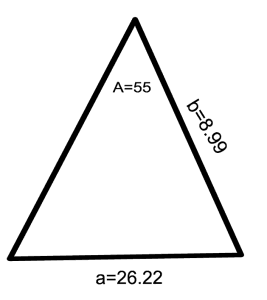
Let’s work through an example. (Note on labeling: the calculation below treats the given acute angle as the one paired with side a. To align the algebra with the displayed calculation we will read the given 55° as the angle paired with side a.)

Given values

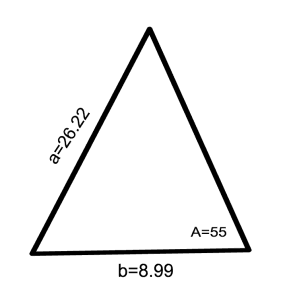
Given: $$B = 55 ^{circ}, b=8.99,a=26.22$$

Drawings

Draw the triangle and label the known values.
triangle 1

Angle A is shown in the lower-right in this drawing. You could place angle A at the top instead — the orientation does not affect the analysis.
triangle 2

Applying the Law of Sines

The Law of Sines states: $$displaystyle frac{sin(A)}{a}=frac{sin(B)}{b}=frac{sin(C)}{c}$$

As described above, use the Law of Sines to solve for the unknown angle opposite the second given side. The worked computation follows:

$$begin{align*} frac{sin(55^{circ})}{26.22}&=frac{sin(B)}{8.99} \ sin(B) &= frac{26.22sin(55^{circ})}{8.99} \ sin(B) &approx 2.389 end{align*}$$

Why no triangle exists

We have a problem. The sine function has range [-1, 1], so an output of approximately 2.389 is impossible. There is no angle B that satisfies this equation, so no triangle exists for these given values.

Try entering sin^{-1}(2.389) into a calculator and you will get an error — another way to see there is no solution.

Key points

  • Always draw and label the triangle first. It does not need to be to scale.
  • Apply the Law of Sines to the known angle–side pair and attempt to solve for the angle opposite the other given side.
  • If you compute sin(A), sin(B), or sin(C) and the result lies outside the interval [-1, 1], then no triangle exists for the given SSA data.
  • If the result falls inside [-1, 1], you must then determine whether there is one or two possible triangle solutions (the classic ambiguous outcome).

More Related Articles

  • All About the Einstein Field Equations
    Tags: geometry
    Share this entry
    • Share on Facebook
    • Share on X
    • Share on WhatsApp
    • Share on LinkedIn
    • Share on Reddit
    • Share by Mail
    https://www.physicsforums.com/insights/wp-content/uploads/2022/08/impossible-triangles.png 135 240 Jameson https://www.physicsforums.com/insights/wp-content/uploads/2019/02/Physics_Forums_Insights_logo.png Jameson2021-01-28 10:50:352026-02-17 07:39:42Ambiguous SSA Case in Triangles — Law of Sines Explained
    You might also like
    prequantumgeometry Higher Prequantum Geometry I: The Need for Prequantum Geometry
    Theorema Primum tutorial An Introduction to Theorema Primum
    tan rule Physical Applications of the “Tan Rule”
    trig special functions A Trick to Memorizing Trig Special Angle Values Table
    qtf_geometry Learn the Geometry of Mathematical Quantum Field Theory
    geometrysimple When Simple Geometry Unveils Deep Math
    0 replies

    Leave a Reply

    Want to join the discussion?
    Feel free to contribute!

    Leave a Reply Cancel reply

    You must be logged in to post a comment.

    Trending Articles

    • Revisiting the Velocity-Time Function
    • Time Dilation & Redshift of Schwarzschild Black Holes
    • What Planck Length Is and It’s Common Misconceptions
    • Richard Feynman Quiz: Think You Know Richard Feynman?
    • Why 1 Equals 0.999… — Explanations & Rigorous Proofs
    • Learn Why Ohm’s Law Is Not a Law
    • Frequently Made Errors in Mechanics: Kinematics
    • Why the Need of Infinity in Physics
    • How Does an Airplane Wing Work? A Primer on Lift
    • Learn the Physics of Virtual Particles in Quantum Mechanics

    Physics Forums

    • Classical Physics
    • Atomic and Condensed Matter
    • Quantum Physics
    • Special and General Relativity
    • Beyond the Standard Model
    • High Energy, Nuclear, Particle Physics
    • Astronomy and Astrophysics
    • Cosmology
    • Other Physics Topics

    Receive Insights Articles to Your Inbox

    Enter your email address:

    Blog Information

    • Become a Member!
    • Write for Us!
    • Table of Contents
    • Blog Author List

    Popular Topics

    astronomy (17) black holes (17) classical physics (35) cosmology (16) education (23) electromagnetism (19) general relativity (19) gravity (24) interview (21) mathematics (39) mathematics self-study (21) Physicist (26) programming (18) Quantum Field Theory (31) quantum mechanics (36) quantum physics (24) relativity (40) Special Relativity (16) technology (19) universe (21)
    2026 © Physics Forums, ALL RIGHTS RESERVED - Contact Us - Privacy Policy - About PF Insights
    • Link to X
    • Link to Facebook
    • Link to LinkedIn
    • Link to Youtube
    Link to: Equations of Motion Revisited Link to: Equations of Motion Revisited Equations of Motion Revisitedequations of motionLink to: How to Use Duality in Computational Electromagnetic Problems Link to: How to Use Duality in Computational Electromagnetic Problems electromagnetic computationsHow to Use Duality in Computational Electromagnetic Problems
    Scroll to top Scroll to top Scroll to top