
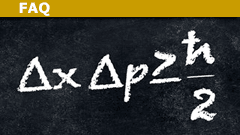
Does Heisenberg Uncertainty Violate Energy Conservation?
The short answer is: No — there is no violation.
Table of Contents
The longer answer
Given the probabilistic aspect of quantum theory, what do we mean now by “conservation of energy”?
Two ways energy conservation appears in quantum theory
In quantum theory, energy conservation is commonly expressed in two different but compatible ways.
First: a state with a precisely known energy will always keep that energy. The reason is that a state with a precisely known energy is an eigenstate of the Hamiltonian; such an eigenstate is stationary under unitary evolution, so it remains (up to a phase factor) itself.
Second: for a given state, consider its expectation value of the energy <ψ|H|ψ>. This expectation value is the statistical average over many trials of measuring energy, and it remains constant during time evolution. In other words, if the energy was not a well-defined quantity initially (only its expectation value was), you cannot speak of a violation of energy conservation — the average energy is conserved.
Where the time–energy uncertainty relation comes in
The time–energy uncertainty relation tells you that to perform an energy measurement with precision ΔE you need the measurement apparatus to interact with the system for a time of at least Δt.
This means that when you probe the system for times shorter than Δt, there is no operational difference between (a) a stationary state with precise energy E and (b) a superposition of stationary states whose eigenvalues lie within ΔE of E. Below the time Δt the unitary evolution (the Schrödinger equation integrated) does not significantly change the relative phases between these contributions: each energy eigenterm picks up a factor exp(-i E t / ħ), so the interference that would distinguish the two cases is not resolved in such a short time.
Because of that, you cannot tell whether the system was in a pure energy eigenstate or in a nearby superposition. The uncertainty is about the initial condition (was the system prepared in a pure energy eigenstate?) or about energy transfer during the measurement interaction. It is not a question of “stealing energy from nowhere.”
Two typical cases
- Creation in a short time: If the system was “created” during a time interval Δt, then during that creation interaction it need not be in a pure energy eigenstate. It can be created in a superposition with eigenvalues spread over ΔE. A subsequent precise energy measurement simply projects the superposition onto one eigenstate — no violation of energy conservation. This is common for particle resonances and other short-lived phenomena.
- Preparation plus rapid measurement: If the system is prepared in a precise energy eigenstate and then you measure very quickly (within Δt), the interaction between system and apparatus can transfer energy of order ΔE. Observing a different energy (within ΔE) is then a consequence of the perturbation introduced by the measurement apparatus, not a violation of energy conservation.
Finally, in the long run the expectation value is recovered as the average of many measurements, so there is never a net gain or loss of energy.
Contributions by: vanesch
This article was authored by several Physics Forums members with PhDs in physics or mathematics.








“Actually, full credit for this entry should be given solely to vanesch. I merely reposted what he wrote for the original FAQ.
Zz.”
Thanks, corrected
Actually, full credit for this entry should be given solely to vanesch. I merely reposted what he wrote for the original FAQ.
Zz.