

Big Bang Evidence: CMB, Redshift & Element Abundances
Table of Contents
Big Bang: Key Points
- Hubble’s law (redshift of galaxies) and the Doppler effect provide direct evidence that the universe is expanding away from our reference point.
- Expansion has cooled the universe from the initial high temperatures at the Big Bang; radio astronomy detects signals from stars, galaxies, radio galaxies, quasars, and pulsars that trace this history.
- The Cosmic Microwave Background (CMB) was discovered by Penzias and Wilson in 1965; its average temperature today is about 2.7 K, an echo of the hot early universe.
- NASA’s WMAP mission (and later Planck) measured CMB anisotropies and helped determine the universe’s age: roughly 13.8 billion years, and provided observations back to the time of recombination (~375,000 years after the Big Bang).
- The observed abundance of light elements (helium, deuterium, lithium) matches predictions from Big Bang nucleosynthesis and is a powerful test of the model.
- Primary constituents in the early universe include photons, protons, neutrons, electrons (and positrons), neutrinos (and antineutrinos).
- The universe was opaque until recombination; when electrons and protons combined into neutral atoms, photons were released and we now observe those photons as the CMB.
Video: Evidence for the Big Bang (YouTube)
Hubble’s Law and Cosmic Expansion
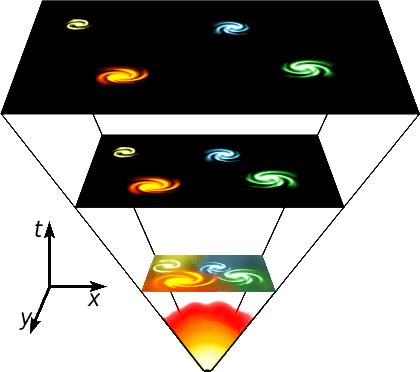
Evidence for the Big Bang comes from observational astronomy. Hubble’s law — the measured redshift of galaxies — shows that most galaxies are receding from us, which implies the universe is expanding. Edwin Hubble published these observations in 1929. The redshift pattern provides direct evidence that, on large scales, space itself is expanding.
Expansion, Cooling, and Radio Observations
As space expands, the temperature of the radiation field decreases. Radio and optical astronomy detect distant sources — stars, galaxies, radio galaxies, quasars, and pulsars — that help map the expansion history. The presence of the Cosmic Microwave Background (CMB) is one of the strongest pieces of evidence for the Big Bang: Penzias and Wilson discovered this nearly uniform microwave background in 1965.
COBE, WMAP, and Planck
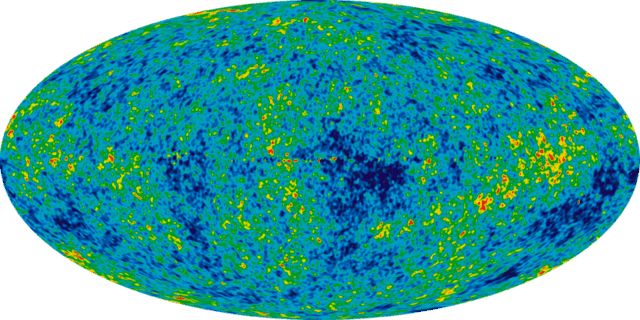
Satellite missions refined our view of the CMB. The COBE satellite (1992) detected minute temperature fluctuations (anisotropies) in the CMB; these fluctuations seeded the later formation of galaxies and large-scale structure. Later missions such as WMAP and Planck measured the CMB spectrum and anisotropies with higher precision. The measured average temperature of the CMB today is about 2.7 K (≈ -270.45 °C), while the radiation originated when the universe had a temperature near 3000 K.
Element Abundances and Matter Constituents
Big Bang nucleosynthesis predicts the primordial abundances of light elements such as hydrogen, helium, deuterium and lithium. Observations of these abundances match the predictions closely; this agreement is one of the most direct tests of the Big Bang model. If the observed helium abundance were significantly different, the model would require revision.
In the early universe the primary constituents included photons (light), baryons (protons and neutrons), electrons (and positrons), and neutrinos (and antineutrinos). Many of these particles and their interactions are studied in particle accelerators and astrophysical observations, providing cross-checks on early-universe physics.
Recombination and the Origin of the CMB
In the first few hundred thousand years after the Big Bang the universe was a hot, dense, ionized plasma and therefore opaque to photons. When the universe cooled enough for protons and electrons to combine into neutral atoms (a process called recombination), photons decoupled from matter and began to travel freely. Those photons have been stretched by cosmic expansion and are observed today as the CMB.
From Observations to a Testable Model
Within a few decades we moved from very limited observational constraints to a precise, testable cosmological model. Observations of redshift, the CMB, light-element abundances, and large-scale structure together form a consistent picture that supports the Big Bang theory.
FAQ
What is the Big Bang?
The Big Bang is the scientific theory that describes the origin and evolution of the observable universe. It states that the universe began in a hot, dense state roughly 13.8 billion years ago and has expanded and cooled ever since.
What evidence supports the Big Bang theory?
Key observations supporting the Big Bang include:
- The cosmic microwave background radiation (CMB).
- The abundance of light elements predicted by Big Bang nucleosynthesis.
- Hubble’s law (the redshift–distance relation showing an expanding universe).
- The large-scale distribution and growth of structure (galaxies, galaxy clusters).
What is the Cosmic Microwave Background Radiation?
The CMB is relic electromagnetic radiation from the early universe. It appears as an almost uniform microwave glow across the sky and provides evidence that the universe was once in a hot, dense state. Small anisotropies in the CMB map reveal the seeds of later structure formation.
How did the Big Bang change the universe?
The Big Bang initiated the expansion and cooling of the universe, producing the matter and radiation we observe today. As the universe expanded, matter and energy spread and later condensed into galaxies, stars, and planets.
Is the Big Bang still happening?
The initial high-energy event we call the Big Bang was a unique event in the past (about 13.8 billion years ago). However, the universe is still expanding now, and the consequences of the Big Bang (for example, the CMB and the large-scale structure) are still observable.
References
- Clarke, D., Roy, A. E. Astronomy: Principles and Practice (4th ed., 2003), Institute of Physics Publishing.
- Kaviraj, S. (2013). “The significant contribution of minor mergers to the cosmic star formation budget” (arXiv:1310.0007).
- Lintott, C.; May, B.; Moore, P. Bang! (2012), Carlton Books Ltd. www.BangUniverse.com
- Penzias, A. A.; Wilson, R. W. (1965). “A Measurement of Excess Antenna Temperature at 4080 Mc/s”, Astrophysical Journal, 142:419–421.
- NASA Hubble discoveries: http://hubblesite.org/hubble_discoveries/breakthroughs/cosmology
- WMAP: http://map.gsfc.nasa.gov/news/index.html
- Wikipedia: http://en.wikipedia.org/wiki/Big_Bang
Read the next article: How to tell if the universe is rotating.
A Nuclear Fusion Physicist and Astrophysicist.
BSc Physics & Engineering, MSc Nuclear Physics & Engineering, MSc Astrophysics, PhD Plasma Physics


Do you realise there is a GRAVE and fundamemental mistake in ASSUMING the Hubble Constant RECIPROCAL at around 13.8 billion years is the age of the universe? It is in fact is the maximum time / distance from an observer to the “Hubble horizon” determined in range by the redshift, that at 13.8 billion is the furthest that can be observed!!!! The redshift limited Hubble time / distance “horizon barrier” thus is the maximum redshifted observable horizon. It is NOT the age of the “unobservable universe” that lays beyond the Hubble horizon of 13.8 billion. From this NO ONE can know the age of the universe, which could be infinitely large, old, whatever???!!!
Hubble Constant can be very easily calculated from the following equation:- 2 x oneMpc x C/Pi^21 =70.97 km/s/Mpc. The distance to the Hubble horizon is therfore 13.78 billion light years.