
Physics Forums Insights
  • Physics
    • Physics Articles
    • Physics Tutorials
    • Physics Guides
    • Physics FAQs
  • Math
    • Math Articles
    • Math Tutorials
    • Math Guides
    • Math FAQs
  • Bio/Chem/Tech
    • Bio/Chem Articles
    • Computer Science Tutorials
    • Technology Guides
  • Education
    • Education Articles
    • Education Guides
  • Interviews
  • Quizzes
  • Forums
  • Click to open the search input field Click to open the search input field Search
  • Menu Menu
Cosmic Web Connections

Cosmic Web Connectivity: How It Shapes Galaxy Evolution

March 30, 2020/1 Comment/in Physics Articles/by Mark R Smith
📖Read Time: 4 minutes
📊Readability: Advanced (Technical knowledge needed)
🔖Core Topics: stargalaxiesformationconnectivitygalaxy

Table of Contents

  • Introduction
    • Illustration and video
  • Key points about the cosmic web
  • At the crossroads
  • Forming stars—or not
    • Samples and simulations
    • Connectivity vs star formation
  • Transitioning to old age
    • Implications for galaxy evolution
  • References
    • More Related Articles

Introduction

The universe was not perfectly uniform at the beginning; some regions had higher density than others.

Over time these higher-density regions attracted most of the matter and began forming galaxies where matter concentration was greatest. The resulting large-scale structure—the “cosmic web”—connects observed galaxy clusters with a network of filaments. Figure 1 shows a model of this structure.

Illustration and video
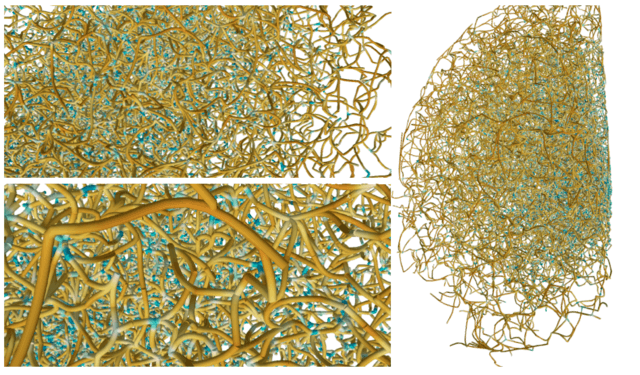
Skeleton of a cosmic web traced by an algorithm on observed galaxies
Figure 1: Skeleton of a cosmic web traced by an algorithm run on a sample of observed galaxies. The far right shows the complete web; the left images show close-up portions. Blue areas indicate higher density.

Watch a short explanatory video: Cosmic web overview on YouTube.

Key points about the cosmic web

  1. The early universe had small density fluctuations; regions with higher density became sites of galaxy formation.
  2. High-density regions are connected by filaments forming the cosmic web; a galaxy’s “connectivity” is the number of filaments attached to it, and higher connectivity correlates with greater galaxy mass.
  3. Connectivity is related to star formation: galaxies with higher connectivity generally show lower star formation rates.
  4. Active galactic nucleus (AGN) activity is more effective at quenching star formation in galaxies that have high connectivity.
  5. Connectivity influences a galaxy’s evolution, affecting star formation, total mass and morphology.

At the crossroads

The cosmic web is a way to represent the density field of the Universe and can be traced using the observed distribution of galaxies. Similar algorithms are applied to both observations and simulations to identify connected structures. The densest, most massive galaxies sit at the crossroads of multiple filaments (nodes), similar to the blue regions in Figure 1. Previous studies also show that a galaxy’s mass increases with the number of connected filaments. Recent research examined whether connectivity is also related to star formation and whether it can suppress star formation.

Forming stars—or not

Samples and simulations

To test this, scientists analyzed observed and simulated galaxies that occupy the densest nodes of the cosmic web. Observed galaxies were taken from the Sloan Digital Sky Survey (SDSS) data release, numbering ≈ 7×10^5 (~700,000). Two independent cosmological simulations were also used for comparison; simulation samples are much smaller because of the computational cost of simulating large galaxy populations.

Connectivity vs star formation

These galaxies have a median connectivity of three filaments. For the observed sample, researchers compared connectivity to star formation rate (inferred from stellar age distributions). Figure 2 shows that as connectivity increases, the excess star formation rate decreases for all galaxy types. The same trend appears in the simulations, where star formation is a direct output parameter.
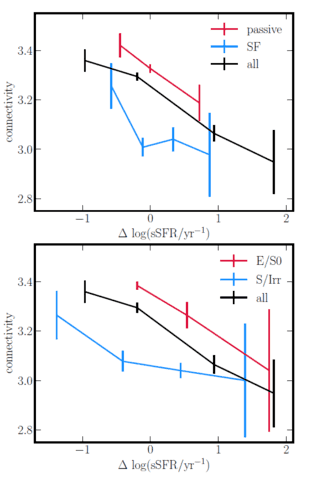
Average connectivity versus excess star formation rate for observed galaxies
Figure 2: Comparison for observed galaxies of average connectivity and excess star formation rate relative to the average for that galaxy type. The black lines show all galaxies. Top panel: blue = star-forming galaxies; red = passive galaxies (not actively forming a significant number of stars). Bottom panel: blue = spherical/irregular galaxies; red = elliptical galaxies. The horizontal axis indicates increasing star formation to the right. The plots show that as connectivity increases, star formation decreases.

This result is counterintuitive because filaments can funnel cold gas into galaxies, which might be expected to stimulate star formation. Scientists propose several explanations: gas arriving along multiple filaments may be more chaotic than gas funneled along a single coherent filament; filaments may be inefficient at delivering gas to the inner, star-forming regions of galaxies; or galaxies with higher connectivity may experience fewer gas-rich mergers. Regardless of the mechanism, observations and simulations both show that greater connectivity correlates with reduced star formation.

Transitioning to old age

Researchers also examined the relationship between connectivity and AGN activity. AGN feedback is an important quenching mechanism: energetic output from an AGN can expel star-forming gas and halt star formation, helping a galaxy transition from an active, star-forming state to a passive, older state. By comparing two similar simulations—one that includes AGN feedback and one that does not—scientists found that AGN are more effective at quenching star formation in galaxies with high connectivity. In those galaxies, AGN can receive more fuel and therefore produce more energetic feedback.

Implications for galaxy evolution

Overall, connectivity emerges as an important factor in galaxy formation: it affects when stars stop forming and influences a galaxy’s mass and morphology in both observations and simulations. Because galaxy evolution unfolds over millions to billions of years, studies like this provide crucial snapshots that improve our understanding of cosmic history.

References

Arnouts, S.; Codis, S.; Davé, R.; Devriendt, J.; Dubois, Y.; Hwang, H. S.; Kraljic, K. (Institute for Astronomy, University of Edinburgh); Laigle, C.; Musso, M.; Peirani, S.; Pichon, C.; Pogosyan, D.; Slyz, A.; Treyer, M.

Comment Thread

Mark R Smith

A Nuclear Fusion Physicist and Astrophysicist.

BSc Physics & Engineering, MSc Nuclear Physics & Engineering, MSc Astrophysics, PhD Plasma Physics


More Related Articles

  • The Many Faces of Topology
    Tags: astronomy, cosmology, universe
    Share this entry
    • Share on Facebook
    • Share on X
    • Share on WhatsApp
    • Share on LinkedIn
    • Share on Reddit
    • Share by Mail
    https://www.physicsforums.com/insights/wp-content/uploads/2020/03/cosmic_web.png 135 240 Mark R Smith https://www.physicsforums.com/insights/wp-content/uploads/2019/02/Physics_Forums_Insights_logo.png Mark R Smith2020-03-30 11:32:502026-02-17 07:27:21Cosmic Web Connectivity: How It Shapes Galaxy Evolution
    You might also like
    dark energy cosmology lcdm Dark Energy Part 2: LCDM Cosmology
    What is Mass Inflation Mass Inflation Inside Black Holes — Explanation & Equations
    inflation5 A Poor Man’s CMB Primer: Quantum Seeds
    infinite universe Open, Flat & Closed Universes: Curvature Explained
    blackholesuniverse Why the Early Big Bang Universe Didn’t Form a Black Hole
    expandinguniverse Explore Coordinate Dependent Statements in an Expanding Universe
    1 reply
    1. Prof Mark R Smith says:
      April 1, 2020 at 8:06 am

      Nothing surprising, this is an overview of the cosmic process which applies to various galaxies and the composition of matter within and surrounding!

      Log in to Reply

    Leave a Reply

    Want to join the discussion?
    Feel free to contribute!

    Leave a Reply Cancel reply

    You must be logged in to post a comment.

    Trending Articles

    • Revisiting the Velocity-Time Function
    • Time Dilation & Redshift of Schwarzschild Black Holes
    • What Planck Length Is and It’s Common Misconceptions
    • Richard Feynman Quiz: Think You Know Richard Feynman?
    • Why 1 Equals 0.999… — Explanations & Rigorous Proofs
    • Learn Why Ohm’s Law Is Not a Law
    • Frequently Made Errors in Mechanics: Kinematics
    • Why the Need of Infinity in Physics
    • How Does an Airplane Wing Work? A Primer on Lift
    • Learn the Physics of Virtual Particles in Quantum Mechanics

    Physics Forums

    • Classical Physics
    • Atomic and Condensed Matter
    • Quantum Physics
    • Special and General Relativity
    • Beyond the Standard Model
    • High Energy, Nuclear, Particle Physics
    • Astronomy and Astrophysics
    • Cosmology
    • Other Physics Topics

    Receive Insights Articles to Your Inbox

    Enter your email address:

    Blog Information

    • Become a Member!
    • Write for Us!
    • Table of Contents
    • Blog Author List

    Popular Topics

    astronomy (17) black holes (17) classical physics (35) cosmology (16) education (23) electromagnetism (19) general relativity (19) gravity (24) interview (21) mathematics (39) mathematics self-study (21) Physicist (26) programming (18) Quantum Field Theory (31) quantum mechanics (36) quantum physics (24) relativity (40) Special Relativity (16) technology (19) universe (21)
    2026 © Physics Forums, ALL RIGHTS RESERVED - Contact Us - Privacy Policy - About PF Insights
    • Link to X
    • Link to Facebook
    • Link to LinkedIn
    • Link to Youtube
    Link to: Gaia Astrometry: Detecting Gravitational Waves Guide Link to: Gaia Astrometry: Detecting Gravitational Waves Guide Gaia Astrometry: Detecting Gravitational Waves GuideGaia search for black holesLink to: Big Bang Evidence: CMB, Redshift & Element Abundances Link to: Big Bang Evidence: CMB, Redshift & Element Abundances Evidence for Big BangBig Bang Evidence: CMB, Redshift & Element Abundances
    Scroll to top Scroll to top Scroll to top