
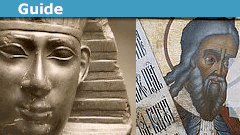
Learn About History’s First Science Experiments
In this Insight, I’m going to talk about two of the first science experiments in recorded history. One was allegedly performed by the Prophet Elijah in Israel in the 800s BC [1], and the other by the Pharaoh Psammetichus in Egypt in the 600s BC [2]. In each case, we only have one primary source from long after the fact, so it is not necessarily the experiments themselves that are the world’s first, but rather the attestation of these experiments that occurred for the first time in history.
Table of Contents
Elijah Empirically Determines the One True God
Elijah was a prophet in the Northern kingdom of Israel, one of the two biblical kingdoms of the early Iron Age, that was conquered by the Assyrians in 720 BC. Much of the biblical narrative was written to support the legitimacy of the Southern kingdom of Judah [3], so the kings of Israel as described in the Books of Kings are generally described as evil blasphemers who permit and promote the worship of various Semitic gods. The Book of Kings describes Elijah’s encounter with Ahab, king of Israel.
Ahab ruled in the mid-800s BC. We know that King Ahab existed because his defeat in battle is described by the Assyrian king Shalmaneser III, and we know that it was in 852 BC by connecting the list of which Assyrian kings ruled and for how long until a solar eclipse is mentioned as having occurred during the reign of Asher-Dan III, which we can trace to 763 BC through our knowledge of astronomy.
Ahab was married to Jezebel, daughter of the Phoenician King of Tyre (in Lebanon). In the biblical account, Ahab and Jezebel had established the worship of the god Baal. Elijah, believing his god to be the true one, proposed a controlled study to find out which of the two was the correct god to worship. The priests of Baal would prepare a bull for sacrifice and leave it on their altar, and Elijah would leave a bull on his altar, and they would see which one spontaneously caught on fire. The experimental protocol and its results are discussed in 1 Kings, chapter 18, but to summarize, the sacrifice to Baal was left unburnt, while Elijah covered the wood below his bull with water and it still caught on fire. This allowed the Israelites to know which god they should be worship, and subsequently, all the priests of Baal were taken down to the river and murdered.
This study has several methodological flaws. The same protocol was not followed for each sacrifice, and priests only gathered a single data point and neglected the possibility that a god was choosing an altar to burn at random. Any attempts at replication were hindered by the murder of the Baal camp, and that is generally frowned upon in scientific circles. While this allegedly occurred in the 800s BC, it probably didn’t happen, and certainly not as written. But when was it actually written about? The Books of Kings are thought to have been first written down in the 600s BC and edited by the 500s and was introduced to the rest of the world when translated to Greek after the 300s BC.
Psammetichus Looks for the Origins of Language
Psammetichus is the Greek name of the pharaoh Psamtik, who ruled Egypt in the 600s BC. He was the first ruler of the 26th dynasty, when Egypt was on the decline as a world power, well, well beyond its heyday. It was one of the last “native” dynasties in Egypt after the rule of the county was re-conquered from the Nubians (from modern Sudan) and before it was overrun by the Persians. Besides being one of the first scientific grant funders, his reign was not spectacular.
The Greek historian Herodotus, writing around 440 BC, relayed a story that was told to him by priests of Vulcan in Memphis. Psammetichus experimented to determine which group of people was the oldest and hypothesized that it was either the Egyptians or the Phrygians (Phrygia was a country in modern Turkey after the Hittites fell but before the Greeks rose; their most famous king was Midas). He hypothesized that the most ancient people would speak a language that is the natural human language. To figure out what that was, he had two common children raised by a shepherd with the instruction never to speak to them so that they would learn a language without any external influence. According to Herodotus, at the age of two the children started saying the word “Becos,” and Psammetichus’ experts informed him that that was the Phrygian word for bread. Therefore, Phrygian must be the natural human language, and therefore the Phrygians are the oldest people, older even than the Egyptians (going by written works, the Egyptians are roughly tied with the Sumerians).
From a methodological standpoint, this result is somewhat biased in that they expected the first words to come out to either be Egyptian or Phrygian and then matched the first sounds to Phrygian. Perhaps Psammetichus should have hired several translators to listen to the kids without telling him his linguistic expectations, which would have added a layer of blinding to the result.
Unfortunately, Herodotus is the only source for this story. Pharaonic Egypt was highly literate and the pharaohs wrote in great detail about their exploits and achievements, so it is somewhat telling that no Egyptian version of this story has surfaced. Psammetichus may have been the first to attempt this experiment, but he wasn’t the last. It is sometimes referred to as “the forbidden experiment” because of the various ethical issues it raises. It was later attempted by Holy Roman Emperor Frederick II and King James IV of Scotland. To my knowledge, the experiment has not been attempted since the development of scientific ethics, but there is perhaps an analogy with children who are born deaf but whose parents do not realize it until they are several years old.
Herodotus has another interesting semi-scientific story about the Egyptians that also may never have happened, which is that Pharaoh Necho II commissioned some Phoenician navigators to sail down the Eastern coast of Africa and back around the other side, returning through the straits of Gibraltar, proving that the continent that Egypt was on is surrounded by water on all sides. The most interesting thing about the story is that Herodotus is skeptical because the Phoenicians claimed to see the sun in the Northern sky rather than in the South, which was ridiculous to Herodotus but we recognize it as signifying that they had crossed the equator.
Odds and Ends
There are a few other quasi-scientific tidbits from the ancient world. King Mithridates of Pontus (North of the Black Sea) was allegedly so afraid of being poisoned that he took small doses of every known poison to build immunity. When circumstances lead him to try to kill himself, he finds it impossible because he is immune to the poison he tried to take, thus rejecting the null hypothesis with N=1 that taking small doses of poison does not build immunity. Similarly, the First Emperor of China, who goes by Qin Shi Huang which just means First Emperor of China, allegedly failed to reject the null hypothesis that mercury leads to immortality when he died of mercury poisoning attempting to ward off death.
The two experiments I talked about probably didn’t happen, but it’s still important to note that these are some of the first times that the ancients even wrote about people attempting some form of scientific inquiry.
Further Reading
[1] The History of Herodotus, Book II
[2] The First Book of Kings, Chapter 18
[3] The Bible Unearthed: Archaeology’s New Vision of Ancient Israel and the Origin of Sacred Texts
Ph.D. McGill University, 2015
My research is at the interface of biological physics and soft condensed matter. I am interested in using tools provided from biology to answer questions about the physics of soft materials. In the past I have investigated how DNA partitions itself into small spaces and how knots in DNA molecules move and untie. Moving forward, I will be investigating the physics of non-covalent chemical bonds using “DNA chainmail” and exploring non-equilibrium thermodynamics and fluid mechanics using protein gels.







Leave a Reply
Want to join the discussion?Feel free to contribute!