

Clifford V. Johnson: The Dialogues & Science Outreach
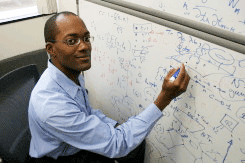
Clifford V. Johnson is a professor in the Physics and Astronomy Department at USC. He says, “I mainly work on (super)string theory, gravity, gauge theory and M-theory right now, which lead me to think about things like space-time, quantum mechanics, black holes, the big bang, extra dimensions, quarks, gluons, and so forth.” Clifford V. Johnson runs a well-respected blog, Asymptotia, and recently wrote and illustrated an exploratory book on physics called The Dialogues, presented in the format of a graphic novel. Learn more below…
Table of Contents
 Background: how you got interested in physics
It all started the way I think everyone starts out. I just asked lots of questions about the world and found ways to get them answered — by experimenting, taking things apart and putting them back together, or reading about things. I got hooked on that, and people mostly left me alone to get on with it (maybe it helped being a youngest child).
I later learned that there was a career where you could keep asking questions and figuring out how stuff worked, which became my goal as early as age 8 or 9: to do that as a career. I was surprised when a family friend asked what kind of scientist I wanted to be. I didn’t know you had to choose. I remember sitting with a dictionary and looking up every “-ist” and “-ologist” until I hit “physicist.” The definition said something about it being the field that underlies all the other scientific fields. That was it for me — I loved (and still love) all of science, and that definition felt like permission to keep my options open.
Theoretical physics: what drew you in?
Again, it was about keeping options open. I could study any kind of physics my mind wanted to explore. I loved (and still love) experimental physics, but as I learned more about careers it seemed you had to choose either experiment or theory. Theory allowed me to go as deep or as wide as I wanted.
Science communication: issues and approach
I don’t like that science is considered separate from the rest of our culture. It is often presented as something done by “other” people — weird, socially awkward super-geniuses. That presentation puts people off. Also, many scientists secretly enjoy the myth of being super geniuses and do nothing to dispel it.
My main effort is to make science more for everybody: present it as something all kinds of people can contribute to. Science belongs to everyone. I hope the book shows that, and you can also see it in the behind-the-scenes work I do as a science advisor in the entertainment industry. I try to encourage filmmakers to portray a wider variety of people doing science and to humanize scientists more generally.
 Blog vs. social media: roles in science communication
I don’t really think of blogs as social media. Blogs can be actual content — long-form discussion, extended explanations, and reflections — whereas what we call social media today is usually a way to point to content. Social media is excellent for sharing the location of content; blogs are where you can expand an idea.
That said, all these platforms can work together to create a rich landscape of information: direct access to people producing scientific results, complemented by social channels that amplify and guide readers to that content.
Balancing technicality and public accessibility
I (politely) reject the notion that physics is more technical or specialized than many other subjects the public can learn about if they’re interested, whether music, architecture, law, medicine, politics, or art. The mistaken belief that you need a special brain for physics is a major barrier.
The key is to be empathic and help people find a door into the subject that suits them. Not everyone can use the same door, nor should they. No book should have to start from scratch every time; otherwise you waste time rewriting the same introductory material. Editors often insist on that, so many physics books repeat the same opening chapters.
Readers should be prepared to immerse themselves, sit with the book, and be active in their reading. That’s why one of the most important aspects of The Dialogues is a set of notes for further reading at the end of each conversation. If I tried to unpack everything in every conversation, each character would be doing a mini-lecture every time they spoke — that’s not a real conversation.
 Why a graphic format for The Dialogues?
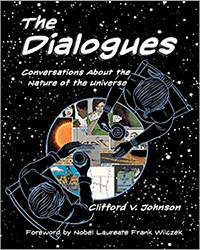
I first had the idea in 1999 about what was missing in standard prose books: the feeling of being part of a conversation rather than being lectured. I wanted readers to see the people, the places, and what they were writing — to show that science can happen in cafes, on streets, buses, and trains. That inclusiveness led me to go graphic, and I was surprised no one had really done it before.
I had dabbled in doodling and sketching, but to make a whole book I taught myself to draw at the level needed. I drew a lot. Drawing is not about innate talent; it’s mostly about learnable skills you can perfect by practice. It’s a skill you can develop.
Process: creating The Dialogues
I used many modes while creating the book. Sometimes I wrote dialogue on its own, paying little attention to art. Other times I wrote visually, creating tiny thumbnail pages and developing dialogue to fit the visuals. Most often it was a mix: words, layout, settings, and design evolved in parallel so they support each other.
Throughout, I was learning drawing techniques and the overall process of making a graphic book — writing, layout, and art informed each other continuously.
If we had a planetary-mass black hole in our solar system, what experiments first?
First, precision versions of the tests done for Einstein’s General Relativity: see how it bends light of distant objects, how objects orbit around it, and so forth, to look for deviations that might point beyond relativity. Then I’d scatter specially prepared beams of known particles near it and throw test masses in to study behavior. This close look at strong gravity could reveal deviations from General Relativity or indicate how strong gravity affects quantum mechanics.
Can string theory be experimentally tested this century?
I don’t know. Perhaps we’ll start seeing phenomena that find their most elegant explanation in a string-theory-like context, but that would be an early sign of a new framework rather than a definitive test. If I had to bet, it might occur in an astrophysical or cosmological scenario.
State of the field: string theory today
String theory remains a wonderful framework of ideas with immense and expanding value, touching particle and nuclear physics, astrophysics, condensed matter physics, and more.
Black hole heat engines: what, why, and what we learn
It is a remarkable and still mysterious fact that black holes, combined with quantum physics, seem to obey the laws of thermodynamics. That is an important clue. When one allows the cosmological constant to be dynamical (a result from Kastor, Ray, and Traschen, 2009), notions of pressure and volume enter black hole thermodynamics, and with them the idea of mechanical work.
Once pressure and volume are included, the idea of a heat engine made from a black hole — a system that does mechanical work while exchanging heat — becomes natural. Much of what we learned about thermodynamics historically was driven by thinking about engines. Limits on efficiency provide lessons across physics and information theory. Because black hole physics can be dual to classes of quantum field theory, formulating questions in terms of black hole heat engines may yield far-reaching insights.
Recent projects and publications that excite you
Oh, that’s easy: colliding black holes, neutron stars, and all the discoveries coming from LIGO/Virgo and the associated multi-messenger astronomy revolution. It will change a lot of things.
Thanks to Clifford V. Johnson for his time. Now go buy his book The Dialogues!
Read the next interview with physicist Arnold Neumaier.
I have a BS in Information Sciences from UW-Milwaukee. I’ve helped manage Physics Forums for over 22 years. I enjoy learning and discussing new scientific developments. STEM communication and policy are big interests as well. Currently a Sr. SEO Specialist at Shopify and writer at importsem.com






Clifford V. Johnson Named as Recipient of the 2018 Klopsteg Memorial Lecture Award
http://www.aapt.org/aboutaapt/Clifford-Johnson-2018-Klopsteg.cfm
If you're near LA you can meet him and get your book signed!
http://lastbookstorela.com/events/dialogues-clifford-johnson-aimee-bender-discussion/
The read is definitely accessible but I wouldn't say quick.Some parts quick. Others, not so much… :biggrin:
The read is definitely accessible but I wouldn't say quick. There is a lot to digest and packed with value!
he production is really really impressive.I agree. I bought the book and it came in the mail yesterday. It's a very unique book, and I'm having fun reading it so far.
One part I really like is at the end of each chapter, he's included comments and references about some of the things that have been covered in the dialogs in that chapter. That includes references at various levels, from popular literature to peer-reviewed journal articles. Good stuff. :smile:
View attachment 221381
View attachment 221382
Just got 3 more books yesterday! The production is really really impressive. I'll have more contests for them later next week. You're going to want it!
Two of his books are being used as prizes for this new contest!
https://www.physicsforums.com/threa…-book-giveaway-who-wants-it-n95-straw.940872/