
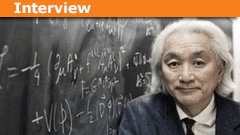
Michio Kaku Interview — Peak Oil, String Theory & Space
Don’t forget to read Part 1 of this interview.
Table of Contents
Peak Oil and Future Energy Sources
Professor Kaku, what do you think of “peak oil”? How serious is it, and what alternative sources of energy do you think will best provide the world’s needs in the coming decades after fossil fuels start to decline (whether it be organic oils, nuclear breeder-types, fusion, etc.)?
Dr Michio Kaku:
It seems as if oil production is peaking right now. This is called Hubbert’s peak, I recall. This means that 50% of the total oil in the Earth has already been taken out. That also means oil prices will gradually soar as oil becomes harder to extract. As a consequence, I feel that we should transition to non‑fossil energy sources fairly soon.The immediate winner, especially in Europe, is wind power. Solar electricity is still too expensive to be commercially competitive with oil and coal, but with mass production and increased efficiency I think it might become competitive within a decade. Fusion power, unfortunately, is still about 30–40 years away; no one knows for sure. Fission power has its own problems, e.g. waste, accidents, terrorism and sabotage. So we are in a transition period. Hybrid cars, for example, are part of this transition, but it will take another 10–15 years before renewable technologies seriously compete with oil and coal.
Nobel Prize: What Would It Take?
I recently attended a lecture by 1999 Nobel Prize winner in physics, Gerard ‘t Hooft. If I wanted to win the prize in 2005, what would I have to discover/invent/formulate?
Dr Michio Kaku:
To win a Nobel Prize, all you have to do is:
- Find out what dark energy is made of.
- Find out what dark matter is made of.
- Find the unified field theory.
You will not win a Nobel Prize by violating the laws of thermodynamics, as some claim.
Alternate Careers
On “Inside the Actors Studio,” what profession other than yours would you like to attempt?
Dr Michio Kaku:
When I was a child of around ten, I knew I wanted to become a physicist, although I did not know the precise word then. Later, I felt that if I could not make physics my profession I would moonlight doing physics on the side while doing commercially viable work outside, as Einstein did. Fortunately, I never had to test this theory, as I became a professor rather quickly.At Harvard I also thought about majoring in philosophy. I took some philosophy courses and realized it was not for me — I was shocked at how empty classical philosophy seemed. So I stuck with physics and never regretted it.
Universe Expansion and Gravity
Can you tell me if the Universe expansion would eventually cause an increase in gravitational cohesion?
Dr Michio Kaku:
No, the expansion of the universe will have no effect on gravity itself. The fundamental laws are known, and the expanding universe is one of their solutions. Actually, any theory of gravity necessarily allows for an expanding or collapsing universe — even Newton understood this. Gravity is strictly attractive, so a finite collection of stationary stars would collapse. Newton proposed that an infinite, uniform collection of stars could be stable, but that configuration is inherently unstable. The resolution is an expanding or collapsing universe, which avoids that paradox.
Current String-Theory Work
What aspects of string theory are you currently working on?
Dr Michio Kaku:
Right now I am working on M‑theory. The beauty of M‑theory is that it can unify five string theories into one framework in 11 dimensions. The problem is that the “action” for M‑theory is totally unknown — M‑theory is not really a complete theory yet; it is more of a framework or a wish. The fundamental equations for M‑theory are not known.For example, if you write down the equations for a membrane, you find they are often unstable and membranes can fall apart. Strings are stable, but membranes usually are not, which suggests M‑theory cannot be fundamentally a theory of membranes even though it contains them. My goal is to find a compact equation — something concise — that summarizes the properties of M‑theory.
Is There an “End” to Physics?
Scientists in the past have suggested an ‘end of physics’ (e.g., after the discovery of the electron). Do you believe there will ever be an “end to physics”?
Dr Michio Kaku:
Yes, in one sense — the rules (like the rules of chess) can be known. That does not make you a grand master. I believe we will learn the fundamental rules of nature, but becoming a grand master at manipulating nature is inexhaustible. Steve Weinberg said the deeper we go, the simpler it gets, but he could not imagine simplicity continuing forever. Theories that get simpler usually stop eventually.So I think there will be plenty of work for physicists, and eventually we may find the fundamental laws. Stephen Hawking later suggested he might have been wrong about a final theory; I don’t think so, but time will tell.
Human Spaceflight vs. Robotic Missions
Do you support sending humans to Mars and the Moon, or do you think the money would be better spent on other NASA missions?
Dr Michio Kaku:
Sending humans into space is secondary for now. I agree with the late Carl Sagan: one day we should be a two‑planet species (Earth and Mars). But there is plenty of time — now is not the right moment. It costs about $10,000 to put a pound into orbit. Space travel is dangerous and extremely expensive.Robots never complain and, more important, never have to come back. I support robotic missions, such as permanent robotic bases on the Moon and Mars. The 1960s space race was driven by geopolitics; if pure science had driven it, we might already have permanent robotic bases. I am for manned exploration, but not now — it’s simply too expensive, too dangerous, and yields almost no science relative to cost.
Time Travel Possibilities
Do you think time travel is possible? And, if so, when?
Dr Michio Kaku:
Yes, time travel might be possible. However, the energy required to significantly “bend” time is on the order of the Planck energy — vastly beyond current capabilities (a quadrillion times the energy of the LHC). A Type III civilization might have the power to build a time machine.In my book Parallel Worlds I argue that any civilization facing the Big Freeze may be forced to open a gateway either to another universe or to our past, when things were warmer. I also accept the many‑worlds interpretation, so going back in time creates no paradoxes: if you change the past you branch into a different history rather than creating a contradiction.
Keeping Up with Research
As a physicist, do you read professional journals to keep up with the latest in theoretical physics? What other sources do you use?
Dr Michio Kaku:
Most of us use the web rather than print journals to keep up. Journals are often months out of date by the time they appear. So most researchers post work on sites such as xxx.lanl.gov (now arXiv), which hosts current research on string theory, math, physics, etc.Gossip — informal discussions among colleagues — is also a fast way to learn about new work, given the hundreds of papers published each month. We also attend seminars to exchange ideas. Rarely do we rely on journals alone to keep up with research.
Will New Math Be Needed?
To prove a theory of everything, has it been rumored that a new form of mathematics will be created?
Dr Michio Kaku:
This might be true. Mathematicians have been surprised to find new mathematics emerging from string theory. Sophus Lie cataloged many Lie groups used to categorize subatomic particles but missed the supergroups that arise in supersymmetry and string theory.Much of calculus, differential geometry, and topology had to be extended when physicists introduced supersymmetry. I personally believe we can invent new mathematics as needed. Often “miracles” in string theory are later explained by higher symmetries the string incorporates. So while new math may appear, we probably have enough mathematics right now — the challenge is solving the equations. The equations for string theory are known in many forms, and I’ve written many of them, but solving them remains difficult.
Strings, Particles, and the Music Metaphor
I saw a NOVA special saying there are tiny vibrations called strings. If everything is made of these vibrations, how does everything fit together to become one?
Dr Michio Kaku:
Each vibration of the string corresponds to a particle. Thus an atom is made of electrons, quarks, etc., each of which is a mode of string vibration. Physics becomes the laws of harmony; chemistry becomes melodies, as molecules are combinations of strings. The universe becomes a symphony of strings — the “mind of God,” as Einstein put it, becomes cosmic music resonating through 10‑ and 11‑dimensional hyperspace.
Music and Physics
You have used musical metaphors in popular explanations of string theory. Do you play an instrument, and are there musical compositions that inspired mathematical or physical ideas?
Dr Michio Kaku:
I used to play trumpet in the Harvard Band, so I can read and play music. The connection between music and physics is mainly analogical. Great composers often daydream and refine melodies in their heads before writing them down; physicists do the same with ideas. When the idea is formed, both musicians and physicists write down symbols that can resemble one another. Doing great physics is like doing great music: instead of melodies, physicists look for great principles.
Population, Resources, and the Middle Class
How high a population do you think the Earth can support without oil?
Dr Michio Kaku:
That’s difficult to say, but the Earth cannot support 6 billion people all living a middle‑class lifestyle as currently defined. If everyone consumed like typical middle‑class consumers — hamburgers, shopping malls, gasoline use — the strain on the planet would be unsustainable. We are already past the carrying capacity for 6 billion middle‑class people.We must either conserve energy and resources or face pollution and international friction. By mid‑century there may be only two or three superpowers: the US, China, and possibly India. Europe’s population is declining, so it may become geopolitically less relevant. We will likely have to redefine “middle class” to mean conserving more and using fuel far more efficiently.
Personal Tastes: Music and Art
What kind of music do you like at home? Pop and classical?
Dr Michio Kaku:
We tend to listen to the music of our youth. The rap music that irritates parents today will likely become the favorite music of the elderly years from now.
As you know, physics and art are intertwined… who’s your favorite artist and why?
Dr Michio Kaku:
I once puzzled over surrealism and cubism until someone pointed out that Picasso and Dalí were trying to capture the fourth dimension in their art. If a four‑dimensional being saw a woman, he would see many sides at once — nose, face, back of head simultaneously. Picasso painted figures as a hyperbeing might perceive them. Dalí’s melted clocks represent time as a fourth dimension. In works like Dalí’s Crucifixion (Corpus Hypercubus), the fourth dimension is explicitly explored. Around the turn of the last century the fourth dimension was a dominant theme in art and science.
Stem Cells and Regenerative Medicine
It was stated today that doctors have put human stem cells in a paralyzed rat and made it walk. This may be conceivable for humans in the not‑too‑distant future. What do you have to say?
Dr Michio Kaku:
Studies in rats do not always translate to humans, but stem cell research has advanced rapidly. Eventually we may have a “body shop” to replace aging and damaged organs the way we replace car parts. Already we can grow ears, noses, bladders, skin and bone in the lab. In the future we may grow livers and perhaps pancreases to cure diabetes.However, even if we can grow spinal tissue, we still must reconnect nerves and retrain patients to regain functions; recovery would likely be difficult and require rehabilitation.
Mathematics in M‑theory
What aspects of mathematics are involved in M‑theory?
Dr Michio Kaku:
Almost all: topology, homology, differential geometry, Riemann surfaces, tensor calculus, and Lie groups. Physicists usually learn the necessary mathematics on their own. I suggest budding physicists become familiar with Lie groups and differential geometry; the rest can be learned from the literature. See my book Introductions to Superstrings for more mathematical detail.
Falsifiability and the Fate of String Theory
If string theory were wrong, what would be the key indicator — the Achilles’ heel — indicating this?
Dr Michio Kaku:
That used to be easier to imagine: a unique universe emerging from theory so we could rule it in or out. But M‑theory and string theory appear to predict a vast number of possible universes, many of which seem stable. This makes it harder to find a single prediction that would falsify the framework, since our universe could be one among many.Falsifying string theory has therefore become more difficult as we discover more solutions. I’m optimistic, though: we have not yet found the final form of string theory. When the final equations are discovered, we may find ways to devise clear tests and either verify or falsify the theory.
Relevant Lie Supergroups and Superalgebras
Which Lie supergroups and superalgebras are most relevant to string and M‑theory?
Dr Michio Kaku:
The important ones are those that contain the conformal and Poincaré groups: the series Osp(N/M) and SU(N/M). More exotic supergroups that do not contain the proper spacetime symmetry do not reproduce Einstein’s theory, so we are largely limited to Osp(N/M) and SU(N/M).
Read the next interview with Garrett Lisi.
I have a BS in Information Sciences from UW-Milwaukee. I’ve helped manage Physics Forums for over 22 years. I enjoy learning and discussing new scientific developments. STEM communication and policy are big interests as well. Currently a Sr. SEO Specialist at Shopify and writer at importsem.com






Leave a Reply
Want to join the discussion?Feel free to contribute!