
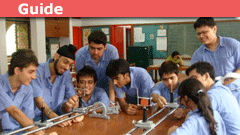
Physics Major Guide: Succeed in Years 3–4 and Research
Table of Contents
Full Chapter List – So You Want To Be A Physicist… Series
- Part I: Early Physics Education in High schools
- Part II: Surviving the First Year of College
- Part III: Mathematical Preparations
- Part IV: The Life of a Physics Major
- Part V: Applying for Graduate School
- Part VI: What to Expect from Graduate School Before You Get There
- Part VII: The US Graduate School System
- Part VIII: Alternative Careers for a Physics Grad
- Part VIIIa: Entering Physics Graduate School From Another Major
- Part IX: First years of Graduate School from Being a TA to the Graduate Exams
- Part X: Choosing a Research area and an advisor
- Part XI: Initiating Research Work
- Part XII: Research work and The Lab Book
- Part XIII: Publishing in a Physics Journal
- Part XIV: Oral Presentations
- Part XIII: Publishing in a Physics Journal (Addendum)
- Part XIV: Oral Presentations – Addendum
- Part XV – Writing Your Doctoral Thesis/Dissertation
- Part XVI – Your Thesis Defense
- Part XVII – Getting a Job!
- Part XVIII – Postdoctoral Position
- Part XIX – Your Curriculum Vitae
Becoming a Physics Major (End of Year 2)
So far, I have covered what a student needs through the end of the second year of study. In most U.S. schools, undergraduates must declare a major by the end of the second year (often sooner). By this point you should already be an official physics major and have met other physics majors in your year.
Those connections matter: study partners help with homework and exam preparation, and a local chapter of the Society of Physics Students (SPS) can help you meet peers and senior students who can advise you on professors, classes, and research opportunities. The friendships you form now may become valuable professional contacts later—never underestimate the value of personal connections.
Core Foundations: Years 3+
The transition into the third year typically brings smaller classes and more advanced subjects. This is where you study the “meat” of a physics program—the three foundations I consider essential: classical mechanics, electromagnetic fields, and quantum mechanics. These are usually taught across two semesters each.
Typical textbooks: classical mechanics — Marion or Symon; E&M — Griffiths or Reitz/Milford/Christy; QM — Griffiths or Liboff. All other physics subjects build on the foundation these courses provide.
If possible, consider lowering your course load for a semester while taking one or more of these classes so you can devote extra time to them. An E&M course, for example, can absorb a lot of study time and produce lengthy problem sets.
If you can afford it, buy study guides with sample problems and worked solutions (Schaum series, Rhea, etc.). Use those resources as practice and to check your understanding—do not use them to cheat.
Getting Involved: Research & Seminars
At smaller schools faculty will likely know you by sight or name. If they don’t, take the initiative: visit office hours, introduce yourself, and ask questions. By the middle of your third year you should be prepared to contribute to simple research tasks. Ask about research groups, small projects, or senior research classes available in your fourth year.
Start attending your department’s weekly seminars and colloquia. Much of the content may be advanced, but seminars expose you to research-front topics and may reveal projects being done at your institution. The aim is to become known to faculty outside of class time.
Academic Advising and Planning
Your contact with your academic adviser will depend on your needs. Often advisers help with course selection for the next term, but they can also advise on advanced-course choices and career paths. Check your department’s policy: some schools let you choose your adviser. If so, consider asking a faculty member you work well with to be your undergraduate adviser.
Summer Opportunities (U.S. students)
If your school lacks research opportunities that interest you, consider applying to U.S. Department of Energy (DOE) summer internship programs. These positions place students at national labs and provide hands-on experience with practicing physicists. Information is available on the DOE site: http://www.scied.science.doe.gov/scied/sci_ed.htm
Competition is intense—apply early.
What’s Next
In the next installment we will address your final undergraduate year and the choice between entering the workforce and continuing to graduate school.
Next Chapter: Applying for Physics Graduate School

PhD Physics
Accelerator physics, photocathodes, field-enhancement. tunneling spectroscopy, superconductivity


Are opportunities for internships year round or are they usually available only at the beginning of the school year?