
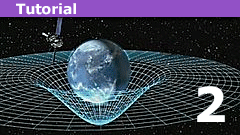
Learning Fermi-Walker Transport in Schwarzschild Spacetime
In the first post in this series, we introduced the concepts of frame field, Fermi-Walker transport, and the “Fermi derivative” of a frame field, and developed some basic machinery for dealing with them. In this post, we will use that machinery to look at two congruences in Schwarzschild spacetime, to see how things differ from the Minkowski case. This will introduce some of the complexities due to curved spacetime while still having the metric diagonal, which makes the math easier.
The Schwarzschild line element is, of course, familiar:
$$
ds^2 = – \left( 1 – \frac{2M}{r} \right) dt^2 + \frac{1}{1 – 2M / r} dr^2 + r^2 \left( d\theta^2 + sin^2 \theta d \phi^2 \right)
$$
We define the convenience function
$$
V^2 = \left( 1 – \frac{2M}{r} \right)
$$
and we also restrict ourselves to the “equatorial plane”, ##\theta = \pi / 2##, to make the math simpler so that we have
$$
ds^2 = – V^2 dt^2 + \frac{1}{V^2} dr^2 + r^2 d\phi^2
$$
The first congruence is the static, or “hovering”, congruence; this describes a family of observers who is each hovering at rest relative to the gravitating mass that is the source of the Schwarzschild geometry. Note that we will “cheat” a bit in describing our basis vectors by labeling one with ##z## instead of ##\theta##, and we won’t inquire too closely into exactly how the ##z## coordinate is normalized since nothing of interest will depend on it; we just want a convenient label for the direction perpendicular to the plane that our trajectories will lie in. (If you like, you can imagine that we are using a cylindrical chart instead of the spherical one used in the line element above; it will make no difference for what we’re doing.) The hovering frame field is then
$$
\hat{h}_0 = \frac{1}{V} \partial_t
$$
$$
\hat{h}_1 = \partial_z
$$
$$
\hat{h}_2 = V \partial_r
$$
$$
\hat{h}_3 = \frac{1}{r} \partial_{\phi}
$$
The only coordinate that anything depends on is ##r##, so we can read off the covariant derivatives along the 4-velocity pretty easily:
$$
\nabla_{\hat{h}_0} \hat{h}_0 = – \frac{1}{2} g^{rr} \partial_r g_{tt} u^t u^t \partial_r = V^2 \frac{M}{r^2} \frac{1}{V^2} \partial_r = \frac{M}{r^2 V} \hat{h}_2
$$
$$
\nabla_{\hat{h}_0} \hat{h}_1 = 0
$$
$$
\nabla_{\hat{h}_0} \hat{h}_2 = \frac{1}{2} g^{tt} \partial_r g_{tt} u^t r^r \partial_t = \frac{1}{V^2} \frac{M}{r^2} \frac{1}{V} V \partial_t = \frac{M}{r^2 V} \hat{h}_0
$$
$$
\nabla_{\hat{h}_0} \hat{h}_3 = 0
$$
We can see at once that this congruence Fermi-Walker transports its basis vectors; in fact, except for differences in labeling and the different functional dependence of the proper acceleration, it looks just like the Rindler congruence in Minkowski spacetime! This is not a coincidence, of course; but we’ll pass over that here.
Now let’s look at an analog of the Langevin congruence in Schwarzschild spacetime, the “rotating” congruence:
$$
\hat{p}_0 = \frac{1}{G} \partial_t + \frac{\omega}{G} \partial_{\phi} = \gamma \hat{h}_0 + \gamma v \hat{h}_3
$$
$$
\hat{p}_1 = \partial_z
$$
$$
\hat{p}_2 = V \partial_r
$$
$$
\hat{p}_3 = \frac{\omega r}{G V} \partial_t + \frac{V}{r G} \partial_{\phi} = \gamma v \hat{h}_0 + \gamma \hat{h}_3
$$
where ##\omega## is the angular velocity of rotation, ##G^2 = V^2 – \omega^2 r^2##, ##v = \omega r / V## is the tangential velocity of the rotating observer relative to a hovering observer, and ##\gamma = 1 / \sqrt{1 – v^2} = V / G##. Now we have some more nonzero terms in the derivatives:
$$
\nabla_{\hat{p}_0} \hat{p}_0 = – \frac{1}{2} g^{rr} \left( \partial_r g_{tt} u^t u^t + \partial_r g_{\phi \phi} u^{\phi} u^{\phi} \right) \partial_r = – V^2 \left( – \frac{M}{r^2} \frac{1}{G^2} + r \frac{\omega^2}{G^2} \right) \partial_r
$$
$$
\nabla_{\hat{p}_0} \hat{p}_1 = 0
$$
$$
\nabla_{\hat{p}_0} \hat{p}_2 = \frac{1}{2} r^r \left( g^{tt} \partial_r g_{tt} u^t \partial_t + g^{\phi \phi} \partial_r g_{\phi \phi} u^{\phi} \partial_{\phi} \right) = V \left( \frac{1}{V^2} \frac{M}{r^2} \frac{1}{G} \partial_t + \frac{1}{r^2} r \frac{\omega}{G} \partial_{\phi} \right)
$$
$$
\nabla_{\hat{p}_0} \hat{p}_3 = – \frac{1}{2} g^{rr} \left( \partial_r g_{tt} u^t e^t + \partial_r g_{\phi \phi} u^{\phi} e^{\phi} \right) \partial_r = – V^2 \left( – \frac{M}{r^2} \frac{1}{G} \frac{\omega r}{G V} + r \frac{\omega}{G} \frac{V}{r G} \right) \partial_r
$$
This looks messy, but it can be wrangled into a form that is familiar from the Langevin case:
$$
\nabla_{\hat{p}_0} \hat{p}_0 = A \hat{p}_2
$$
$$
\nabla_{\hat{p}_0} \hat{p}_2 = A \hat{p}_0 + \Omega \hat{p}_3
$$
$$
\nabla_{\hat{p}_0} \hat{p}_3 = – \Omega \hat{p}_2
$$
where the proper acceleration ##A## and the vorticity ##\Omega## are given by
$$
A = \frac{V}{G^2} \left( \frac{M}{r^2} – \omega^2 r \right) = \frac{M}{r^2 V} \gamma^2 \left[ 1 – \left( \frac{r}{M} – 2 \right) v^2 \right]
$$
$$
\Omega = \frac{1}{G^2} \omega \left( 1 – \frac{3M}{r} \right) = \frac{\gamma^2 v}{r V} \left( 1 – \frac{3M}{r} \right)
$$
So once again we have an extra “twist” in the basis vectors; relative to gyro-stabilized vectors, they are spinning about the ##z## axis, in the same sense as the observers are rotating. But now we have several key differences from the Minkowski case:
(1) The time dilation factors are different because we now have gravitational time dilation as well as time dilation due to the motion of the observer relative to a static observer.
(2) The proper acceleration ##A## now has two parts, which in the first formula above have obvious Newtonian interpretations as the outward acceleration to cancel the pull of gravity and the inward centripetal acceleration due to the orbital motion. These two effects will cancel at a particular orbital speed that, of course, corresponds to a free-fall orbit. In the second formula, the factors are rearranged for reasons which are discussed in more detail in my previous Insights article on centrifugal force reversal.
(3) The factor of ##(1 – 3M / r)## in ##\Omega## is due to the geodetic effect, also called de Sitter precession, which is not present in flat spacetime; in Schwarzschild spacetime, Fermi-Walker transported spatial vectors have an extra rotation in the prograde direction which offsets the Thomas precession (which is retrograde). This means that the rotating basis vectors, which are locked to neighboring members of the rotating congruence, will differ less from Fermi-Walker transported basis vectors in Schwarzschild spacetime than in flat spacetime, and the difference will decrease as ##r## gets smaller. At some value of ##r##, in fact, the difference will have decreased to the point where ##\Omega = \omega / G##; at this point, the Fermi-Walker transported vectors are rotating backwards, relative to the rotating congruence basis vectors, just enough to remain pointing in the same direction relative to a distant observer. (Note that this point is ##omega / G##, not ##omega##, because ##Omega## is the frequency as seen by the rotating observer, while ##omega## is the frequency relative to an observer at rest at infinity.) So for this particular value of ##r##, the gyro-stabilized vectors actually behave just as they would in Newtonian physics.
As ##r## continues to get smaller, we finally reach ##r = 3M##, where something odd happens: the twist of the rotating congruence vanishes (meaning that the de Sitter precession is large enough that Fermi-Walker transported vectors precess, in the prograde direction, exactly as fast as the rotating congruence vectors), and its proper acceleration no longer depends on the angular velocity. In other words, no matter how fast you orbit at ##r = 3M##, your rocket thrust is the same and your gyro-stabilized basis vectors are rotating, relative to a distant observer, at the same angular velocity that you are (just as the rotating congruence vectors always do).
For ##r < 3M##, things get even stranger: the proper acceleration now increases with angular velocity, rather than decreasing. This is often termed “centrifugal force reversal”, and I talked about it in a previous Insights article. Also, the twist of the rotating congruence is now negative, meaning that Fermi-Walker transported basis vectors are now rotating *faster* than those of the rotating congruence. The limiting value of the twist, as ##r \rightarrow 2M## and ##A \rightarrow \infty##, is ##- \gamma^2 v / (4M)##.
In the next article, we’ll look at Kerr spacetime, which will add some more complexities.

- Completed Educational Background: MIT Master’s
- Favorite Area of Science: Relativity





Thanks for the thread! This is an automated courtesy bump. Sorry you aren't generating responses at the moment. Do you have any further information, come to any new conclusions or is it possible to reword the post? The more details the better.