

Frequently Made Errors in Mechanics: Momentum and Impacts
Entire List for Frequently Made Errors Series
An impact is an impulse (change of momentum) that involves arbitrarily large forces acting very briefly. These result in near-instantaneous changes in speed. In general, work will not be conserved.
Table of Contents
1. Examples of impacts
Most textbook impacts are collisions, but anything involving a sudden change in speed is an impact. For example, a string suddenly becoming taut.
“A thin string of linear mass density ρ lies in a pile of no size (it is very thin) on a smooth table. One end is drawn off horizontally at a constant speed v. What power is needed?”
Attempted solution:
Mass is taken from the pile at a rate ρv. The gain in KE of each δm element of mass is ½ δmv2.
X Power needed = ½ ρv3.
The mistake is the assumption that work is conserved even though, as each element of a string is picked up in the departing thread, it apparently accelerates instantaneously from rest to speed v.
Using conservation of momentum instead:
Tension = rate of change in momentum = ρv2.
In time t, the tension draws the string a distance vt.
✓ Power = force ##\times## distance / time = ρv3.
So, where did the other half of the work done go?
In the real world, no string is of zero thickness nor totally inelastic.
- To the extent that the string has a thickness, drawing the string off must generate sideways motions.
- To the extent that the string is elastic, the acceleration from rest will generate longitudinal oscillations.
2. ‘Force’ of Impact
Impacts are generally treated as having an unknowable force-time profile. That is, they involve very large forces acting for very short times, and all that can be known for sure is the total impulse imparted:
##\Delta m\vec v = \int \vec F.dt##
Thus, this frequently asked question is unanswerable without detailed mechanical data:
X “A rock mass m falls from a height h onto solid ground. What is the force of impact?”
3. Limited and Unlimited forces
“A bullet mass m strikes a block mass M lying on a rough floor with a horizontal velocity v. What is the speed of the block+bullet immediately after impact?”
X “Not enough information since we do not know the coefficients of friction”
As noted, the horizontal forces in an impact are arbitrarily large. By contrast, the gravitational force is fixed at mg, so the normal force and frictional force are limited. The impact lasts an arbitrarily short time, so the impulse from the friction, ##\int \vec{F_f} dt##, is negligible.
✓ “In an impact, forces that do not grow commensurately with the impact force can be neglected.”
4. Non-conservation of work
In general, an impact has three phases:
- an elastic compression phase, where the force grows roughly in proportion to the extent of deformation;
- a plastic phase, where the force may remain roughly constant for a while, or even reduce a little;
- an elastic rebound, approximately reversing the elastic compression phase. The force/deformation slope in the rebound will typically be less than in the elastic compression phase.
These diagrams illustrate some possible force-time profiles.
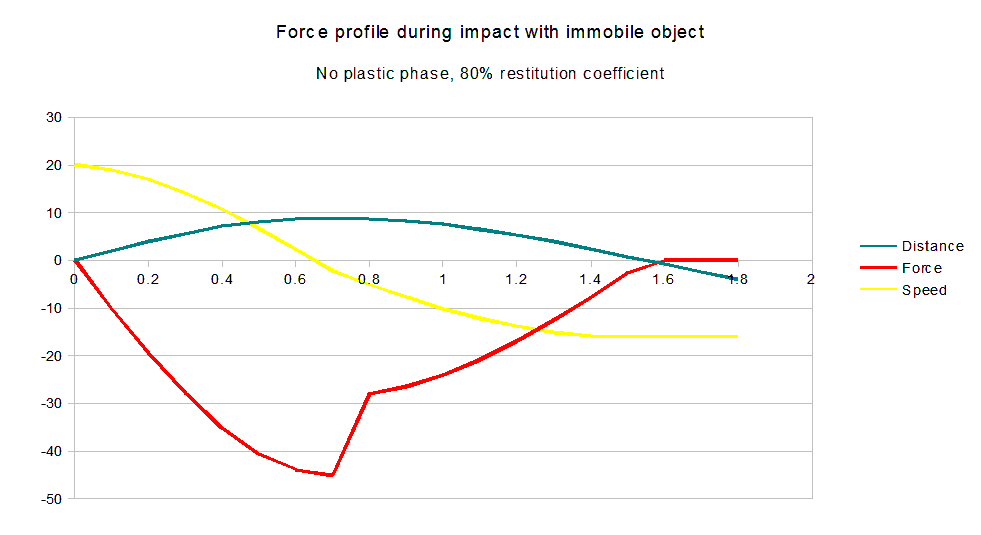
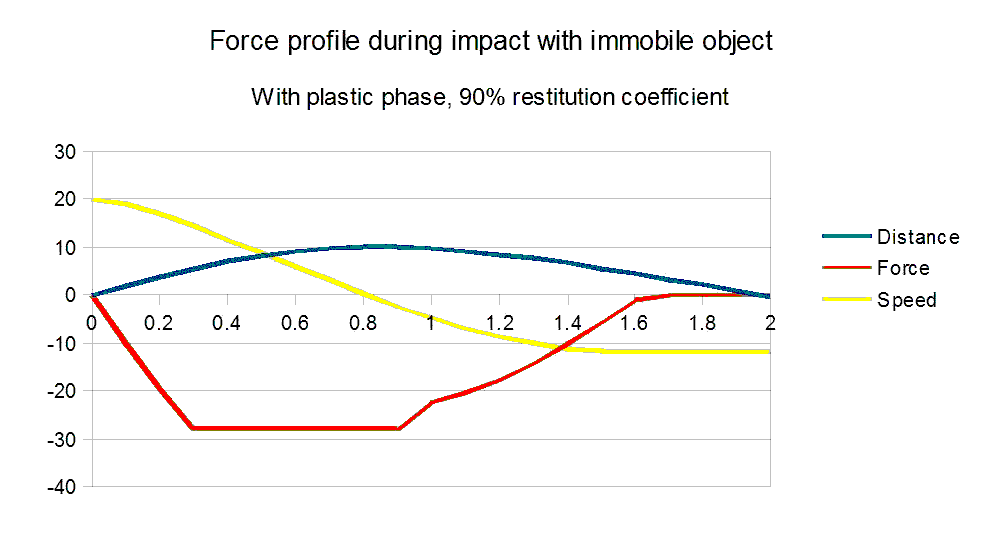
Thus, work energy is lost in two ways: the deformation in the plastic phase is not recovered, and the force at a stage in the rebound may be less than in the corresponding stage of the elastic compression phase.
- An elastic collision is a collision in which no work is lost.
- An inelastic collision is a collision in which some work is lost.
- X A completely inelastic collision is a collision in which all work is lost.
- ✓ A completely inelastic collision is a collision in which the maximum possible work is lost.
Example: “A ball mass M strikes a stationary ball mass m square-on at velocity u. What is the maximum possible loss of kinetic energy?”
Let the subsequent velocities be ##\vec {v_M}, \vec {v_m}##. By conservation of momentum:
##M\vec {u} = M\vec {v_M}+m\vec {v_m}##
The final KE is ½(MvM2 + mvm2).
Combining with the momentum equation and differentiating wrt vm, we find that this is minimized when vM = vm, that is, if the two masses coalesce.
5. Impulsive Friction
X “In a collision, the impulse acts along the normal”
Since the impact generates a large normal force, it can also generate large frictional forces. If the normal impulse is ##\vec {J_N} = \int \vec{F_N}.dt## then
✓ If no slipping occurs there is a static frictional impulse ##\vec {J_{F_s}} \leq \int \mu_s \vec {F_N}.dt = \mu_s \vec {J_N}##
Correspondingly for kinetic friction,
✓If slipping occurs throughout the impact then ##\vec {J_{F_k}} = \int \mu_k \vec {F_N}.dt = \mu_k \vec {J_N}##
More generally, since the normal force may vary in an unknown way during the impact, it may be that slipping commences at an indeterminate point during the impact.
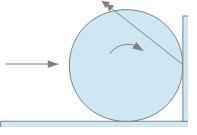
Example: “A uniform ball radius r rolls at speed u and hits a step of height r/2. The collision is inelastic. No slipping occurs. What is the speed v of the ball immediately after impact?”
To simplify matters, take moments about the impact point of the step. Neither the normal impulse nor the frictional impulse have any moment about that point:
Ball’s angular momentum before impact ##= m u \frac r2+I u \frac 1r = 0.9 m u r##.
Angular momentum after impact ##= m v r+I v \frac 1r = 1.4 m v r##.
Hence v = 9u/14.
Note that even for a vertical wall, any friction in the impact implies the ball becomes airborne. There is no downward impulse to counter the upward impulse from friction.
6. Changing Mass
Since momentum is ##\vec p = m\vec v##, force can be expressed as the rate of change of momentum according to ##\frac d{dt}\vec p = m\frac d{dt}\vec v = m\vec a##. But what if the mass is changing too? Shouldn’t it be ##\vec F = \frac d{dt}\vec p = m\frac d{dt}\vec v + \dot m\vec v##?
That might make sense if mass could materialize out of nothing in a moving object. Whether that means it would take force just to keep it moving with the same velocity we may never know because in the real world this doesn’t happen.
What can happen is that mass may be transferred between the object of interest and the surroundings. The transferred mass brings momentum with it, or carries momentum away with it.
Example: “A cart full of sand, total mass ##m_0##, is set moving on a horizontal rail at speed ##v##. Sand leaks from the cart at rate ##\rho##. What force is required to maintain the cart’s speed?”
X ##\vec F_{net} = \frac d{dt}\vec p = m\frac d{dt}\vec v + \dot m\vec v = -\rho \vec v##
The equation is invalid here because ##\vec F_{net}=\dot{\vec p}## only applies to an isolated system. In this case, momentum is leaking out with the lost mass at rate ##\rho \vec v##.
✓ ##\vec F_{net} = \frac d{dt}\vec p+\rho \vec v = 0##

Masters in Mathematics. Interests: climate change & renewable energy; travel; cycling, bushwalking; mathematical puzzles and paradoxes, Azed crosswords, bridge






“haruspex submitted a new PF Insights post
[URL=’https://www.physicsforums.com/insights/frequently-made-errors-mechanics-momentum-impacts/’]Frequently Made Errors in Mechanics – Momentum and Impacts[/URL]
[IMG]https://www.physicsforums.com/insights/wp-content/uploads/2015/05/impacterrors-80×80.png[/IMG]
[URL=’https://www.physicsforums.com/insights/frequently-made-errors-mechanics-momentum-impacts/’]Continue reading the Original PF Insights Post.[/URL]”
Nice post! :)