

Frequently Made Errors in Probability: Conditionals in Natural Language
Entire List for Frequently Made Errors Series
Table of Contents
1. Turning a verbal condition into Algebra
An actual thread…
“A study of auto accidents has found that 40% of all fatal accidents are attributed to texting drivers…”
Attempt 1:
X P(F|T) = .4
No, that says if an accident occurs while texting there is a 40% chance of its being fatal.
Attempt 2:
X ##P(F\cap T) = .4##
No, that says 40% of all accidents occurred while texting and were fatal.
Perhaps the incomprehension comes from the word order. In the question wording, ‘fatal’ comes before ‘texting’. Fatality here is the given – we are restricting attention to those accidents which were fatal and considering the incidence of texting in that subset. So in algebra it comes second:
✓P(T|F) = .4
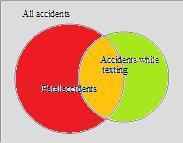
The orange area is 40% of the orange+red areas.
P(F|T) would be the orange area as a fraction of orange+green.
##P(F\cap T)## would be the orange area as a fraction of the entire space.
2. The limitations of English
Conversational English is not good at expressing logical combinations. Consider the common waterway injunction:
“Swimming or paddling prohibited”
The baffled logician wonders which are prohibited, swimming or paddling. So the council rewords the sign:
“Swimming and paddling prohibited”
Now it’s clear: we may swim, we may paddle, just don’t try to do both.
Merely amusing in everyday life, but potentially disastrous in an academic exercise.
3. Epistemological Dependence
In general, a conditional probability may depend on how the conditional fact came to be known. This is a kind of selection bias. It can be particularly problematic for questions posed in a conversational style.
“Louise tells me she has two children, and that one of them is a girl. What is the probability that the other is a boy?”
In the real world, if Louise were to announce to you “I have two children, one is a girl,” you would naturally deduce that the other is not a girl. Why? Because if Louise had two girls she would say so. The conversational form invites the reader to interpret the statement in a conversational context. I would not fault a student for answering either 1 or ##\frac 12##.
The questioner intends:
“Louise has two children. If they are not both boys, what is the probability that they are not both girls.”
but may have felt that made it too easy. If so, the questioner needs to remember that the purpose of the exercise is to test the students’ understanding of mathematics, not their ability to read the questioner’s mind.
Let’s try a compromise:
“Louise has two children. One of them is a girl.”
That still doesn’t do it. The poser is somehow choosing a child whose gender to state, and the reader is not told how that child is chosen. Is it the child the poser happens to know the gender of? The elder child? The one dressed in pink? Just about every assumption one makes leads to the answer “##\frac 12##”; every assumption, that is, except the one the poser intended, namely, that the child was chosen by happening to be a girl; moreover if both had been boys then no statement would have been made.
What if we insert “at least”? See what happens when we personify the question setter:
Your friend spots an acquaintance out shopping with two children, but only gets a proper view of one. Your friend reports back “Pranav has two children; at least one is a girl.”
Unless you suppose your friend to be deliberately withholding information, you might correctly infer that the other is equally likely to be a boy or a girl. So how to fix it? Here’s one way:
“Mei-Ling, how many children do you have?”
“Two”
“Any girls?”
“Yes”.
This version is from an Australian HSC paper circa 2000 (not this exact wording):
“Helen picked two balls at random from a bag of 3 red and two white and hid them behind her back. She asked Leslie to guess their colours, but at that moment dropped one. Leslie saw it was red. What is the probability that the other ball is also red?”
X The answer marked correct was 1/3.
✓The true answer (as given by most students) is 1/2.
The flaw is that the ball whose colour is known is identified by its having been seen by Leslie. To arrive at the answer 1/3, we need instead to be informed that at least one is red, without any specification of which.
Problem setters: beware when striving for a conversational style.

Masters in Mathematics. Interests: climate change & renewable energy; travel; cycling, bushwalking; mathematical puzzles and paradoxes, Azed crosswords, bridge






Good read. Probability can be so counterintuitive. One thing that’s helped me a lot is seeing the log reciprocal relation between the probability of an event and the information in it. If I tell you that of Susan’s two children, at least one is a girl, then I have given you log2(4/3) bits of information. (There are 3 of 4 possibilities where at least one is a girl, take reciprocal and log.) If on the other hand you see the older one, and see she is a girl, you have gained log2(4/2) bits of information. (50/50 chance the other one is.) Where does the extra information come from in the latter case? It comes from you having the which-child information you don’t have in the first one: You know the older child is the one that’s a girl. It gets a little weird though when you see a child of Susan who is a girl, but don’t know which it is in terms of the predefined younger/older variable. You’re back to the log(4/3) bits of information. It’s a weird way to look at the world.
Extremely unique topic!