
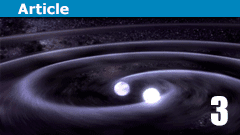
Does Gravity Gravitate: The Wave
In the first two posts in this series, we looked at different ways of interpreting the question “does gravity gravitate?” We left off at the end of the last post with an open question: what do the various “mass integrals” look like in a spacetime where gravitational waves are being emitted? Let’s look at that question now.
The key difference between GWs and other types of radiation is that GWs have zero stress-energy. They are oscillations in the curvature of spacetime. This fact makes it tempting to conclude that GWs can’t carry energy at all; in fact, many physicists who studied GR in the 1950s and 1960s thought this. The basic argument goes like this: the “source” in the EFE is on the RHS, but GWs can be present when the RHS of the EFE is zero, i.e., when there is no “source”. By analogy with EM waves, that should mean that GWs can’t carry any “source” along with them, just as EM waves can’t carry any charge. But the “charge” associated with gravity is just energy (more precisely, stress-energy), so it seems like GWs should not be able to carry any energy.
However tempting this line of reasoning is, though, it isn’t valid. We can see this by a simple thought experiment, inspired by Feynman’s response at a gravity conference when he saw so many people struggling with this issue: “This is what comes from looking for conserved tensors, etc., instead of asking, can the waves do work?” Suppose we have gravitational waves passing through a certain region of empty space, which we will idealize as plane waves for this case (we assume we are very far from the source and that the waves are weak enough that no nonlinearities, i.e., no self-interactions, can be detected). We place an object transverse to the direction of wave propagation; for example, we could place a flat plate of some material such that it lies in a plane perpendicular to the wave vector. What will happen? It is straightforward to show that the wave oscillations will induce vibrations in the object which will heat it up; i.e., the waves will do work on the object, adding energy to it. That means the waves themselves must be carrying energy.
This is a local view (or at least, quasi-local–we’ll see below that the energy carried by GWs can’t really be localized), but there is also a global view. Consider a spacetime containing GWs, such as a binary pulsar spacetime, and assume that there is *no* other radiation present besides the GWs (which is *not* true for a real binary pulsar, but which is a valid idealization for our purposes here). We can still do the same comparison we did for the case of EM radiation in the previous post, and we will find the same result: the ADM mass and Bondi mass of the system will *not* be the same. The ADM mass of the spacetime will include the energy carried by the GWs, but the Bondi mass will not. So we can separate out, globally, the energy carried away by GWs from the gravitating mass that remains behind.
But what about that line of reasoning that we gave above? Where, exactly, does it break down? After all, local conservation of the SET still holds; the covariant divergence of the SET is still zero everywhere. So where does the energy get “transferred” from the matter (which has nonzero SET) to the GWs (which have zero SET)? And how can that happen without violating the local conservation law?
Consider an idealized binary pulsar system again. We have two neutron stars orbiting each other, and as GWs are emitted, the orbital parameters slowly change: the stars get closer to each other and their orbital speeds increase. The net effect is an energy decrease for the system consisting of the two stars only (remember that we assumed for our purposes here that there was no radiation present other than GWs), and this can be understood, qualitatively, in Newtonian terms: the reduction in potential energy due to the stars getting closer is larger than the increase in kinetic energy due to the increase in orbital speeds. (If you actually do the math, you will see that this follows from Kepler’s Third Law.) However, the change in orbital parameters also means a change in the RHS of the EFE, because the relative positions of the “sources”–the regions of nonzero SET in the interiors of the two neutron stars–have changed. This shows up as a change in the metric coefficients. This change isn’t as simple as a slow reduction of [itex]M[/itex] in the Schwarzschild line element would be, but its effect is similar: if we put a test object in orbit at a large distance from the binary pulsar system, and measure its orbital parameters, the “gravitating mass” of the system that we obtain will slowly decrease as GWs pass by us on their way out to infinity.
If we try to localize exactly “where” the change in metric coefficients is being triggered from, though, there is no answer. Locally, the covariant divergence of the SET is zero at every event; there are time and space variations in the metric, and they are driven by time and space variations in the “source” (because the two pulsars are orbiting each other), but those variations are constrained by the local conservation law. It is only when you look on a larger scale (a scale at least as large as the wavelength of the GWs being emitted, which for a typical binary pulsar is pretty large, on the order of the orbital radius) that you can see a pattern in the time and space variations in the metric that tells you that GWs are being emitted and are carrying away energy, globally, from the binary system.
So we have a third way of interpreting our title question, which leads to the answer “yes”: if “gravity” is interpreted as “spacetime”, and “gravitate” is interpreted as “can store and propagate energy”, then yes, spacetime can store and propagate energy: gravity does gravitate.
Postscript
You may be wondering about one loose end: what about the Komar mass of a system that is emitting radiation? That’s where the comment I made in the previous post, about the Komar mass being applicable in a somewhat different class of spacetimes, comes in. Spacetimes where radiation is present can be asymptotically flat, so the ADM and Bondi masses can still be defined and computed. But spacetimes where radiation is present *cannot* be stationary: they cannot have a timelike Killing vector field. That means the Komar mass simply can’t be properly defined for such spacetimes. There may be ways to adjust the Komar mass definition, for example by using the total 4-momentum of the spacetime as defined in the asymptotically flat region to find a timelike unit vector to plug into the Komar mass integral. But that’s a subject for (possibly) another post.

- Completed Educational Background: MIT Master’s
- Favorite Area of Science: Relativity







"It must be admitted that this introduction of the energy tensor is not justified by the relativity postulate alone. For this reason we have deduced it from the requirement that the energy of the gravitational field shall act gravitationally in the same way as any other kind of energy. " Einstein, Foundation of the General Theory of Relativity.
“No. If you want to learn about our best current theory of gravity, I suggest taking the time to work through a good GR textbook. Sean Carroll’s online lecture notes aren’t a bad start:
[URL]http://arxiv.org/abs/gr-qc/9712019[/URL]”
Thank you for the reference
“Do you thing gravity could be particles, like neutrinos, that orbit an object with mass?”
No. If you want to learn about our best current theory of gravity, I suggest taking the time to work through a good GR textbook. Sean Carroll’s online lecture notes aren’t a bad start:
[URL]http://arxiv.org/abs/gr-qc/9712019[/URL]
“I have tried to find information on the actual experiment but find conflicting data.”
Can you give some specific examples?
“An experiment like this, would not seem practical to me personally.”
The experiment has been repeated multiple times with modern equipment. There is no doubt at all about the results. Here is an example of a modern setup:
[URL=’http://www.phys.utk.edu/labs/modphys/Pasco%20Cavendish%20Experiment.pdf’]http://www.phys.utk.edu/labs/modphys/Pasco Cavendish Experiment.pdf[/URL]
“We all know that we are: rotating at 10,000mph, orbiting the sun, have barometric pressure, have seismic activity, have oceans that pull toward the moon, etc.
This is a lot of natural forces to shield against.”
All that just means you need to do the experiment under controlled conditions in a lab; that is easily done with modern equipment. It can even be done by a lay person nowadays; for an example, see John Walker’s description, “Bending Spacetime in the Basement”:
[URL]https://www.fourmilab.ch/gravitation/foobar/[/URL]
“from my perspective, the Cavendish experiment does not prove the force of gravity.”
You are entitled to your perspective, but that doesn’t make it correct. I strongly advise looking into this in more detail before you jump to the conclusion that modern physics is wrong.
“Um, what? Cavendish did his original experiment in the late 1700’s. There was no “peer review” then.
Quite the contrary; Cavendish’s results were accepted, because they could be used to calculate an accurate value for Newton’s gravitational constant, and that value could then be plugged in to Newtonian models of the solar system and shown to match observations.”
[URL]http://www.public.iastate.edu/~lhodges/Michell.htm[/URL]. I know of the Cabendish experiment. I have tried to find information on the actual experiment but find conflicting data. An experiment like this, would not seem practical to me personally. We all know that we are: rotating at 10,000mph, orbiting the sun, have barometric pressure, have seismic activity, have oceans that pull toward the moon, etc.
This is a lot of natural forces to shield against. So from my perspective, the Cavendish experiment does not prove the force of gravity.
Also, Edriven, when you quote someone’s post, you can put your reply in the same post, as I did in post #11 of this thread in reply to you; you don’t have to put it in a separate post, as you did with posts #9 and #10 in this thread.
“I thought cavendish failed his peer review?”
Um, what? Cavendish did his original experiment in the late 1700’s. There was no “peer review” then.
“So it was determined that he didn’t demonstrate gravity.”
Quite the contrary; Cavendish’s results were accepted, because they could be used to calculate an accurate value for Newton’s gravitational constant, and that value could then be plugged in to Newtonian models of the solar system and shown to match observations.
I thought cavendish failed his peer review? So it was determined that he didn’t demonstrate gravity.
“It doesn’t have to be “simulated”. We can measure the gravity of ordinary objects with very precise tools. Google for “Cavendish Experiment”.”
“Why do u think gravity can’t be simulated in a lab?”
It doesn’t have to be “simulated”. We can measure the gravity of ordinary objects with very precise tools. Google for “Cavendish Experiment”.
“Yes, but the first three were already written, since they were blog posts on the old PF blog facility. I’ll actually have to write the next one. :wink:”
Well get to it :-)
“More to come?”
Yes, but the first three were already written, since they were blog posts on the old PF blog facility. I’ll actually have to write the next one. :wink:
Thank you for help on this topic. I don't think modern physics is wrong. I am trying to question it only to understand it further. Do you thing gravity could be particles, like neutrinos, that orbit an object with mass?
Loved ur post. Why do u think gravity can't be simulated in a lab? If we solve gravity and accurately find a graviton, do u think we then could produce gravity in a lab? Thanks for your help.
I thoroughly enjoyed all 3 articles thus far. More to come? =D
Excellent summary of a subtle and somewhat non-intuitive issue. Well done :)
Wonderful series!