
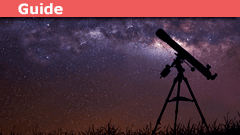
Beginner Telescope Guide: Choose the Right First Scope
Table of Contents
What telescope should a beginner buy?
Overview for beginners
People often ask what telescope an aspiring amateur astronomer should buy. There isn’t a single “correct” answer — it depends on expectations, budget, storage, transport, and observing goals. This guide consolidates the common advice I give so it can be a reference for newcomers on the astronomy forum.
Join a local astronomy club first
Before you spend a dime, find a local amateur astronomy club.
Attend meetings as a guest and arrive early to mingle. Tell members you’re new and open to equipment suggestions. Then attend a club star party (many are public outreach events). These steps let you:
Benefits of club membership
- See how different telescopes and mounts are transported and stored.
- Observe setup complexity and required time for various rigs.
- Look through many instruments to learn their strengths and weaknesses.
Manage expectations about astrophotography
One important benefit: star-party observing helps temper expectations shaped by marketing. Advertisements show bright, colorful nebulae and galaxies created by long-exposure astrophotography; visually you will usually see shades of gray-green in faint deep-sky objects. You can see color in bright stars and planets through modest scopes, but cameras can integrate light over long exposures in ways the human eye cannot.
Finding used equipment
Another advantage: club members are often gear collectors. You may find used telescopes for sale that are gathering dust — a great way to buy after trying the scope in person.
Do you really need a telescope?
Consider binoculars
Many beginners get a lot of enjoyment from binoculars and charts. A good pair of no-frills binoculars from a reputable optics company gives wide-field views, makes learning the sky easier, and is highly portable. A classic recommendation is 7×50 binoculars (7× magnification, 50 mm objective lenses). I use binoculars at nearly every observing session for quick looks and star-hopping.
If you do want a telescope: basic options
Compare common designs
Newtonian reflectors (Dobsonians)
Alt-azimuth-mounted Newtonian (Dobsonian) telescopes deliver the best aperture per dollar. You can get large mirrors and bright views for reasonable money. Dobsonians are simple to use, easy to transport compared with a similarly sized tube on an equatorial mount, and are popular with beginners for that reason.
German equatorial and other mounts
Newtonian tubes can also be mounted on German equatorial mounts. Optically they are similar, but equatorial mounts add complexity and cost because they allow polar alignment and motorized tracking for long-exposure astrophotography.
Catadioptric telescopes
Catadioptric designs (Schmidt–Cassegrain, Maksutov–Cassegrain) fold the light path, making fairly compact telescopes with longer focal lengths. They are more portable than large Newtonians of comparable aperture but generally have slower focal ratios (longer focal lengths) so the image surface can appear dimmer than a faster Newtonian at the same aperture.
Refractors
High-quality refractors (not the cheap department-store types) use well-corrected lens systems and often expensive glass to produce very high-contrast views. Because they lack a central obstruction, they can deliver excellent planetary and double-star performance. They tend to be more costly per inch of aperture than reflectors.
Learn the basics of optics
Why mirror quality matters
Some inexpensive Newtonians reduce costs by using poorer mirror figures. Cheap tubes may use spherical or poorly-figured mirrors that introduce aberrations. If you search “spherical aberration” you will see why paying a bit more for a properly figured parabolic primary mirror is usually worthwhile for reflectors.
Mounts, automation, and reliability
Choosing a mount
There is a wide range of mounts and automation options. Dobsonians can be fitted with electronic encoders; German equatorial and fork mounts may include computerized “goto” systems preloaded with tens of thousands of objects. These systems are attractive, but consider long-term serviceability: encoders or hand controllers can fail, firmware can become corrupted, and older manufacturers may not have replacement parts.
Practical recommendation
My recommendation is practical: choose an optical tube assembly that meets your needs and pair it with a mount that is no more complex or automated than necessary. Quality optics on a simple, sturdy mount will give many years of reliable use. Learning star-hopping and reading charts builds lasting navigation skills; you won’t be dependent on a computer to know “what’s that star?”
Accessories: what to buy first
Start slowly
Don’t rush to buy many eyepieces immediately. Use your club to test eyepieces and discover what works well with your telescope. Experienced amateurs usually bring a selection of popular eyepieces to share so you can compare performance before spending money.
Eyepieces and Barlow lenses
Be aware that some hobbyists use exotic eyepieces that cost more than an entire beginner scope; be courteous if someone hesitates to hand over an expensive eyepiece. For many telescopes, classic Plössl eyepieces perform very well. Short focal-length, fast reflectors sometimes benefit from higher-end wide-field eyepieces, but those can be costly.
Buying strategy
Buy eyepieces with a plan. You’ll want a range of focal lengths rather than duplicates. A high-quality Barlow lens is often the best single eyepiece purchase because it multiplies the usefulness of your longer, more comfortable eyepieces. For example, if you own 10 mm and 20 mm eyepieces and a 2× Barlow, you’ll only create one additional unique magnification — so choose focal lengths to give a useful spread.
Consider Barlows of 2×, 2.5×, or 3× and map out magnifications in a simple spreadsheet to avoid unnecessary purchases. A good Barlow is used more than you might expect, so invest wisely.
Final tips
Quick final advice
Buy what you’ll use, learn basic optics and sky navigation, and leverage local club resources. Try before you buy, prioritize solid optics and a mount you can handle, and plan eyepiece purchases sensibly. Good luck, no matter how you proceed.

Leave a Reply
Want to join the discussion?Feel free to contribute!