

Garrett Lisi: E8 Theory, Surfing & Physics Interview
We are pleased to introduce Theoretical Physicist and Physics Forums member Garrett Lisi, an experimental surfer who developed a distinctive approach to a theory of everything. Read on for an interview covering his early life, E8 work, and life in Maui.
Table of Contents
Tell us a little about growing up in San Diego
I grew up in Rancho Santa Fe, a pretty idyllic part of San Diego. I had a fairly normal, happy childhood. Although I was an introverted kid, I spent a lot of time reading, playing with LEGO, riding my bike — and later programming computers after my father brought one home. Most of the best things I learned were outside of school, such as while playing games with friends. I later went to Santa Barbara for boarding school, where academic life became more intense.
What drew you to physics, with so many waves to get your attention?
Surfing is extremely fun, but it can’t be all one does. In high school I had the usual adolescent questions about what the universe is and our part in it. My reading led me through philosophy to popular physics, where I learned that mathematics is the “secret” language underlying how the universe operates. I had always been good at math, so discovering that math is the key to understanding the universe through physics was thrilling — and I’ve been hooked ever since.
Best surf story or adventure
The one I’m on now: living in Maui is pretty fantastic. The water is warm and beautiful, and we have lots of waves and wind — this place is a wonderful playground. I especially enjoy having friends and other scientists visit and introducing them to the island.
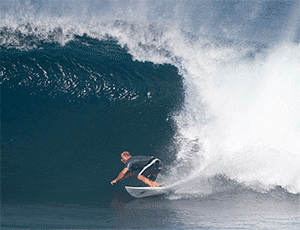
Have adventure sports influenced your approach to physics?
I suspect so. Going out and playing a lot gives me more mental flexibility when tackling hard problems. There are times you hit a wall working on a tough problem and nothing you try works. By throwing yourself into a different, intense experience for a couple of hours, you can come back with a fresh perspective and find a new approach that you might not have found by continuing along previous lines.
Staying productive while maintaining work/life balance
It’s complicated. Playing outside, spending time with people, and working on other projects keeps me happy enough to devote most of my intellectual energy to physics, which is rewarding but much harder. There is some competition in physics, but I don’t feel it very strongly.
From my perspective, many other theoretical physicists are searching along the wrong paths. String theorists should have abandoned strings and supersymmetry and tried other models decades ago. Even within the loop quantum gravity community, only a handful have pursued geometric descriptions of particles and the Standard Model. Occasionally I see a blip on the radar — such as Chamseddine’s recent paper (http://arxiv.org/abs/1602.02295) — but they seem at least a decade behind. I know that sounds arrogant; it’s also possible I am completely wrong.
How did publishing the E8 theory affect your professional life?
The E8 Lie group itself was discovered by Killing about 120 years ago, but I assume you mean the E8 Theory paper I published in 2007. The attention that followed was a mixed bag. I was invited to some bizarre and cool things — heliskiing and making a TV show — which were fun but distracting. I also received considerable criticism, including some mean-spirited attempts to discredit me and my work from the likes of Motl and Distler; that was annoying and professionally harmful.
Because I had been working largely on my own along a research direction foreign to the broader community, I didn’t have much community support. Many physicists looked at the hype and criticism and assumed my work couldn’t be any good. Maybe that will turn out to be true — but I don’t think so. My life has since returned to a more normal cycle of surfing and physics, which is how I like it.
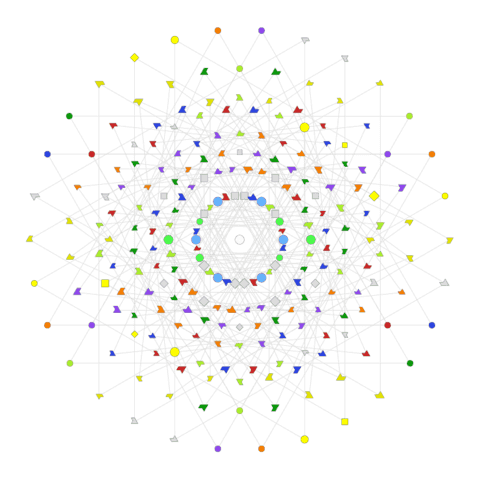
Key projects and current work on E8
Back in 2007 I was excited to show that the mathematical structure of fermionic spinors can be described algebraically by E8 and other exceptional Lie algebras. More recently, in the Lie Group Cosmology paper (http://arxiv.org/abs/1506.08073), I described how to understand anti-commuting, fermionic degrees of freedom geometrically within this context.
In brief, spacetime is embedded within a deforming Lie group, and the physical anti-commuting Grassmann fields are 1-form fields orthogonal to spacetime. With this piece, I feel much better about a geometric description of Standard Model fermions. The main remaining problem is how triality relates the fermion generations and produces their masses. For the past few months I’ve been working with the octonions and split-octonions as they relate to triality, which has been very fun.
Who would you collaborate with on E8, past or present?
I’ve had productive conversations with several mathematicians and a few established physicists, but what I’d most like is to collaborate with students and postdocs interested in the same directions. The geometric description of fermions is a rich area, and it’s been hard for me to follow up on all the possibilities alone. Getting younger eyes on the topic would likely be productive.
Pacific Science Institute and the science hostel idea
More than plans: the Pacific Science Institute (http://www.pacificscienceinstitute.org) has been open and operating for a year, with a steady stream of visiting scientists, students, and friends. About 60 people have come to Maui, stayed in our guest cabins, and enjoyed the island and the atmosphere here.
Other research and scientific developments of interest
There has been a lot of fantastic recent progress across experimental physics and other sciences. AlphaGo’s success is a major step forward for AI, and CRISPR in bioengineering has enormous potential. The detection of gravitational waves by LIGO was a great achievement. In particle physics, the LHC saw an intriguing 750 GeV bump at one point, and there continue to be important developments regarding neutrinos.
Near- and long-term plans
Mostly more physics, surfing, and kitesurfing. I’ve also been enjoying my role as Director of the Pacific Science Institute. It’s been great to have old and new friends visit Maui; I’ve enjoyed the conversations and taking folks out to play around the island. I may continue this role for a while and perhaps branch out to other locations.
Favorites and how to follow Garrett
For favorite books, movies, and musicians, you should friend or follow him on Facebook.
To learn more about Garrett Lisi and his E8 work, visit his homepage: http://sifter.org/~aglisi/
Read the next interview: Interview: Carlo Rovelli
I have a BS in Information Sciences from UW-Milwaukee. I’ve helped manage Physics Forums for over 22 years. I enjoy learning and discussing new scientific developments. STEM communication and policy are big interests as well. Currently a Sr. SEO Specialist at Shopify and writer at importsem.com


Nice header logo for the article! It makes use of my artwork based on a (slightly) modified Lisi model for particle assignments within E8. I too use it as a header image for my online presence. http://theoryofeverything.org/theToE/
I have yet get to Hawaii, but when I do, I'm heading straight for PCI!
Garrett looks like Vin Diesel in that pic!Nice interview.
"Tell us a little bit about growing up in San Diego"I have a pretty similar history of the surf sport as Garrett according to this post. I grew up in Ventura in the late 70's and in middle school got turned on to surfing where I surfed mostly at this place called "surfer's point" which was down by the Ventura pier. I then went to high school in Hawaii (Oahu) where I surfed pretty much every break on the Island at one time or another. I also surfed breaks on the Big island during a family vacation and on Kauai when I was picked to represent my HS in the state golf championship. Later on after HS I surfed a few breaks on a trip to Maui I took but the surf wasn't so great that week. I spent most of the time in Lahaina bars working on my bar tan.After HS I went to undergraduate school at UCSB in Santa Barbara. I'm sure Garret is familiar with "campus point" right there by the lagoon on campus and, of course Rincon just a ways south. Also, off the campus of UCSB is a shore break called "sands" beach which is typically a close-out but if the swell is right it can be righteous, dude.Finally, I also lived in San Diego down by the pier in Ocean beach during the mid-90's for a while while I was finishing up a degree at SDSU. So I'm also familiar with most of the breaks in the San Diego area as well as many in Baja on a few trips we took down there in the 80's where we usually got extorted by the Federalies. And that was back when it was calm in Mexico! I'm sure Garrett is familiar with many of the breaks I'm referring to here.Has your pursuit of adventure sports influenced how you approach physics (vice-versa)?While Garrett was probably struggling with understanding the wave functions of quantum mechanics, I was struggling with understanding the wave dynamics of chaotic oscillations in the neocortex as they related to behavior and cognition in mammals. I always thought that my experienced with surfing, especially in my formative years when I was building primary neuro-repertoires REALLY helped me in this pursuit. Sitting out in the surf for hours upon hours a day (sometimes 8 hours or more), which I used to do in high school, you really get built into your biology the kinesthetic and proprioceptic sense of wave dynamics built into your neural assemblies, which I believe affect the efficacy as to how well you can understand wave dynamics intuitively. For example, at many breaks you don't just run into the surf from the sandbar, you have to have to stand at the edge of a cliff and wait for a wave to come in and time it perfectly in order to not get killed. Even if you did time it right you typically got caught in a major cross-current where you really got the message of what a standing wave felt like. You can also get this effect off of a steep sandbar but it's not really the same as when you get caught in a cove on a big surf day. In the cove you're being hit from multiple sides at once, and I truly think that gave me an advanced intuitive sense of how standing wave dynamics work over someone that didn't surf.