

Superdeterminism and the Mermin Device
Superdeterminism as a way to resolve the mystery of quantum entanglement is generally not taken seriously in the foundations community, as explained in this video by Sabine Hossenfelder (posted in Dec 2021). In her video, she argues that superdeterminism should be taken seriously, indeed it is what quantum mechanics (QM) is screaming for us to understand about Nature. According to her video per the twin-slit experiment, superdeterminism simply means the particles must have known at the outset of their trip whether to go through the right slit, the left slit, or both slits, based on what measurement was going to be done on them. Thus, she defines superdeterminism this way:
Superdeterminism: What a quantum particle does depends on what measurement will take place.
In Superdeterminism: A Guide for the Perplexed she gives a bit more technical definition:
Theories that do not fulfill the assumption of Statistical Independence are called “superdeterministic” … .
where Statistical Independence in the context of Bell’s theory means:
There is no correlation between the hidden variables, which determine the measurement outcome, and the detector settings.
Sabine points out that Statistical Independence should not be equated with free will and I agree, so a discussion of free will in this context is a red herring and will be ignored.
Since the behavior of the particle depends on a future measurement of that particle, Sabine writes:
This behavior is sometimes referred to as “retrocausal” rather than superdeterministic, but I have refused and will continue to refuse using this term because the idea of a cause propagating back in time is meaningless.
Ruth Kastner argues similarly here and we agree. Simply put, if the information is coming from the future to inform particles at the source about the measurements that will be made upon them, then that future is co-real with the present. Thus, we have a block universe and since nothing “moves” in a block universe, we have an “all-at-once” explanation per Ken Wharton (originally from a Geroch quote shown below as used in this 2007 paper). Huw Price and Ken say more about their distinction between superdeterminism and retrocausality here. I will focus on the violation of Statistical Independence and not worry about these semantics.
So, let me show you an example of the violation of Statistical Independence using Mermin’s instruction sets. If you are unfamiliar with the mystery of quantum entanglement illustrated by the Mermin device, read about the Mermin device in this Insight, “Answering Mermin’s Challenge with the Relativity Principle” before continuing.
In using instruction sets to account for quantum-mechanical Fact 1 (same-color outcomes in all trials when Alice and Bob choose the same detector settings (case (a)), Mermin notes that quantum-mechanical Fact 2 (same-color outcomes in ##\frac{1}{4}## of all trials when Alice and Bob choose different detector settings (case (b)) must be violated. In making this claim, Mermin is assuming that each instruction set produced at the source is measured with equal frequency in all nine detector setting pairs (11, 12, 13, 21, 22, 23, 31, 32, 33). That assumption is called Statistical Independence. Table 1 shows how Statistical Independence can be violated so as to allow instruction sets to reproduce quantum-mechanical Facts 1 and 2 per the Mermin device.
Table 1
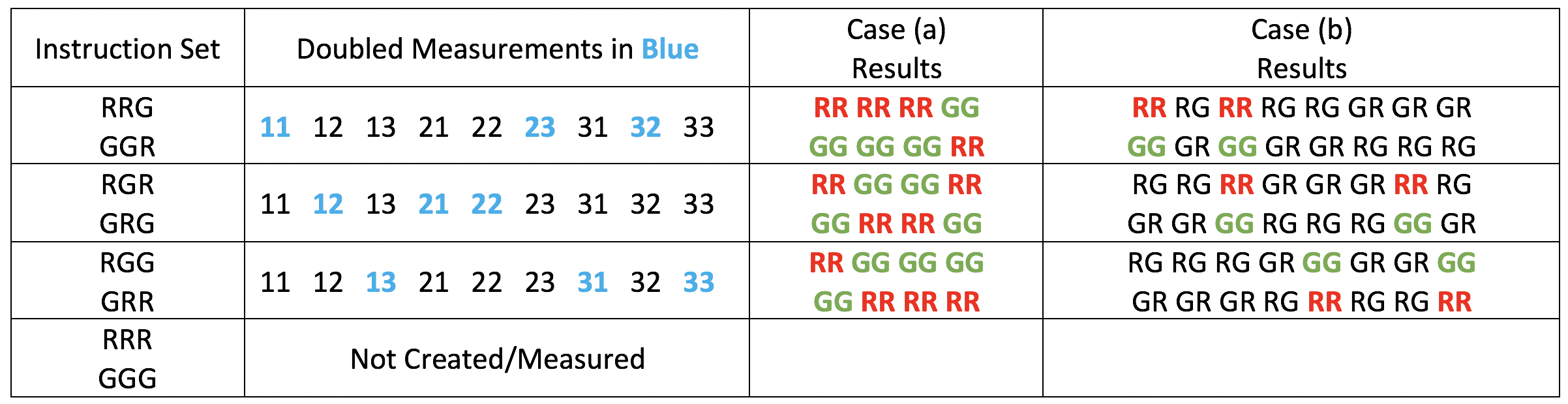
In row 2 column 2 of Table 1, you can see that Alice and Bob select (by whatever means) setting pairs 23 and 32 with twice the frequency of 21, 12, 31, and 13 in those case (b) trials where the source emits particles with the instruction set RRG or GGR (produced with equal frequency). Column 4 then shows that this disparity in the frequency of detector setting pairs would indeed allow our instruction sets to satisfy Fact 2. However, the detector setting pairs would not occur with equal frequency overall in the experiment and this would certainly raise red flags for Alice and Bob. Therefore, we introduce a similar disparity in the frequency of the detector setting pair measurements for RGR/GRG (12 and 21 frequencies doubled, row 3) and RGG/GRR (13 and 31 frequencies doubled, row 4), so that they also satisfy Fact 2 (column 4). Now, if these six instruction sets are produced with equal frequency, then the six case (b) detector setting pairs will occur with equal frequency overall. In order to have an equal frequency of occurrence for all nine detector setting pairs, let detector setting pair 11 occur with twice the frequency of 22 and 33 for RRG/GGR (row 2), detector setting pair 22 occur with twice the frequency of 11 and 33 for RGR/GRG (row 3), and detector setting pair 33 occur with twice the frequency of 22 and 11 for RGG/GRR (row 4). Then, we will have accounted for quantum-mechanical Facts 1 (column 3) and 2 (column 4) of the Mermin device using instruction sets with all nine detector setting pairs occurring with equal frequency overall.
Since the instruction set (hidden variable values of the particles) in each trial of the experiment cannot be known by Alice and Bob, they do not suspect any violation of Statistical Independence. That is, they faithfully reproduced the same QM state in each trial of the experiment and made their individual measurements randomly and independently, so that measurement outcomes for each detector setting pair represent roughly ##\frac{1}{9}## of all the data. Indeed, Alice and Bob would say their experiment obeyed Statistical Independence, i.e., there is no (visible) correlation between what the source produced in each trial and how Alice and Bob chose to make their measurement in each trial.
Here is a recent (2020) argument against such violations of Statistical Independence by Eddy Chen. And, here is a recent (2020) argument that superdeterminism is “fine-tuned” by Indrajit Sen and Antony Valentini. So, the idea is contested in the foundations community. In response, Hance, Sabine, and Palmer recently (2022) proposed a different version of superdeterminism here. Thinking dynamically (which they don’t — more on that later), one could say the previous version of superdeterminism has the instruction sets controlling Alice and Bob’s measurement choices (Table 1). The new version (called “supermeasured theory”) has Alice and Bob’s measurement choices controlling the instruction sets. That is, each instruction set is only measured in one of the nine measurement pairs (Table 2). Indeed, there are 72 instruction sets for the 72 trials of the experiment shown in Table 2. That removes the complaint about superdeterminism being “conspiratorial” or “fine-tuned” or “violating free will.”
Table 2
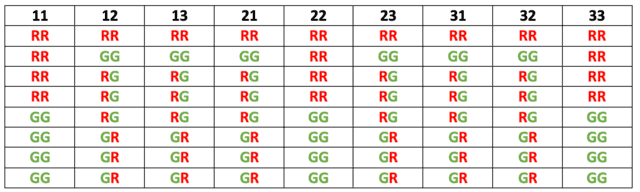
Again, that means you need information from the future controlling the instruction set sent from the source, if you’re thinking dynamically. However, Hance et al. do not think dynamically writing:
In the supermeasured models that we consider, the distribution of hidden variables is correlated with the detector settings at the time of measurement. The settings do not cause the distribution. We prefer to use find [sic] Adlam’s terms—that superdeterministic/supermeasured theories apply an “atemporal” or “all-at-once” constraint—more apt and more useful.
Indeed, they voice collectively the same sentiment about retrocausality that Sabine voiced alone in her quote above. They write:
In some parts of the literature, authors have tried to distinguish two types of theories which violate Bell-SI. Those which are superdetermined, and those which are retrocausal. The most naive form of this (e.g. [6]) seems to ignore the prior existence of the measurement settings, and confuses a correlation with a causation. More generally, we are not aware of an unambiguous definition of the term “retrocausal” and therefore do not want to use it.
In short, there does seem to be an emerging consensus between the camps calling themselves superdeterministic and retrocausal that the best way to view violations of Statistical Independence is in “all-at-once” fashion as in Geroch’s quote:
There is no dynamics within space-time itself: nothing ever moves therein; nothing happens; nothing changes. In particular, one does not think of particles as moving through space-time, or as following along their world-lines. Rather, particles are just in space-time, once and for all, and the world-line represents, all at once, the complete life history of the particle.
Regardless of the terminology, I would point out that Sabine is not merely offering an interpretation of QM, but she is proposing the existence of a more fundamental (deterministic) theory for which QM is a statistical approximation. In this paper, she even suggests “what type of experiment has the potential to reveal deviations from quantum mechanics.” Specifically:
This means concretely that one should make measurements on states prepared as identically as possible with devices as small and cool as possible in time-increments as small as possible.
According to this article in New Scientist (published in May 2021):
The good news is that Siddharth Ghosh at the University of Cambridge has just the sort of set-up that Hossenfelder needs. Ghosh operates nano-sensors that can detect the presence of electrically charged particles and capture information about how similar they are to each other, or whether their captured properties vary at random. He plans to start setting up the experiment in the coming months.
We’ll see what the experiments tell us.
PhD in general relativity (1987), researching foundations of physics since 1994. Coauthor of “Beyond the Dynamical Universe” (Oxford UP, 2018) and “Einstein’s Entanglement” (Oxford UP, 2024).








Leave a Reply
Want to join the discussion?Feel free to contribute!