Why the Observable Universe Radius Exceeds Its Age
The radius of the observable universe is about 46 billion light-years, which is considerably greater than its age of about 14 billion years. The radius of the observable universe is defined by the greatest distance from which light would have had time to reach us since the Big Bang, so you might think that it would lie at a distance of only 14 billion light-years, since x = ct for motion at a constant velocity c. However, a relation like x = ct is only valid in special relativity. When we write down such a relation, we imagine a Cartesian coordinate system (t, x, y, z), which in Newtonian mechanics would be associated with a particular observer’s frame of reference. In general relativity, the counterpart of this would be a Minkowski coordinate frame, but such frames only exist locally. It is not possible to make a single frame of reference that encompasses both our galaxy and a cosmologically distant galaxy. General relativity can describe cosmology using cosmological models, and this description is successful in matching observations to a high level of precision. In particular, no objects are observed whose apparent ages are inconsistent with their distances from us.
This is unrelated to cosmic inflation. Inflation makes certain testable predictions about cosmological observations (for example, it predicts that the universe is spatially flat), but it is irrelevant for understanding why the radius of the observable universe has the size it does compared with the age of the universe. Inflation may not even be correct; if it turned out never to have happened, that would not affect this particular question.
The remainder of this FAQ, split into nonmathematical and mathematical versions, gives a more detailed explanation of how all of this works.
Table of Contents
Nonmathematical description
Intuitive picture
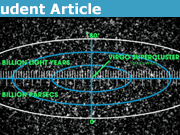
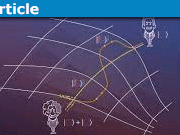
For readers who prefer a verbal explanation, a helpful way to think about the difference between special relativity’s x = ct and the actual distance–time relationship is to imagine that the space between galaxies is expanding. In this picture, as a ray of light travels from galaxy A to galaxy B, extra space is being created between A and B, so by the time the light arrives the proper distance between them can be greater than ct. A detailed popular presentation with illustrations is given by Lineweaver (2005).
Limitations of the popular picture
Popularizations like Lineweaver’s are useful but can encourage overly literal interpretations. Two common oversimplifications are:
- Presenting kinematic Doppler shifts and cosmological redshifts as if they were fundamentally different phenomena rather than two descriptions of the same underlying mathematics (see Baez 1994).
- Implying that the relative velocity of cosmologically distant objects is uniquely well-defined in general relativity; in fact, such relative velocities are coordinate-dependent and not uniquely defined for very distant objects.
Mathematical description
FRW approximation
A surprisingly good estimate of the size of the observable universe can be obtained using a simplified Friedmann–Robertson–Walker (FRW) cosmological model consisting only of pressureless matter (“dust”). This approximation works because the universe spent most of its history in a matter-dominated phase, with only a brief early radiation-dominated era and a relatively recent era dominated by the cosmological constant. Current observational data also justify the approximation that the universe is spatially flat.
Photon travel and proper distance
In a spatially flat FRW model, the radial–time part of the metric can be written as ds^2 = dt^2 - a^2 dr^2, where the scale factor a depends on time. For a photon, ds = 0, so the emitting and detecting galaxies have r coordinates that differ by
∫ dr = ∫ dt / a,
with the limits of integration taken from shortly after the Big Bang until the time of detection. The galaxies themselves remain at fixed r coordinates, so at the time when the photon is detected, the proper distance between them is
L = a ∫ dr = a ∫ (dt / a).
This proper distance is the distance that would be measured at time t by laying down a chain of rulers, each at rest with respect to the Hubble flow. For a matter-dominated solution where a ∝ t^(2/3), the integral gives L = 3 t. That is close to the value of about 3.3t found in more realistic models that include radiation and a late-time cosmological constant; the slightly larger factor reflects the universe’s recent accelerated expansion.
Sources
Contributors
- bcrowell
- George Jones
- jim mcnamara
- marcus
- PAllen
- tiny-tim
- vela
This article was authored by several Physics Forums members with PhDs in physics or mathematics.