
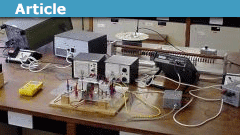
Revamping Undergraduate Introductory Physics Laboratory
This is a compilation of my blog entry on this singular “project” to change the way we conduct the introductory physics laboratory in most US universities. I think we are missing a tremendous opportunity to educate a general audience on how we acquire and learn something in physics, and how we analyze something that we don’t quite understand. To me, the ability to have such skills is extremely important, and transcends beyond just physics but into our everyday lives, since we have to make decisions all the time based on what we believe to be true.
Needless to say, this is an ongoing project. This document will be updated as more of my thoughts are put down into words.
Table of Contents
Part 1
I used to hate doing the lab in First-Year college intro physics classes. It would be 2 hours of torture, and at that time, I didn’t see the point. Unless things have changed, most students taking such classes would tend to feel the same way as I did. And I think this is a waste of opportunity to get through to the students THE most important aspect of science, and physics in particular – the empirical testing of physical concepts, and how we arrive at our knowledge to accept something as valid. This is what separates science from pseudosciences (and even religion).
The problem here starts from the very beginning. When I was a freshman undergraduate, no instructor ever spent time explaining why the laboratory sessions are important, and why we must DO things, rather than just read or watch what is being done. No one was explaining to me the fact that the SKILLS that I could get out of the physics lab may turn out to be a rather important aspect of my education that transcends beyond just physics, but into other parts of my life. This means that it doesn’t matter if you’re a physics major or not, the physics labs can be quite beneficial as one progresses in one’s education, career, and life. I strongly believe students should be made aware of this in no uncertain terms. The physics instructors must impress upon the students why doing these laboratory experiments is important, what kind of skills are being practiced, and why this is different than just sitting and reading. I would think that the students would at least become aware that there is a rational reason for forcing them to do such a thing, rather than just being told that they need to do this for no valid reason.
When I was a lab TA years ago, I tried doing just the very thing. More than 3/4 of my students at that time were not physics majors, and I flat out told them that in the lab sessions, it was more important to pay attention to what they were doing, and report what they were doing, rather than the final “answer” or results that they were trying to measure. I was more interested in what they were thinking as they were experimenting, reporting accurately their observations, and if the results looked weird, to notice that they did look weird rather than just reporting the number and not realizing something was not quite right. In other words, I was more interested in doing the experiments themselves rather than testing if the students understood the physics theory or idea that was being tested. I was more interested that the student acquired proper experimental skills. They can learn more effectively about the theory and principles in class. I wanted the lab session to be more “hands-on” on how to think and conduct an experiment to measure something.
So already my philosophy of what an intro physics lab session should be was different than what I encountered during my undergraduate years. And after being in this profession for many years, and being an experimentalist, I am even more convinced that this is what such lab sessions should be.
Part 2
So what is the main purpose of the intro physics laboratory?
Keep in mind that MOST students in such courses are NOT physics majors. In fact, for many, these are the only physics courses they’ll ever take. So I see it as the best opportunity to introduce to the students how physics works. How exactly do we consider something to be valid in physics? After all, anyone and everyone can come up with some “theory” to describe something (and in the age of the internet, everyone does!). How do we select which ones are valid and which ones aren’t? It all comes down to experimental verification. How we know something to be valid comes from our empirical observations. Therefore, proper experimental techniques must be crucial since they can determine what is valid and what isn’t. This is where the acquired skills come in.
When I say “skills”, I don’t just mean physical skills, such as the efficient way of using an oscilloscope, or one’s agility in soldering a piece of wire. It also includes mental skill, which is the ability to think through a problem or a nagging feeling that something isn’t quite right. It also includes the ability to know what is the best and most accurate way of doing something. For example, why can’t a student simply make one measurement of the restoring force of a spring, make the corresponding measurement of the spring extension, and then plug those values into Hooke’s law equation to find the spring constant? Why do we have to make a series of measurements instead? The ability to know why we need to do that is an acquired skill in the proper technique to test a particular relationship of two different variables. One acquires such skill after consciously and repeatedly learning ways to make such tests. However, the students need to be told that these are the skills they are being taught so that they are consciously aware of what they are doing and why. So often, in the usual physics labs, this awareness is lacking and not being emphasized.
What the labs can do is reveal in a very direct way how we gain and verify knowledge. What exactly is the relationship between variables x and y, and how do I test it? How do I know my result is valid? In the end, without one having to tell them point-blank, they learn the difference between “scientific evidence” versus other forms of evidence, and they get a glimpse of some form of what people like to call “the scientific method”. Considering that most of them will go on to do other things in life beyond just doing physics (or even science), I would think that this ability to have them understand what is involved in determining what is valid is something extremely valuable. This lack of understanding can easily be the cause of why people accept pseudoscience and other flaky ideas. That is why I consider these physics labs as extremely important not just in physics, but as part of the general education of the population.
Since I’ve already mentioned what is wrong with the current way of doing intro physics labs, I should put my money where my mouth is. What exactly should we do in such courses? In the next part, I will give an explicit suggestion on how to revamp these lab sessions.
Part 3
To me, the biggest problem with the current structure of the intro physics lab is that we give students a list of things they have to do and measure and hand-hold them to get the result. In other words, they don’t have to think too much to complete the exercise. They may have to do a bit of thinking and understanding of physics to complete the write-up, but the actual part of experimenting requires simply the ability to follow instructions.
I believe that we should have a more open-ended experiment to be given to the students. So I’ll give an example. Note that while the thing is something that I’ve thought about for a while, I’m still writing this off the top of my head. So there may be other problems with it that I haven’t carefully considered.
Give them a problem to solve such as something like this:
Construct a pendulum clock. To make this clock useful, it would be helpful if the pendulum could swing back and forth once as close to 1 second as possible. Then each complete oscillation will take just one second. That way, this clock measures time in increments of one second. You may use a stopwatch to calibrate your pendulum to verify that it makes a one-second swing. Try to build this as accurately as possible. You must describe in detail in your lab report how you accomplished this task and why you chose to do it this way.
Now, as apparatus, give them a length of string, a set of weights, and a stopwatch, plus other necessary items for them to be able to mount the pendulum on something.
Here’s what I expect to occur. You’ll have some students doing this by trial and error. They’ll mount a length of string, and then start changing the weights to change the period of oscillation. Of course, there’s no guarantee here that there is JUST the right weight for that length of the pendulum to produce 1 second of oscillation. So students doing it this way may face a problem, but that’s OK because in the end when we discuss on to do such a thing, they’ll discover why their technique isn’t the best way.
You’ll also get a bunch of students who would use a fixed weight but try to vary the pendulum’s length. Again, they may try this simply by trial-and-error, adjusting it a little bit at a time until the period is close to a 1-second interval. This technique is, of course, more “refined” than the earlier one, since there’s a high possibility of getting the right period.
Of course, what should be done, rather than simply doing a trial and error method, is simply to use a fixed weight, and then measure a set of periods corresponding to a set of pendulum lengths. Using the table, one can plot period versus lengths, and from there, interpolate (or extrapolate, depending on the range of lengths that were used) the exact length to produce 1 second can be read off. So after the experiment is done and the students write their report, the lab instructor can start a discussion on the best possible technique to get the most accurate result. One can even make it a bit more complicated and ask the students how accurate is their clock as they let it swing for a length of time. This is where if they constructed a clock that swings over a large angle of oscillation, they may discover that it doesn’t keep time very well.
What this type of lab forces them to do is think about the relationship between two measured variables. The first group had to figure out how the period changed as they changed the weights. The second group is finding out the relationship between the period and the length of the pendulum. There may be a 3rd group that may be changing both the length and the weights simultaneously. If they do, and they’re doing this by trial and error, god help them! :) But no matter what, the students are forced to think of what to do, and why they’re doing it, to accomplish the task. They are not told how to do it. The experiment and the equipment given are familiar enough to them that this isn’t something out of the ordinary. When they were kids, they probably played with something like this. The curiosity about finding how to do things is the purpose of the lab exercise. It is playing, it is just that now, they have to think about what they are doing, why they are doing it, and how to present it in writing.
Next time, I’ll try to present another possible laboratory exercise along this line.
Part 3 – Follow-Up
OK, I got some very interesting responses to my suggestion of an experiment that can be done for an intro physics lab. I think I didn’t explain myself too clearly on the premise and how I’m going to present it here, so I should do that now.
While I tried to be explicit in describing the experiment and what would be a good way to do it, I didn’t want to reveal the whole hand. That’s why I went along with the idea that there could be a dependence of the period with varying weights because that is a very likely path that the students might attempt. If someone is thinking of actually trying to introduce this experiment in an intro lab, I don’t want the possibility that some student might google it and find my blog where the whole thing has been revealed. :) That would defeat the purpose of them doing this without any kind of “previous knowledge”.
So while I’m trying to be as clear and complete as possible in the experimental description, and the “philosophy” behind it, I don’t want to reveal everything either. I’m hoping that there WILL be students who decide to figure out if they can do it by changing just the weights. I consider discovering something that cannot work to be very educational. In fact, in science, knowing what doesn’t work can be quite important (re Michaelson-Morley experiment). They at least now know that changing the weights would not work. If they are curious enough, they’ll try to find out WHY it doesn’t work, and this is where physics can be introduced.
Note that the experiment that I suggested does NOT require that they have learned anything in intro physics. It is quite independent of the lesson they might have received in class. So in principle, this experiment could be done even during the first week of class. It doesn’t require that they had learned about the simple pendulum.
Part 4
Continuing with this series, here’s another experiment that I would propose. This would still be something that can easily be done at the beginning of the semester, which means it doesn’t require that the students have already learned any physics related to it. BTW, in case people think that all the experiments that I’m going to propose are this “simple”, that is not going to be the case. These “no physics” experiments are aimed only at the beginning of the semester where we want to introduce to the students that physics is nothing more than a systematic way of deriving what is valid and how to figure out a way to understand the relationship between things. It reinforces the idea that one doesn’t need to abandon all that we already know to understand physics. We need to bring in our “common sense” and the sense of “play” to do physics, or at least, these physics experiments. As the semester progresses and, presumably, the students’ understanding gets more sophisticated, the experiments should also evolve the same way.
OK, for this experiment, we will deal with springs and masses, so again, it shouldn’t be something difficult. The task this time is simple:
You will be given a “mystery” object in which you need to determine its mass. You are given a set of springs and a set of calibrated masses. In addition, you will also have access to a ruler and a stopwatch if you need them. Figure out how you can determine, as accurately as possible, the mass of this mystery object. You must describe explicitly how you go about making this determination.
Now, of course, in many intro physics classes, this type of experiment typically requires that they find the spring constant by looking at the extension versus force or mass applied to the spring. I’m going about this the other way. Forget about the spring constant for now. The key thing here is that the student learns about the relationship between the spring extension as different masses are added to the spring. This to me would be the most obvious technique that most of the students would do. They would find the extension of the spring with different masses. Then, when given a mystery mass, they may have to do some interpolation or extrapolation to estimate the mass of that object.
Now, there’s also a possibility that some students may do this differently. They could, instead, let each of the known masses oscillate one at a time and find the relationship between the mass and the period of oscillation. They won’t end up with a straight line, but as in the previously suggested experiment, this is OK. While we tell them they need to do this as accurately as possible, in the end, we don’t care as long as they explain what they did and how they did it. So even if they had to extrapolate/interpolate by hand, this is perfectly fine.
Now, what we can do further is this. For the students who did the first method (hanging the mass and finding the spring extension), we can ask them this:
Now, often it is difficult to get the spring to be very still – the mass tends to oscillate up and down. So maybe it might also be a good idea to see if we can make use of this property to see if there’s an additional relationship here between the mass on the spring and the period of oscillation. Can you determine the mass of the mystery object this way? Does it give the same answer? It is always more convincing when two different methods give consistent answers.
For those who did the second method (oscillating the mass and finding the period), you then say:
Oscillating the spring doesn’t allow you to read off the mass very quickly, which is something you need quite often. So is there another way to determine the mass quickly? How about looking at how much the spring extends as you hang different masses? Can this lead you to a different way to measure the mystery mass? Does this value agree with the one you got earlier? It is always more convincing when two different methods give consistent answers.
.. and voila, you’ve gotten them to do this in both ways! They also learn that in science, it is always more convincing when you can show a consistent result from two different techniques (although to be technically accurate, these are not two different techniques, this is a good enough demonstration at this level). Now the fun starts if they come up with very different answers. This is where they need to figure out (with the help of an instructor) what went wrong. To me, figuring out what went wrong is as important as what went right.
After the students have done both, you then can pose an additional question such as this:
What you have now is a graph that you always need to use whenever you want to determine a mass. Is there a way to know the mass of something without having to resort to using such a graph? Can we figure out a way in which, if we know how much the spring extends, we can simply punch that number in and out comes the mass?
I think you know where I’m going with this, don’t you? Considering that the students should have a background in sufficient mathematics, they would have seen a straight-line equation. If not, a bit of help and hand-holding is called for, which, at this point, should be right.
So in essence, we have done the mass-spring experiment but done it differently. Rather than giving out the necessary steps that the students have to do, we instead “coerced” them into doing them with a series of questions and tasks that we want them to accomplish by themselves. Inadvertently, they “discover” Hooke’s Law by themselves.
Part 5
I read this post in PhysicsForums and immediately realized that this is an excellent laboratory experiment and a perfect one to follow what I’ve described in Part 4. This was done as part of a test, but I can see this as being quite suitable for an intro undergraduate lab, especially after they had just done Springs and Hooke’s law.
Again, this gives them a task, rather than an explicit set of instructions on what to do. They will need to know about the elastic spring extension and also simple, basic mechanics. So this may not be that suitable to be done at the very beginning of the course, but maybe after a couple of weeks or so to make sure the students have been introduced to simple 1D kinematics. But the fact that this student could have done it, and done it well, indicates that this is certainly doable.
BTW, do most “elastic bands” obey Hooke’s law rather well? I remember testing a typical rubber band one time, and it deviated from linearity rather easily. It would be a cruel thing to do to give the students such elastic bands! :)
Part 6
This may be a bit misleading because it is not strictly a “laboratory exercise”. I think it might be more suitable to be presented during class. Still, it involves the students doing something, that fits in with the spirit of a laboratory.
This exercise has 2 parts to it. The first is in class where the students are asked to think about a situation and write down what they think should occur. Then, they get to go out and test it themselves and observe the situation. They then come back and write down what they observe, and compare it to what they wrote earlier of what they THINK should occur. Finally, they get to explain their observations, especially if what they wrote earlier is different than what occurred.
So what is the exercise? Here goes…
You are in a stationary vehicle (a train, bus, or a large vehicle). You have a helium balloon attached at the end of a length of string, so the balloon floats freely (without being confined or rubbing against other objects), while you hold the other end of the string. The vehicle then accelerates forward. What happens to the balloon?
The whole point here is to see the effect of the acceleration in a vehicle (on Earth) on an object that is less dense than air. You first give this in a class (or a lab) towards the end of the session, and then ask the students to write down what they think they will observe. They don’t have to give you any reason, just what they expect to happen.
Then, give them some way to get a helium balloon. This shouldn’t be too expensive, should it? Maybe they can get on a train to go downtown, let’s say, with a group of their friends. That would be a great way to observe the balloon. Advise them that maybe it would be a good idea to write down there and then some notes on what they observe, and any relevant circumstances surrounding the observation (i.e. was the train packed? Did the balloon float freely? Were the windows open? Was the air conditioning blasting right at them? etc.) Then when they come back, they need to write down exactly what they observed and compare that to what they wrote earlier before they did the “experiment”.
I would then suggest that everyone discuss what they have done. Who predicted an observation that is consistent with what they observed? Who didn’t see what they thought would happen? Why?
Now, it would be OK to tell the students before they did this that they need to make sure that there is no significant moving air because that would ruin any effects of the acceleration. But I’m even tempted not to say that. This is because if there are students who did not consider this effect, then there could easily be a discussion on the nature of the ‘experiment’, and why the result that these students get doesn’t quite tell you the effects of the acceleration. The “observation” isn’t valid as far as finding the effect of the acceleration in a vehicle on the balloon because other external factors have intruded into the observation. If these students acknowledged this extra factor, then they have been observant and understand the non-validity of their observation. If the students did not realize this, then hopefully, other students will point it out during the discussion.
I’m hoping that during the discussion session is where the students start “arguing” about the validity of each other’s observations, such as the possibility that the wind or other factors might affect some other’s observations. I’m also hoping that they might try to come up with some physics on what exactly is the most valid observation for a balloon in an accelerating vehicle that isn’t affected by any other external factors. As the instructor, I would suggest you simply stay out of the way and see how the students are thinking and reasoning their way through this. You can certainly offer some guidance, but the “thinking process” may take a while, especially if there are many students who observe things differently from each other. They need to weed out which observation is “faulty” as far as answering the question at hand. Once they figured out the valid observation, then they need to figure out why it happened that way. It is the students that need to make their self-discovery.
BTW, the valid observation, in this case, is that the balloon will tilt FORWARD, in the direction of the motion of the vehicle. This is, at first, counter-intuitive, because when a vehicle accelerates, objects tend to get pushed back in the opposite direction of motion. So the first inclination is to expect the balloon to tilt backward. However, a floating balloon is less dense than the air surrounding it. So when the vehicle accelerates, the air surrounding the balloon gets pushed to the back of the vehicle more than the balloon thus displacing the balloon forward.
Strangely enough, its observation shouldn’t be THAT unusual, because there’s an identical situation to this that we are quite familiar with. If we apply Einstein’s equivalence of gravity to acceleration, then technically, we are accelerating “upwards” at 9.8 m/s^2. Now try letting go of a helium balloon. It floats UP, in the direction of our “motion”. It’s the same effect we see in the accelerating vehicle. Yet, I’m sure, for many people, the observation of the balloon tilting forward is non-intuitive. If you are lucky enough to have students who argue using this point, then you have one heck of a student! I consider the ability to see the similarities of something “new” with something that they are familiar with as a major accomplishment. It is how we can describe many things that appear to be “different”, yet share almost the same type of description or phenomena. I would suggest that if no students realize this, that you bring it up at the end of the discussion.
Part 7
This time, we do simple optics. Again, as a reminder of the whole point of this series is that the students should be given the ability to simply EXPLORE these things on their own (with minimal guidance), and come up with some sort of relationship between two different parameters, all based on the physics which they may or may not have learned. Each of these experiments does not require that they have encountered the corresponding material in class. So there is no “theory” to “prove” or to verify here. It is pure “play”.
Part A
In this part, there is a lighted object, which will be the source, placed “far away”. The students are given several convex lenses (with different focal lengths) and some paper as their screens. The object here (no pun intended) is to figure out how to get a focused image of the object onto the screen, without moving any closer to the object itself. The student can certainly vary the location of the screen and, to some extent, the lens itself. Ask them to record the position of the screen concerning the lens when they find a focused image. Ask them to try it with the different lenses that they were given.
Part B
Now ask them to start moving closer to the lighted object and see where they get a focused image on the screen using one of the lenses of their choosing. This time, they should record both the distance between the lens and the image and the distance between the lens and the object. Ask them to do this several times, each time getting closer to the object.
If they have the time or wish to explore some more, let them try this with a different lens.
Analysis
- Now, you tell them that they should put these numbers in a table, or a chart, or a graph, etc… anything that might be useful for them to figure out if there is any systematic relationship between (i) the distance between the lens and the screen where the focused image is formed, and (ii) the distance between the lens and the object. Ask them if they can think of how these two parameters are related. Note that we don’t expect them to be able to know the thin lens equation, so, we should not expect them to be able to arrive at such a relationship. However, they should be able to notice that as they move closer to the object (thus, the object distance is getting smaller), the focused image will be further away from the lens.
- You tell them the focal lengths of the lenses that they used. Ask the students to think about how this number (which is a length) relates to all the data that they had collected. If the student is observant enough, he/she will notice that this number corresponds to the distance of the focused image when the object is “far away”, i.e. while they did Part 1 of the experiment. If the student notices this, then ask him/her what she would do if he/she is given a lens with an unknown focal length, and needs to make a quick determination, rough of the focal length.
- When the students finally got introduced to the thin lens equation, ask them to re-analyze the data, plot a graph, and use the data to extract the value of the focal length of the lenses. This would be a more accurate determination of the focal length.
Again, these experiments, the way they are designed, do not require any sophisticated knowledge of the accompanying theory. In fact, for this particular experiment, anyone off the street will be able to do it. It simply requires a bit of thinking and common sense to try and figure out the pattern in the observation and the data. The students may not be able to come up with the exact relationship between the parameters, but they need to notice the pattern of what happens to one and you vary the other.
PhD Physics
Accelerator physics, photocathodes, field-enhancement. tunneling spectroscopy, superconductivity





Leave a Reply
Want to join the discussion?Feel free to contribute!