
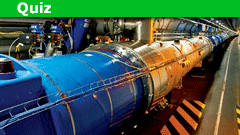
Large Hadron Collider Quiz: Test Your CERN Knowledge
The Large Hadron Collider (LHC) is the world’s largest particle accelerator, built by CERN beneath the France-Switzerland border near Geneva. It began operating on 10 September 2008 and is best known for providing experimental evidence of the Higgs boson in 2012. This quiz covers its history, function, safety record, and upcoming upgrades.
- The LHC officially started up on 10 September 2008, after construction began in 1998.
- CERN’s LHC provided experimental evidence for the Higgs boson in 2012, a particle linked to how other particles acquire mass.
- The High Luminosity LHC upgrade is expected to become operational around 2027.
- Particle beams inside the LHC collide at four points around the accelerator ring.
- CERN offers guided public tours that include visits to parts of the LHC facility.
Please share your results after taking the quiz below.

Ready for your next quiz? Try How well do you know about the Periodic Table of Elements?
Table of Contents
What Is the Large Hadron Collider (LHC)?
The Large Hadron Collider (LHC) is the world’s largest and most powerful particle accelerator. It was built by the European Organization for Nuclear Research (CERN) and lies beneath the France-Switzerland border near Geneva. The LHC’s main function is to collide particles at close to the speed of light to study fundamental physics, the basic forces of nature, and the properties of subatomic particles.
When Was the Large Hadron Collider Built?
Construction of the LHC began in 1998, and it was officially started up on 10 September 2008. It was one of the most ambitious and complex experimental facilities ever built, involving thousands of scientists and engineers from around the world.
How Does the Large Hadron Collider Work?
The LHC accelerates two high-energy particle beams, usually protons, in opposite directions around a circular tunnel. These beams are guided by a strong magnetic field and collided at four points around the LHC ring. The collisions create a range of unusual and short-lived particles, allowing physicists to study the basic constituents of matter.
What Are the Main Goals of the LHC?
The main goals of the LHC include understanding the basic laws governing the interactions and forces among particles, exploring the fundamental structure of matter, and searching for unknown particles, such as the Higgs boson, which was discovered in 2012. It also aims to study matter under extreme conditions, similar to those just after the Big Bang.
What Was the Higgs Boson Discovery?
In 2012, the LHC provided experimental evidence for the existence of the Higgs boson, a fundamental particle associated with the Higgs field, which is thought to give mass to other particles. This discovery was a significant breakthrough in understanding the origin of mass in the universe.
Is the Large Hadron Collider Safe?
Yes, the LHC is safe. Concerns have been raised about the potential for creating dangerous phenomena such as microscopic black holes, but extensive studies have shown that collisions in the LHC pose no threat. Any black holes that could theoretically be produced would be extremely small and short-lived.
What Are the Future Plans for the LHC?
The LHC is currently undergoing upgrades to increase its luminosity, known as the High Luminosity LHC project. This upgrade, expected to be operational around 2027, will allow it to collect more data and provide more opportunities to understand the fundamental physics of the universe.
Can the Public Visit the Large Hadron Collider?
Yes, CERN offers guided tours for the public, which include visits to various parts of the LHC. These tours provide an opportunity to learn more about particle physics, the experiments conducted at CERN, and the LHC itself.
Frequently Asked Questions
Where is the Large Hadron Collider located?
The LHC is located beneath the France-Switzerland border near Geneva, built and operated by the European Organization for Nuclear Research (CERN). The accelerator ring runs through an underground tunnel that crosses the international border.
When did the LHC start operating?
The LHC officially started up on 10 September 2008, following construction that began in 1998. It remains one of the most complex experimental facilities ever built, involving thousands of scientists and engineers worldwide.
What is the Higgs boson and why does it matter?
The Higgs boson is a fundamental particle associated with the Higgs field, which is thought to give mass to other particles. The LHC provided experimental evidence for its existence in 2012, a discovery considered a major breakthrough in understanding the origin of mass in the universe.
Could the LHC create a dangerous black hole?
Extensive studies have shown that collisions in the LHC pose no threat, despite concerns raised about the potential for microscopic black holes. Any black holes theoretically produced would be extremely small and short-lived.
What upgrade is planned for the LHC?
CERN is currently working on the High Luminosity LHC project, an upgrade expected to become operational around 2027. The upgrade aims to increase luminosity so the accelerator can collect more data and expand opportunities for studying fundamental physics.
Can members of the public visit the LHC?
Yes, CERN offers guided tours for the public that include visits to various parts of the LHC. These tours provide an opportunity to learn about particle physics, the experiments conducted at CERN, and the accelerator itself.

I have a BS in Information Sciences from UW-Milwaukee. I’ve helped manage Physics Forums for over 22 years. I enjoy learning and discussing new scientific developments. STEM communication and policy are big interests as well. Currently a Sr. SEO Specialist at Shopify and writer at importsem.com








“6/13 Just passed! Phew! :oldtongue:”
I think PF is a blessed place to have a member like you. Yes, so good! :nb)
6/13 Just passed! Phew! :oldtongue:
8/13 is too many to me.:wideeyed:
Nice try ;)
my score is 8 out of 13
6, (At least I was mostly right about some technical aspects of the various experiments and what they are.)
You are right – the tunnel was started much earlier. That’s another bad question. However, it is possible to start building magnets before the LEP tunnel was emptied.
5/13
“That is fully loaded, your brain should contain a large volume of LHC knowledge.”
Not particularly — it’s just I seem to have a pretty good recall of what I’ve read about the LHC recently.
“11/13 — I guess I didn’t too badly at all! :)”
That is fully loaded, your brain should contain a large volume of LHC knowledge.
11/13 — I guess I didn’t too badly at all! :)
3/13
I decided not to take the test when I saw the first question and I realized it was a good decision when I continued reading other questions!
“I got most material from the CERN website or the LHC wiki entry.”
Nevertheless, the first papers were based on data obtained at 900 GeV.
7/13 yikes.
“I don’t think I agree with #2 – the first papers were based on data obtained at 900 GeV.”
I got most material from the CERN website or the LHC wiki entry.
5/13
I had no clue on any quetion and guessed every single one, so that says something about multiple choice tests.
5/13
Failed..:oldfrown:
I don’t think I agree with #2 – the first papers were based on data obtained at 900 GeV.
“11/13, but several somewhat lucky guesses.”
Nice work! Some of the numbers can be tricky.
I got 13/13Unbeatable
Construction started in 1998? But LEP was still down there :/
6/13, mostly guessing. I divided 300,000 by 27 to get 11,000 times a second (close to light speed) and of course the picture looks like a "compact" muon solenoid…
11/13, but several somewhat lucky guesses.
Please share your results