

LHC Part 2: Commissioning
Table of Contents
View All Parts
- Part 1: LHC about to restart – some FAQs
- Part 2: Commissioning
- Part 3: Protons as Large as a Barn
- Part 4: Searching for New Particles and Decays
Introduction
Last month, I wrote a FAQ about working at the LHC, at the time the first beams were circulating in the machine after a stop of two years. We did not have collisions yet, and data taking won’t happen before June. So what is taking so long?
A lot of maintenance work was done during the last two years – many things got repaired, upgraded, replaced, …
It is not a completely new machine, but it still needs a lot of work to understand it well enough for collisions.
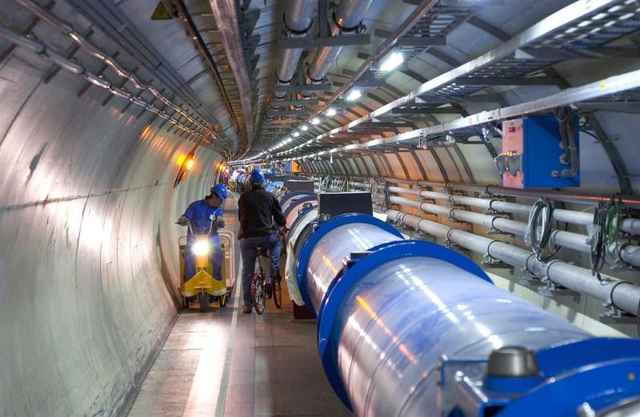
One of the most important steps is finding a so-called “reference orbit“. This includes machine parameters where the beam can travel through the ring reliably without bumping into anything. Both beam pipes are rings about 27 kilometers long and have a diameter of just a few centimeters – at some points the diameter is below 2 cm. Every particle that hits the wall is lost. Even worse, its collision with the wall produces other particles that fly through the machine, leading to heat and radiation damage. The particles have to stay in the vacuum inside, and get deflected by magnets just in the right way to stay in the ring.
You also have to control the position along the ring: acceleration is done with oscillating electromagnetic fields. If the particles come at the wrong time, they are slowed down and not accelerated.
There are tens of thousands of components that have to work together in a machine the size of a small town.
Another important part is safety. At full power, the energy in the beams is sufficient to melt hundreds of kilograms of metal. There are special beam dumps (one for each beam) designed to handle this energy. You certainly do not want the beams to hit anything else! At many places along the ring, there are radiation detectors: if the beams deviate from their optimal position too much, a few protons hit the wall and the produced radiation gets detected. The beams are then dumped within 3 revolutions of the particles in the ring.
Most tests so far were done with bunches of 10 billion protons each – just 1/10 the nominal value to reduce the possible damage if something goes wrong. On Saturday, the first bunches with the full number of protons were accelerated.
UFOs in the LHC
Yes, they are real! In 2010, it was noted that occasionally small particles fell through the beam pipe and into the beam. As the origin was unclear, they were called “unidentified falling object” – UFO. They are probably dust particles. If they hit the beam, they produce collisions outside the detectors. This looks like a beam hitting the wall, so large UFOs trigger a beam dump. If they are too frequent, this is very problematic.
Recently, another obstacle for the beams was found. At one point of the ring, the bottom of the free volume of one beam pipe is higher than expected. This has been called “unidentified lying object” (ULO) as it looks like something lying around. The remaining free space might be sufficient to get the beam through, but more checks are needed. It would be possible to open the machine. That would involve heating up the whole area including the superconducting magnets, opening the machine, breaking the vacuum, removing whatever is there, sealing the beam pipe again, closing everything, cooling it down again. This could take weeks.
Another issue was an electrical fault. At one point, there was an unplanned connection between an electrical line and ground. Same issue as with the ULO: a proper repair could have taken a long time. The machine operators studied it in detail and then decided to take a risk: send a large current through this connection to burn it away.
It worked, the incorrect connection disappeared.
What will be done with collisions?
Collision rates will be low initially and there are not many months planned for data-taking. The LHC experiments collected a huge amount of data in 2011 and 2012, and it is not expected that we can get more collisions in 2015 than in 2012. So what can we do?
Previous collisions had an energy of 8 TeV (roughly the kinetic energy of a fly in flight), in 2015 we will get collisions with an energy of 13 TeV – the most high-energetic collisions ever studied in an accelerator. The total collision rate will be an interesting measurement on its own, together with the production rate of various particles (“cross-section”) which depends on collision energy. The higher energy also allows to look for very heavy particles that could not get produced in 2011/2012, and it increases the frequency of other interesting particles. Finally, it is possible to combine results from 2015 with results from 2011/2012 to increase the precision. This will be done mainly for studies of the Higgs boson and other key studies.
Resources

Working on a PhD for one of the LHC experiments. Particle physics is great, but I am interested in other parts of physics as well.







“At one point, there was an unplanned connection between an electrical line and ground. … The machine operators studied it in detail and then decided to take a risk: send a large current through this connection to burn it away.”
To the LHC Machine Operators: Hope you guys are getting paid well. :bow:
It’s not just lead, it’s Pb-208. This is a spherical nucleus, which is helpful in analysis, and it happens to be the only isotope that the CERN ion source can inject into the LHC. The LHC itself can handle pretty much any ion, but to get the ion into the LHC would require some reworking of the source first.
It is the heaviest stable element and it has a high gas pressure when heated (which makes it easier to collect a nice group of ions closely together). Other experiments also used gold, uranium and a few other heavy elements. Uranium could be interesting as it is not spherical.
Proton-proton collisions can produce all known particle types (and hopefully some unknown types!), at the LHC many of them are more frequent than at every other accelerator. All those get studied – the Higgs of course, the top-quark, W and Z bosons of the weak interaction, heavy mesons and baryons with a bottom- or charm quark, together with studies of the strong interaction, the electromagnetic interaction, and so on. And searches for new particles, of course. At the end of 2015, the LHC will also collide lead nuclei with protons and lead nuclei with lead nuclei. The main focus there is on the strong interaction.
The experiments have lists of their publications:
[url=https://twiki.cern.ch/twiki/bin/view/ALICEpublic/ALICEPublicResults]ALICE[/url]
[url=https://twiki.cern.ch/twiki/bin/view/AtlasPublic]ATLAS[/url]
[url=https://twiki.cern.ch/twiki/bin/view/CMSPublic/PhysicsResults]CMS[/url]
[url=https://lhcb.web.cern.ch/lhcb/Physics-Results/LHCb-Physics-Results.html]LHCb[/url]
[size=2]And the smaller experiments:
[url=http://www.stelab.nagoya-u.ac.jp/LHCf/LHCf/Papers.html]LHCf[/url]
[url=http://totem.web.cern.ch/Totem/publ_new.html]TOTEM[/url][/size]
LEP in the same tunnel about 15 years ago needed more power: its beam lost ~20 MW to synchrotron radiation, and the dipole magnets to keep the beams on track were not superconducting.
The LHC accelerates protons with 2000 times the mass of electrons, that makes synchrotron radiation negligible.
The power needed to actually accelerate the protons is small: ~500 MJ over 20 minutes is just ~400 kW.
False alarms are an issue (they are a very common reason for dumps), but not reacting to all alarms could give an even larger problem.
“I hope no technician that has had a thyroid scan goes near the detectors. :)”During operating there is no one in the accelerator tunnels. And that would be orders of magnitude too low to trigger radiation monitors.
” That includes not just things like the radiation monitors going into alarm, but also things like the radiation monitors being turned off – if we go blind, even for a moment, the beam is dumped.”
How many distinct radiation monitors are there, any idea? I’m trying to get an idea if false alarms would become a serious problem? Are very low false positive detectors needed? I hope no technician that has had a thyroid scan goes near the detectors. :)
“How often has a beam been emergency dumped so far?”
About half of the store terminations are unscheduled. So “emergency” is maybe not the right word. Essentially, if anything looks even remotely wrong, the beam is dumped. That includes not just things like the radiation monitors going into alarm, but also things like the radiation monitors being turned off – if we go blind, even for a moment, the beam is dumped.
“How often has a beam been emergency dumped so far? Was it always the radiation detectors that triggered this?”Depends on the definition of “emergency”. Dumps due to safety issues in one of the systems are common. Sometimes (and especially during commissioning) the beams get dumped because they are not needed any more, or the machine has to be empty for the next test.
During regular data-taking, the beam gets dumped after ~10-15 hours of data-taking as the decreasing number of protons and beam quality make re-filling for a fresh run more attractive.
“What is the vacuum level during operation?”In the beam pipe: 10[sup]-8[/sup] to 10[sup]-9[/sup] Pa, or 13 to 14 orders of magnitude below atmospheric pressure, it depends on the position. There are other vacuum systems for insulation of the magnets and other parts.
The vacuum system is large and complex, see the [url=http://iopscience.iop.org/1748-0221/3/08/S08001/pdf/1748-0221_3_08_S08001.pdf]technical design report[/url] for details.
“what would stop the muons from entering the beam pipes while the experiment is ongoing? Wouldn’t they interact with the highly energetic protons?”
As mfb pointed out, this is a very low probability (and recognizable) event. The bigger problem is that you get a cosmic ray interaction on top of another event, and the two get confused. Many of the ATLAS and CMS papers spend a good deal of ink explaining how such events are rejected. Fortunately, both experiments have large samples of cosmic rays (some are being collected right now) so they know from data how such events register in the detectors.
There is no one close to the machine when it is operating, but I guess you would mainly hear the cooling systems (not so many fans, mainly liquid cooling). The beam itself does not make any sound.
Dumping it could induce some thermal stress in the beam dumps, no idea if that makes noise.
“Also, when operating does it eat a lot of power.?”About 150 MW, plus 20 MW for the experiments.
CERN does not operate a power plant, so they certainly have to coordinate that with the grid operators. Most of the power consumption is permanent or with long ramping times, however.
“The tube tunnel would be deadly place to be under operation right?”Not necessarily. If nothing goes wrong the radiation is higher than normal, but most places should not be deadly (assuming you don’t stay there for years). If something goes really wrong, in the worst case (which is very unlikely and never happened so far) it can kill you instantly.
“what would stop the muons from entering the beam pipes while the experiment is ongoing?”Nothing.
A single muon/proton collision is (a) incredibly rare and (b) negligible (just releases several TeV of energy).
At ground level, we have about 100 muons/(m[sup]2[/sup]s). There are up to ~5*10[sup]14[/sup] protons in the machine. With a cross-section of ~100mb (probably too high), we get 1.6*10[sup]-5[/sup] collisions per year. Even without the shielding from the material above, it is unlikely that a collision happens within the lifetime of the LHC.
If you replace the protons by the whole ATLAS detector, you get many interactions – enough to use them for initial alignment (measuring the relative orientations of the detector components) until collision events come up.
I have some question after reading that thing about UFOs (catchy name)…
If in the ATLAS detector you can measure some cosmic rays muon background, what would stop the muons from entering the beam pipes while the experiment is ongoing? Wouldn’t they interact with the highly energetic protons?
Large cylinders of graphite (7m long, 70cm diameter). Just shooting the beam into them would still melt them partially, so there are two additional tricks to spread the heat:
– the beam dump is at the end of a tunnel 750 meters long. That gives the beam some time to spread out.
– the beam gets extracted over a time of 100 microseconds (ring length divided by speed of light). During this time, deflection magnets change the direction of the beam, so different parts of the beam hit different parts of the graphite.
The whole beam dump is water-cooled and shielded with hundreds of tons of concrete and iron.
[url=https://lhc-machine-outreach.web.cern.ch/lhc-machine-outreach/components/beam-dump.htm]More details[/url]
Edit: didn’t see Envelope’s post, I was writing already.
“What are these special “special beam dumps” made of?”
The primary absorber itself is a set of steel-encased, water-cooled carbon slugs, each about two feet across. Additional concrete and iron shielding surrounds this. When the beam is dumped, it is swept across the face of the carbon so that the load is spread around.
Awesome first entry mfb!
Thanks for replying. Why are lead nuclei used in particular?
What kinds of interactions will they be looking for once data collection begins?
That’s a lot less power than I was expecting! About one large frame turbine’s worth? A big smelter probably isn’t much less than that. I guess it’s a great example of the hard-to-grasp relationship between scales of size and energy involved with looking way back and “down” into stuff. I had been intuitively picturing staggering amounts of power, but the 2 cm tube, and that relatively run-of-the-mill power consumption, has adjusted that a lot. Very interesting.
What is the vacuum level during operation? What size of vacuum production equipment is needed to maintain the high vacuum?
How often has a beam been emergency dumped so far? Was it always the radiation detectors that triggered this?
Very cool. Does it sound like anything when it’s at full tilt? Or is it just cooling fans and ominous silence? How about when it dumps a beam? Also, when operating, does it eat a lot of power? If so, is there a generation plant on-site, or do you have to coordinate with the wider distribution grid operator? The tube tunnel would be a deadly place to be under operation, right?
What are these special “special beam dumps” made of?