
Physics Forums Insights
  • Physics
    • Physics Articles
    • Physics Tutorials
    • Physics Guides
    • Physics FAQs
  • Math
    • Math Articles
    • Math Tutorials
    • Math Guides
    • Math FAQs
  • Bio/Chem/Tech
    • Bio/Chem Articles
    • Computer Science Tutorials
    • Technology Guides
  • Education
    • Education Articles
    • Education Guides
  • Interviews
  • Quizzes
  • Forums
  • Click to open the search input field Click to open the search input field Search
  • Menu Menu
Falling in Black Holes

Radial Infall into a Static Mass: Equations & Guide

September 4, 2018/0 Comments/in Physics Articles/by stevebd1
πŸ“–Read Time: 2 minutes
πŸ“ŠReadability: Accessible (Clear & approachable)
πŸ”–Core Topics: tex, drip, hail, object, mass

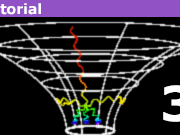
From Exploring Black Holes by John Wheeler and Edwin Taylor. The relations below apply to any object falling radially toward a static, spherically symmetric mass (assuming the mass of the infalling object is much smaller than the central mass).

Table of Contents

  • Types of radial infall
  • E/m (energy per unit mass)
    • Drip
    • Rain
    • Hail
  • E_shell/m (energy per unit mass relative to shell frame)
    • Drip
    • Rain
    • Hail
  • v_shell (velocity relative to shell frame)
    • Drip
    • Rain
    • Hail
  • Source
    • More Related Articles

Types of radial infall

  • Drip β€” dropped from rest at ro
  • Rain β€” dropped from rest at infinity
  • Hail β€” hurled inward at speed vfar from a great distance

E/m (energy per unit mass)

Drip

[tex]\left(1-\frac{2M}{r_o}\right)^{1/2}\ <\ 1[/tex]

Rain

[tex]\left(1-\frac{2M}{r}\right)\frac{dt}{d\tau}\ =\ 1[/tex]

Here dΟ„ is the proper time for an object in free fall from infinity; in this context dΟ„ = √(1-2M/r)·√(1-v^2/c^2) = (1-2M/r), since v = √(2M/r)Β·c for an object in free fall from infinity (see below).

Hail

[tex]\left(1-v_{far}^2\right)^{-1/2}\ >\ 1[/tex]

E_shell/m (energy per unit mass relative to shell frame)

Drip

[tex]\left(1-\frac{2M}{r_o}\right)^{1/2}\left(1-\frac{2M}{r}\right)^{-1/2}[/tex]

Rain

[tex]\left(1-\frac{2M}{r}\right)^{-1/2}[/tex]

Hail

[tex]\left(1-v_{far}^2\right)^{-1/2}\left(1-\frac{2M}{r}\right)^{-1/2}[/tex]

v_shell (velocity relative to shell frame)

Drip

[tex]\left(1-\frac{2M}{r_o}\right)^{-1/2}\left(\frac{2M}{r}-\frac{2M}{r_o}\right)^{1/2}[/tex]

Rain

[tex]\left(\frac{2M}{r}\right)^{1/2}[/tex]

Hail

[tex]\left[\frac{2M}{r}+v_{far}^2\left(1-\frac{2M}{r}\right)\right]^{1/2}[/tex]

Multiply by [itex](1-2M/r)[/itex] for the velocity of the infalling object as observed from infinity (dr/dt).

Multiply by c for SI units.

Source

Sections 3 & B of Exploring Black Holes. (Note: these equations were collected from a draft of chapter 3 for a new edition. Since then the draft has been revised and mentions of the drip and hail frames were removed; the authors chose to focus primarily on the main (rain) frame. The authors did send a copy of the draft that includes the drip & hail frames and said that I was welcome to distribute that version.)

Ch03090103v2

stevebd1

Early life spent working and studying in York UK, 3 year architecture degree at Oxford polytechnic, 2 year architecture diploma at Oxford polytechnic, part-time in US. Worked in both York and London within architectural profession.


More Related Articles

  • What is Mass Inflation? A 5 Minute Introduction
  • Slowly Lowering an Object in a Static, Spherically Symmetric Spacetime
  • The Schwarzschild Geometry: Key Properties
  • An Equation for the Centrifugal Force Reversal Near A Black Hole
  • Exploring the Math in Killing Fields and Black Holes
  • Oppenheimer-Snyder Model of Gravitational Collapse: Mathematical Details
Tags: black holes
Share this entry
  • Share on Facebook
  • Share on X
  • Share on WhatsApp
  • Share on LinkedIn
  • Share on Reddit
  • Share by Mail
https://www.physicsforums.com/insights/wp-content/uploads/2019/09/falling_in_blackhole.png 135 240 stevebd1 https://www.physicsforums.com/insights/wp-content/uploads/2019/02/Physics_Forums_Insights_logo.png stevebd12018-09-04 11:47:492026-01-22 07:44:46Radial Infall into a Static Mass: Equations & Guide
You might also like
what are the black hole thermodynamics Black Hole Thermodynamics: Four Laws Explained β€” Guide
Gaia search for black holes Gaia Astrometry: Detecting Gravitational Waves Guide
Kerr Spacetime Geodesic Congruences in FRW, Schwarzschild and Kerr Spacetimes
matterphoton Will All Matter Be Converted to Photons?
black holes are not empty VHE Gamma Rays from Sgr A*: Black Holes and CTA Observations
SchwarzschildGeometry4 The Schwarzschild Geometry: Physically Reasonable?
0 replies

Leave a Reply

Want to join the discussion?
Feel free to contribute!

Leave a Reply Cancel reply

You must be logged in to post a comment.

Trending Articles

  • What Planck Length Is and It’s Common Misconceptions
  • Scientific Inference: Do We Really Need Induction?
  • Animal Speed Scaling: Body-Lengths per Second Across Sizes
  • Exploring the Anatomy of Compton Scattering
  • How to Better Define Information in Physics
  • Unity Orbital Mechanics and AR Scaling: Implementation Guide
  • Math Self-Study Roadmap: Topics & Book Recommendations
  • Android Rooting & Magisk Guide: Systemless Root Tips
  • Examples of Prequantum Field Theories I: Gauge Fields
  • Negative Absolute Temperatures: Explanation & Examples

Physics Forums

  • Classical Physics
  • Atomic and Condensed Matter
  • Quantum Physics
  • Special and General Relativity
  • Beyond the Standard Model
  • High Energy, Nuclear, Particle Physics
  • Astronomy and Astrophysics
  • Cosmology
  • Other Physics Topics

Receive Insights Articles to Your Inbox

Enter your email address:

Blog Information

  • Become a Member!
  • Write for Us!
  • Table of Contents
  • Blog Author List

Popular Topics

astronomy (17) black holes (17) classical physics (35) cosmology (16) education (23) electromagnetism (19) general relativity (19) gravity (24) interview (21) mathematics (39) mathematics self-study (21) Physicist (26) programming (18) Quantum Field Theory (31) quantum mechanics (36) quantum physics (24) relativity (40) Special Relativity (16) technology (19) universe (21)
2026 Β© Physics Forums, ALL RIGHTS RESERVED - Contact Us - Privacy Policy - About PF Insights
  • Link to X
  • Link to Facebook
  • Link to LinkedIn
  • Link to Youtube
Link to: What Are Your Favorite Science or Math Blogs? Link to: What Are Your Favorite Science or Math Blogs? What Are Your Favorite Science or Math Blogs?physics blogsLink to: LHC Relativistic Energies and Time Dilation at 3.5–14 TeV Link to: LHC Relativistic Energies and Time Dilation at 3.5–14 TeV LHC EnergiesLHC Relativistic Energies and Time Dilation at 3.5–14 TeV
Scroll to top Scroll to top Scroll to top