
Calculating the Balmer Alpha Line: Atomic Hydrogen
Table of Contents
Introduction
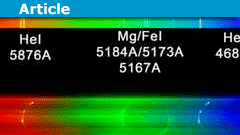
Most readers acquainted with the hydrogen spectrum will be familiar with the set of lines in the visible spectrum representing transitions of electrons from energy levels 3,4,5 and 6 (H alpha, beta, gamma, and delta respectively) of atomic hydrogen to energy level 2 – the Balmer series lines. The picture below shows 3 of these lines (amongst others) in a diffraction-grating image of the solar chromosphere during a total eclipse of the sun. For a very brief moment, the normal dark Fraunhofer lines of the solar absorption spectrum become an emission spectrum. The diffraction grating then shows separated images of the eclipse at various prominent wavelengths (indicated in the diagram) within the chromospheric emission spectrum. See also: The Spectrum of the Chromosphere.

Image Credit: https://icarus-optomechanics.com/flash-spectrum/
This article intends to present methods of calculating (to various degrees of precision) the wavelengths or wavenumbers of such lines. In particular the Balmer Alpha line since for this particular line (actually a set of lines due to fine structure components), there is/are extremely accurate measurement details available. The Balmer Alpha fine structure components have been resolved and individually measured thanks to the unparalleled precision of laser absorption spectroscopy. We use this data to set the ‘target’ for our calculations in terms of wavenumber:
$$H_\alpha\,\text{atomic hydrogen}:\,15233.07061cm^{-1}\,(2p_{3/2}\text{ to }3d_{5/2}\text{ transition})$$
NIST reference for this measurement can be found here (the last line of data).
Method 1: The Rydberg Formula
The obvious ‘go to’ formula for this calculation would be the Rydberg formula:
$$ \frac {1}{λ} = R_∞ \left( \frac{1}{4} – \frac{1}{9} \right) = 15241 cm^{-1}$$
It’s not even worth bothering to include decimal digits in the result of this calculation since we are already showing a difference from measured at the 4th significant figure. Additionally, the original Rydberg formula did not even consider the fine structure of the Balmer Alpha line so the calculation can only pertain to an average of the various fine structure components. Although in retrospect the situation is perhaps a little more nuanced as will be observed in the following paragraphs.
Method 2: Rydberg Formula with Reduced Mass
Fine structure notwithstanding, the Rydberg formula can be improved considerably by recognizing that the electron is bound to a nucleus of finite mass and accordingly electron mass (a component of the Rydberg constant) must be replaced by reduced electron mass. With the Rydberg constant ##R_∞## replaced with ##R_H## reflecting this adjustment we obtain:
$$1/λ = R_H(1/4 – 1/9) = 15233.00cm^{-1} $$
It can be seen that the theoretical prediction has improved considerably and we now have a result differing from the measured by less than 5 parts per million. Historically it is worth noting that Bohr himself introduced this particular change to achieve unprecedented (at the time) six-figure concurrence with measured values. Reduced mass also resolved a significant discrepancy in predicted spectral lines of singly ionized Helium which were expected to be in the ratio 1:4 exactly (as compared to the corresponding Hydrogen lines) whereas the experiment showed a ratio of 1:4.0016. The latter was shown to be a consequence of the reduced mass ratio (Helium to Hydrogen) being 1.0004. Even Einstein was impressed commenting: “This is an enormous achievement. The theory of Bohr must then be right.” See also this note on the “Pickering Lines“.
Six-figure accuracy is sufficient to place the calculated value well within the error bounds dictated by fine structure averages for both energy level 2 and energy level 3. However, the Rydberg formula depends only upon the primary quantum number n and therefore could not address the issue of the Balmer Alpha ‘line’ actually being a composite of several lines. As will later be observed, it turns out that a formula dependent only upon the primary quantum number applies to a certain specific component of the Balmer Alpha fine structure namely the 3p 3/2 to 3d 5/2 transition for which we have the above-mentioned very high-resolution measurement. The Rydberg formula corresponds to a one-term binomial expansion of said formula. The situation is analogous to how classical Newtonian formulae can be derived as low-velocity approximations of their relativistic counterparts.
Method 3: Dirac Energy Equation
The formula referred to in the above paragraph is of course the Dirac energy equation, the relativistic equation of motion for an electron attached (bound) to a nucleus of theoretically infinite mass. Its solution for the Hydrogen atom (including reduced mass correction) is as follows:
$$ \begin{array}{rl} E_{n\,j} & = \mu c^2\left(1+\left[\dfrac{Z\alpha}{n-|k|+\sqrt{k^2-Z^2\alpha^2}}\right]^2\right)^{-1/2}\\ &\\& \end{array} $$ where ##\alpha## is the fine structure constant , Z the atomic number (=1 for Hydrogen) and ##\mu## the electron reduced mass.
Following queries submitted to Physics Forums and guidance thereby obtained (see this link), the following simplification was noted:
For the particular case(s) where for any given principal quantum number n, we set orbital angular momentum quantum number ## l_{max} = n-1## and in turn set total angular momentum quantum number ##j_{max}=l+\frac{1}{2}##, then ## k = j+\frac{1}{2} = l+1 = n ##. Thus n – |k| = 0 and the expression simplifies:
$$ \begin{array}{rl} E_{n} & = \mu c^2\left(1+\left[\dfrac{Z\alpha}{\sqrt{n^2-Z^2\alpha^2}}\right]^2\right)^{-1/2}\\ &\\& \end{array}$$ $$E_ {n}= \mu c^2\left(\frac{n^2}{n^2-Z^2\alpha^2}\right)^{-1/2}=\mu c^2\sqrt{1-\frac{Z^2\alpha^2}{n^2}} $$
Energy levels ## 2p_{3/2} ## and ## 3d_{5/2} ## both meet the requirements under which such simplification occurs and we may therefore write:
$$H_{\alpha}=E_3-E_2=\mu c^2\left(\sqrt{1-\frac{\alpha^2}{9}}-\sqrt{1-\frac{\alpha^2}{4}}\right) $$
To convert the unit from joules to “per m”, the result must be divided by a factor ## hc ##. We entrust this calculation to Wolfram Alpha obtaining: $$ 1/λ = 15233.07093 cm^{-1} $$ (Readers who follow the link to the calculation will need to click the “Plain Text” tab under the result ## y=1.52331\times10^6 ## to view all digits in the output).
Now the calculated wavenumber differs from the measured by just 21 parts per billion which is within the error bounds set by the hyperfine structure of the ##2p_{3/2}## energy level. The difference between hyperfine components of the ## 2p{3/2}## level is about 24MHz (in units of frequency) and the difference between the calculated and measured value is about half that – approximately 10MHz.
Rydberg Formula from Dirac Energy
As a final note to this article, we obtain a 1-term binomial expansion of the simplified Dirac Energy equation as applied to the Balmer Alpha transition:
$$H_{\alpha}=E_3-E_2=\mu c^2\left(\sqrt{1-\frac{\alpha^2}{9}}-\sqrt{1-\frac{\alpha^2}{4}}\right)$$
$$\approx \mu c^2\left((1-½\frac{\alpha^2}{9})-(1-½\frac{\alpha^2}{4})\right)=\frac{\mu c^2\alpha^2}{2}\left( \frac{1}{4} – \frac{1}{9} \right)$$
Dividing the final expression by hc to convert from energy units as joules to energy units as “per m” we obtain: $$ \frac{1}{λ}\approx\frac{\mu c\alpha^2}{2h}\left( \frac{1}{4} – \frac{1}{9} \right)=R_H\left( \frac{1}{4} – \frac{1}{9} \right)$$
References:
| [1] | A. Kramida, Yu. Ralchenko, J. Reader and NIST ASD Team. NIST Atomic Spectra Database (ver. 5.6.1), National Institute of Standards and Technology, Gaithersburg, MD., 2018. [ http ] |
| [2] | T. W. Hänsch, M. H. Nayfeh, S. A. Lee, S. M. Curry, and I. S. Shahin. Precision measurement of the rydberg constant by laser saturation spectroscopy of the Balmer α line in hydrogen and deuterium. Phys. Rev. Lett., 32:1336-1340, Jun 1974. [ http] |
| [3] | H.H. Plaskett. The Pickering series and Bohr’s atom. Journal of the Royal Astronomical Society of Canada, 16:137,1922. [www: ] |

BSc (Elec Eng) University of Cape Town, HDE University of South Africa
Maths and Science Tutor, Florida Park, Johannesburg
Research areas (personal interest): Hydrogen / Hydrogen-like spectra. Historical Maths.
Wikipdedia contributions: Ptolemy’s Theorem, Diophantus II.VIII, Continuous Repayment Mortgage




Leave a Reply
Want to join the discussion?Feel free to contribute!