
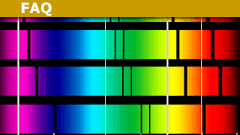
Evidence that Galaxy and Quasar Redshifts Are Cosmological
How do we know that the redshifts of galaxies and quasars are cosmological and not “intrinsic”?
Table of Contents
Evidence for the cosmological interpretation
Historical context
The purpose of this FAQ entry is to explain why nonstandard interpretations of redshifts are not viable; it is not a full history of how standard cosmological models developed. Below is a concise summary of why the cosmological interpretation is accepted.
Doppler shifts of galaxies have been used as an observational tool since 1917. The discovery of Hubble’s law in the 1920s was seen as strong evidence for Lemaître’s early “primeval atom” model, now called the Big Bang. Interpreting redshifts as arising from the expansion of space is natural because it follows from general relativity’s solutions for an expanding universe.
Experimental confirmation of relativity’s Doppler predictions
General relativity’s predictions for gravitational and kinematic (relativistic) Doppler shifts have been tested and applied in multiple experiments and systems:
- Gravitational redshift observed in the laboratory (Pound and Rebka). [Pound]
- Kinematic Doppler shifts measured in laboratory experiments to parts-per-billion precision (Saathoff et al.). [Saathoff]
- Radio tracking of uncrewed space probes requires precise relativistic Doppler corrections (Will). [Will]
- Using a GPS receiver requires relativistic corrections, which empirically verifies these predictions (Ashby). [Ashby]
Proposal of “intrinsic” redshifts by Arp et al.
Beginning in the 1960s, Halton Arp, Geoffrey Burbidge, William Tifft and others proposed a radical alternative: an unknown mechanism that would make nearby galaxies or quasars emit radiation that appears redshifted to a nearby, co‑moving observer. They called these shifts “intrinsic” redshifts.
Intrinsic-redshift hypotheses conflict with established physical theories and lack reproducible experimental support. Their claims relied on perceived observational inconsistencies with cosmological models rather than on laboratory verification or a viable theoretical mechanism.
Specific observational claims and rebuttals
Arp and collaborators advanced several observational arguments. Below are key claims and concise rebuttals:
- Claim: Objects that appear associated on the sky have very different redshifts.
Refutation: Close projections on the celestial sphere do not guarantee physical association. For example, in Stephan’s Quintet one galaxy (NGC 7320) has a much smaller redshift than the other four; Hubble imaging shows stronger surface-brightness fluctuations in NGC 7320, confirming it is a foreground object and not physically associated with the high-redshift group. [Moles] [Gallagher] - Claim: Statistical correlations exist between low-redshift galaxies and apparently nearby high-redshift quasars.
Refutation: Early results were made from small or biased samples. Large, unbiased surveys (for example, the Sloan Digital Sky Survey) show correlations compatible with the cosmological model once gravitational lensing and selection effects are included. [Scranton] - Claim: In physically associated galaxy systems, fainter members systematically show larger redshifts.
Refutation: These analyses are sensitive to systematic errors and statistical biases. Subsequent reanalyses identified methodological flaws, and corrected statistical treatments remove the apparent effect. [Keel] [Newman]
Consistency checks supporting cosmological redshifts
Several independent observational tests strongly favor the cosmological interpretation and are difficult to reconcile with intrinsic redshifts:
- When both a quasar and its host galaxy are detected, the quasar emission redshift matches the host-galaxy redshift where measurements are possible. [Stockton]
- The Lyman‑alpha forest seen in quasar spectra consists of many absorption lines from intervening neutral-hydrogen clouds at redshifts lower than the quasar’s emission redshift, consistent with an expanding line of sight.
- The Gunn–Peterson trough — a broad absorption signature of the epoch of reionization — was detected at the redshifts predicted decades earlier, matching theoretical expectations. [Becker]
- In gravitational-lens systems where lens and source redshifts are measured, the lens is always at lower redshift (closer) than the lensed background source, as expected in a cosmological geometry.
Resources and references
For a more detailed review see Keel’s summary of the Arp controversy: http://www.astr.ua.edu/keel/galaxies/arp.html.
- Pound and Rebka, Phys. Rev. Lett. 4 (1960) 337
- Saathoff et al., Phys. Rev. Lett. 91 (2003) 190403; see Saathoff Ph.D. thesis: http://www.mpi-hd.mpg.de/ato/homes/saathoff/diss-saathoff.pdf
- Will, “The Confrontation between General Relativity and Experiment”: http://relativity.livingreviews.org/Articles/lrr-2006-3/
- Ashby, “Relativity in the Global Positioning System”: http://relativity.livingreviews.org/Articles/lrr-2003-1/
- Moles, Marquez, and Sulentic, Astronomy & Astrophysics 334 (1998) 473: http://arxiv.org/abs/astro-ph/9802328
- Gallagher et al., Astron. J. 122 (2001) 163: http://arxiv.org/abs/astro-ph/0104005
- Scranton et al., Astrophys. J. 633 (2005) 589: http://arxiv.org/abs/astro-ph/0504510
- Keel, Astrophysical Journal Supplement 106 (1996) 27: http://adsabs.harvard.edu/…
- Newman, Astrophysical Journal 441 (1995) 505: http://articles.adsabs.harvard.edu/full/1995ApJ…441..505N
- Stockton, Astrophysical Journal 223 (1978) 747: http://adsabs.harvard.edu/…
- Becker et al., Astron. J. 122 (2001) 2850: http://arxiv.org/abs/astro-ph/0108097
Contributors
- bcrowell
- George Jones
- jim mcnamara
- marcus
- PAllen
- tiny-tim
- vela
This article was authored by several Physics Forums members with PhDs in physics or mathematics.



Leave a Reply
Want to join the discussion?Feel free to contribute!