

Black Hole Thermodynamics: Four Laws Explained — Guide
Table of Contents
Overview
Black hole thermodynamics is summarized by four laws that closely parallel the laws of ordinary thermodynamics. Below I present each law, the key formulas (in geometric and SI units where relevant), and brief physical explanations with links to background material.
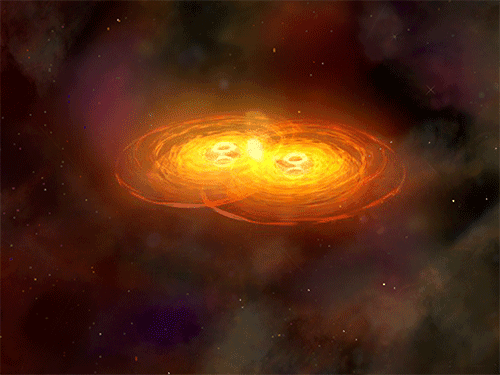
The Zeroth Law
The surface gravity κ is constant over a stationary black hole’s event horizon. In other words, for a stationary black hole the surface gravity has the same value at every point on the horizon — analogous to a system being at uniform temperature at thermal equilibrium. See: black holes (background).
The First Law
The first law relates changes in the black hole mass (energy) to changes in horizon area, angular momentum and charge. For an infinitesimal change between neighboring stationary states (natural units):
dM = (κ / 8π) dA + Ω dJ + Φ dQ
Here:
Ais the horizon area.κis the surface gravity.Ωis the horizon angular velocity.Φis the electrostatic potential at the horizon.Jis angular momentum andQis charge.- The irreducible mass is
M_ir = sqrt(A / 16π).
According to the cosmic censorship conjecture (geometric units), the parameters satisfy:
Q ≤ M, a ≤ M, J = a M ≤ M^2, Q^2 + a^2 ≤ M^2, where M = G m / c^2
Key formulas for Kerr–Newman black holes
r_+ = M + sqrt(M^2 - Q^2 - a^2)      (outer horizon)
r_- = M - sqrt(M^2 - Q^2 - a^2)      (inner horizon)

A = 4π (r_+^2 + a^2)

κ = (r_+ - r_-) / [2 (r_+^2 + a^2)]

Ω = a / (r_+^2 + a^2)

Φ = Q r_+ / (r_+^2 + a^2)
These forms are the standard Kerr–Newman expressions in geometric (G = c = 1) units; they can be converted to SI where needed.
SI units and conversions
Temperature and entropy in SI (ħ is reduced Planck constant, k_B Boltzmann constant):
T_H = ħ κ / (2π c k_B)
S_bh = (k_B c^3 / (4 ħ G)) A
In natural (geometric) units these reduce to T_H = κ / 2π and S_bh = A / 4. Note: when converting κ and Ω to familiar SI units, apply the appropriate powers of c — κ has dimensions related to acceleration and Ω to angular frequency as measured at infinity.
The Second Law
In any classical (non-quantum) process the area of the event horizon never decreases:
dA ≥ 0
Equivalently, the black hole entropy S_bh (proportional to horizon area) does not decrease in classical processes. The horizon area can increase when mass is added or when spin/charge are reduced by accretion or mergers. However, semiclassical quantum effects (Hawking radiation) allow the black hole to lose mass and the horizon area to decrease, so the classical second law is modified once quantum effects are included.
The Third Law
The third law states that the limit κ = 0 (zero surface gravity, i.e., zero temperature) cannot be reached by any finite sequence of physical processes starting from a non-extremal black hole. Extremal black holes (for example Kerr with a/M = 1 or extremal Kerr–Newman) have κ = 0 and thus zero temperature, but they still have nonzero entropy. Reaching an extremal state in a finite number of steps is prohibited by the third law as usually stated.
Extended explanation: the thermodynamic analogy
The first term in the first-law expression, (κ / 8π) dA, corresponds to the heat term T dS in ordinary thermodynamics. Using the Hawking temperature and the Bekenstein–Hawking entropy (SI):
T_H = ħ κ / (2π c k_B)
S_bh = (k_B c^3 / (4 ħ G)) A
so that the combination T_H dS_bh reproduces the geometric form (κ / 8π) dA in natural units. Thus the first law for black holes can be read as an energy balance: mass change equals heat term plus work terms due to rotation and charge.
Further reading and community discussion:
This article was authored by several Physics Forums members with PhDs in physics or mathematics.





Leave a Reply
Want to join the discussion?Feel free to contribute!