
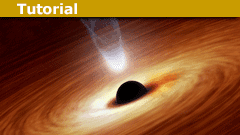
Why the Early Big Bang Universe Didn’t Form a Black Hole
Table of Contents
Why the Big Bang Is Not a Black Hole
In the early universe, the matter was gathered together at very high density — so why wasn’t it a black hole?
Big Bang vs. a Local Explosion
The first thing to understand is that the Big Bang was not an explosion that happened in one place in a preexisting space. The Big Bang happened everywhere at once, so there is no single location that would correspond to a black hole singularity. Cosmological models are either exactly or approximately homogeneous. In a homogeneous cosmology, symmetry guarantees that tidal forces vanish everywhere and that any observer at rest relative to the average motion of matter will measure effectively zero gravitational fields.
Based on these considerations, it is actually a little surprising that the universe ever developed structure at all. The only kind of collapse that can occur in a purely homogeneous model is the re-collapse of the entire universe in a “Big Crunch”. That global re-collapse only happens for matter densities and values of the cosmological constant that are different from what we observe.
Definition of a Black Hole
A black hole is defined as a region of spacetime from which light rays cannot escape to infinity. The phrase “to infinity” can be given a precise mathematical meaning, but that definition requires the assumption that spacetime is asymptotically flat.
To see why asymptotic flatness is required, imagine a black hole in a universe that is spatially closed. A spatially closed cosmology is finite, so there is no sensible notion of escaping “to infinity.” In real astrophysical cases — for example, Cygnus X-1 or Sagittarius A* — the black hole is surrounded by a fairly large region of nearly empty interstellar space, so even though our universe as a whole is not asymptotically flat, we can still use a portion of an infinite, asymptotically flat spacetime as an excellent local approximation for that region.
But if one asks whether the entire universe is a black hole, or could have become a black hole, asymptotic flatness cannot even be approximately defined. In that context the standard definition of a black hole does not provide a meaningful yes-or-no answer. It’s like asking whether “Beauty” is a U.S. citizen — “Beauty” isn’t a person and wasn’t born, so we can’t decide whether “Beauty” was born in the U.S.
Cosmology vs. Black Hole Conditions
Black holes can be classified, and a family of solutions known as Kerr–Newman black holes describes all stationary (time-independent) black holes according to no-hair theorems. (Non-stationary black holes generally settle quickly into one of these stationary solutions.) Kerr–Newman black holes have a central singularity, are surrounded by vacuum, and exhibit nonzero tidal forces.
By contrast, our universe is not a vacuum on large scales, and tidal forces are nearly zero on cosmological distance scales because the universe is homogeneous at those scales. Although cosmological models include a Big Bang singularity, that singularity is not one into which future world lines terminate in a finite proper time; rather it is a singularity from which world lines emerged a finite proper time in the past.
References and contributors
For a more detailed and technical discussion, see the Gibbs page linked below and Hawking & Ellis, The Large-Scale Structure of Space-Time, p. 315.
- Gibbs — “Universe as a Black Hole?”
- Hawking, S. W. & Ellis, G. F. R., The Large-Scale Structure of Space-Time, p. 315
The following forum members contributed to this FAQ:
- bcrowell
- George Jones
- jim mcnamara
- marcus
- PAllen
- tiny-tim
- vela
This article was authored by several Physics Forums members with PhDs in physics or mathematics.



Would it be possible for someone to clarify that sentence?
I thought the singularity was where world-lines finished and that they only extend a finite amount of time into the future from the event horizon before reaching the singularity?This is correct, and I think it is the same thing that the article was trying to say (though the wording was apparently somewhat confusing).
Nice summary, and it's something I'd like to point people at when this question comes up in other forums. Before doing that, can I just check one point which surprises me, I think I'm mis-reading it perhaps:
I thought the singularity was where world-lines finished and that they only extend a finite amount of time into the future from the event horizon before reaching the singularity? Some clarification would help me here.
https://www.physicsforums.com/insights/universe-black-hole/
Here is a paper on this subject I wrote for Am. J. Phys. some years ago: http://users.etown.edu/s/STUCKEYM/AJP1994.pdf
Good reading. I have a thread
https://www.physicsforums.com/threads/big-bang-vs-black-hole.827828/
Which was already closed.
I've previously requested that Greg stop recycling my old posts as Insights blog posts. It suggests that I'm interested in the Insights blog, which I'm not. Also, it makes me feel as though I'm obliged to respond to a flurry of new discussion on some post that I wrote years ago and that was discussed then. Although this post has multiple authors, I basically wrote it. I've repeated my request to Greg that he stop doing this.
This is a great article! You 6 are approaching my theory.Once it is recognized (which you are approaching) that a "black hole" is only a concentrated ZPE area of the fundamental field seen in a galaxy as a "potential of negative matter" (anti-matter) to compensate for the surrounding ordinary matter and that in an area of relatively low density of space matter, it is apparently there doing the same thing, we approach my theory, which is very similar to what Bohm speaks of. As far as a "beginning" everywhere at once coming in view matter; that is an improvement on the standard BBT. But necessary only for those needing a beginning of time. It is quite obvious to many that the attribution of "expansion" of space falls out of only one interpretation of Hubble's data, which ignores Hubble's lack of acceptance, and Fritz Zwicky's and would be quite unnecessary if we could demonstrate objectively how a photon loses frequency when traveling great distances. Does anyone with a reasoning brain expect a photon to cross the universe (unimpeded) to not lose energy in its travels?B