
Balloon Analogy Explained: Cosmology, Expansion & Limits
The Balloon Analogy is a straightforward way to illustrate — without being complete — two important points of modern cosmology that many people find counterintuitive: that the universe expands roughly uniformly and that it has no center or edge (in the sense relevant to the analogy).
The analogy is unpopular with many professional physicists because it can cause as much confusion as it clears up when it is misunderstood or overextended. This article presents the simple balloon analogy, explains what it does and does not illustrate, and highlights the most common misunderstandings so the analogy can be used more accurately.
Table of Contents
What the balloon analogy is intended to describe
- The universe is expanding outside systems that are gravitationally bound or held together by other local forces (for example, galaxy clusters, galaxies, solar systems, planets, people, atoms). Those bound systems do not expand.
- There is no center of expansion: everything moves away from everything else, and objects that are farther apart recede faster from one another than objects that are closer together.
The balloon analogy
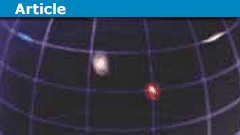
Imagine pennies glued to the surface of a slightly inflated balloon. Each penny represents a gravitationally bound system such as a galaxy or a galaxy cluster. As the balloon inflates, all pennies move apart; pennies that are farther apart move away from each other faster than nearby pennies. Any penny on the surface would observe the others receding from it, and no penny occupies a special central position. That captures the two points above: uniform expansion (on large scales) and no center.
What doesn’t work in the balloon analogy
No center
The analogy uses only the surface of the balloon. The 3D center of the physical balloon is irrelevant. If you insist that the balloon’s 3D center corresponds to a center of the universe, you are misusing the analogy. In the analogy (as intended) there is no center on the 2D surface, just as cosmology indicates no unique center of expansion in our universe.
Size and shape
The analogy should be restricted to a portion of the balloon’s surface. It does not assert anything about the overall size or global curvature of the real universe beyond the fact that characteristic distances increase. The curved surface of a balloon is only a convenient visualization; one can equally well imagine a flat rubber sheet stretching locally. The analogy is not a statement about whether the real universe is open, closed, flat, finite or infinite.
Local effects (bound systems)
In the analogy the pennies do not change size — gravitationally bound systems do not expand with the universe. To make that clearer, imagine the pennies are embedded so their circumference is fixed to the rubber but there is no rubber inside the pennies. When the balloon expands the pennies move apart without stretching. Even this corrected picture is imperfect because it ignores subtleties such as the presence of dark energy inside bound systems, which has negligible practical effect locally.
No literal “stretching” of space
The word “stretching” in the balloon picture can wrongly suggest that space is a material that is being stretched like rubber. A more precise statement is that proper distances between unbound objects increase over time (metric expansion). If you prefer to avoid the stretching image, imagine only that distances between non-bound systems change with time; nothing about local physical forces or objects is being literally pulled apart by rubber.
Cosmological time and the Big Bang
Do not interpret the balloon’s 3D center or a point on the surface as the Big Bang singularity. The analogy is intended only to illustrate the ongoing expansion, not the initial singularity or anything about the full cosmological history beyond expansion behavior.
The three related but distinct concepts
Inflation
A very early, extremely rapid expansion (inflation) is a hypothesized phase that occurred in the first tiny fraction of a second after the Big Bang. It is not the same as the slower expansion that followed but can be thought of as a brief, enormous growth of distances. Inflation is a well-supported but still discussed part of modern cosmology.
Expansion
After (possible) inflation, the universe continued to expand at a much slower, evolving rate. This ongoing increase of distances between unbound systems is what people typically mean by the “expansion of the universe.”
Acceleration of the expansion
Observations since the late 1990s show that the expansion rate is currently accelerating. This acceleration is attributed to an unknown component called “dark energy.” The acceleration is distinct from the expansion itself: expansion refers to distances increasing; acceleration refers to the increase of the expansion rate over time.
Other notes on cosmology
Dark energy and dark matter are distinct. The terms sound similar but describe different phenomena. Dark matter is unseen mass that influences dynamics via gravity; dark energy is a label for whatever drives the accelerated expansion. Conflating them is a persistent error.
On local scales dark energy is effectively negligible. A useful analogy: dark energy’s effect on a planet is like an ant pushing on a house — the ant can push, but it does not meaningfully change the house’s motion or position. Similarly, expansion is essentially irrelevant on scales of solar systems or galaxies because binding forces dominate.
On cosmological scales the effect is large: distant galaxies near the edge of our observable universe can recede from us at effective recession speeds greater than the speed of light. This does not violate relativity because those recession speeds are not proper velocities through local space but a reflection of growing proper distances in the cosmological metric.
Note: Distance measures, cosmological time, the global shape/extent of the universe, and the fact that “space” is part of space-time are subtle and mathematically complex topics. This article intentionally simplifies several points to focus on the balloon analogy itself.
For a more technical explanation of the underlying concept see Metric expansion of space. For discussion and community comments see the original forum thread: Click for forum comments.
Universe expansion FAQ
What is the balloon analogy used to explain?
It is a simplified illustration of two ideas: uniform expansion (on cosmological scales) and the absence of a special center to the expansion.
How does the analogy represent expansion?
Pennies glued to an inflating balloon separate as the balloon grows. Each penny sees others receding, and more distant pennies recede faster. No penny is at the center of this motion.
Does the analogy show the universe’s size or shape?
No. The analogy does not determine whether the universe is curved, flat, finite, or infinite. It only shows that characteristic distances can increase over time.
What are common misconceptions?
- Center = singularity: Incorrect — the analogy does not place the Big Bang at a point on the surface.
- Space is a rubber material that stretches: An oversimplification — distances change according to the metric; thinking of “space” as material can mislead.
- Bound systems expand: False — galaxies, solar systems and atoms remain bound by forces and do not expand with the metric expansion.
How does expansion affect us locally?
Locally the effect is negligible. Gravity and electromagnetic forces dominate at the scales of planets, stars and galaxies.
What is the difference between expansion and acceleration of expansion?
“Expansion” describes the increase of distances over time; “acceleration of the expansion” means the rate at which distances grow is itself increasing (the latter is associated with dark energy).
What is dark energy in this context?
Dark energy is a name for the unknown cause of the accelerated expansion. The balloon analogy does not explain dark energy, but one can imagine it as an extra driver that increases the balloon’s inflation rate over time.
Are there alternative analogies?
Yes. The “raisin bread” analogy (raisins in rising dough) is another common visualization. Like the balloon, it helps show increasing separations but also has similar limitations.
Studied EE and Comp Sci a LONG time ago, now interested in cosmology and QM to keep the old gray matter in motion.
Woodworking is my main hobby.



Регулярное обращение к средствам массовой информации является необходимым в повседневной жизни.
Оно помогает следить за актуальными новостями и разбираться в текущих процессах.
Оперативная информация позволяют принимать взвешенные решения.
Чтение СМИ способствует развитию критического мышления.
https://telegra.ph/Moskva-12-25-7
Несколько точек зрения помогают сравнивать факты.
В профессиональной сфере СМИ дают возможность быстро реагировать на изменения.
Внимательное чтение новостей формирует информационную грамотность.
Таким образом, чтение СМИ делает человека более информированным.
“I’ve always been skeptical of the B&H argument, since it would imply that a string of COs could not all be at the same cosmological time. It may not be a sufficient argument, but to me it made SR redshift as an interpretation for cosmological redshift uncomfortable, to say the least.”
Peacock and Chodorowski argue that interpreting the cosmological redshift one should take gravity into account. And I think this makes sense because in curved space-time the redshift isn’t purely dopplerian per se. But at the end, as we talk about interpretations the answer to this question is not wright or wrong but might be rather a matter of personal taste.
[URL]http://arxiv.org/abs/0809.4573[/URL]
[URL]http://arxiv.org/abs/0911.3536[/URL]
“But, O’s analysis refutes B&H’s argument using SR with small v = Hr between COs.”
I’ve always been skeptical of the B&H argument, since it would imply that a string of COs could not all be at the same cosmological time. It may not be a sufficient argument, but to me it made SR redshift as an interpretation for cosmological redshift uncomfortable, to say the least.
Someone who wishes to remain anonymous sent me the following link: [URL]http://arxiv.org/abs/1111.6704[/URL]. In this paper, [URL=’http://arxiv.org/find/physics/1/au:+Ostvang_D/0/1/0/all/0/1′]Dag Østvan[/URL]g (O) shows that Bunn & Hogg’s (B&H’s) claim that a pair of co-moving observers (COs) who have small enough Hubble velocities (v = Hr) relative to each can be considered to occupy the same flat spacetime frame is false. O shows specifically that in the flat or closed RW models, it is not possible to have H nonzero if the curvature is zero. Thus, O concludes that the redshift caused by v = Hr is 100% attributable to spacetime curvature, so it is best understood as a “gravitational redshift” not a “kinematic redshift” as B&H claim. Further, one cannot use the SR Doppler formula between observers with very small v = Hr, since the SR Doppler formula can only be applied between observers who share the same flat frame and any nonzero v = Hr entails nonzero spacetime curvature. O does agree that the SR Doppler formula can be used on the parallel transported 4-velocity of the emitter at emission, which is the Nalikar-Synge computation. He also eschews the notion of “expanding space,” so I don’t think O would disagree with B&H’s conclusion that the redshift is a “Doppler shift” not an “expanding space shift.” But, O’s analysis refutes B&H’s argument using SR with small v = Hr between COs.
None of this causes me to change what I have my students compute as far as kinematics in RW cosmology (although I will definitely add this material to my GR course). I have them compute recession velocity of and proper distance to the source at time of reception and time of emission as a function of z in the Einstein-deSitter model. [itex]r = 3ct_o left(1 – frac{1}{sqrt{1 + z}}right)[/itex], [itex]v = 2c left(1 – frac{1}{sqrt{1 + z}}right)[/itex], [itex]v_e = v sqrt{1+z} [/itex], [itex]r_e = frac{r}{1+z}[/itex], and [itex]t_e = frac{t_o}{left(1+zright)^{1.5}}[/itex]. Then we add [itex]Lambda[/itex] and obtain [itex]dot{a} = H_o sqrt{frac{Omega _m}{a} + Omega _Lambda a^2}[/itex] with [itex]Omega _m + Omega _Lambda = 1[/itex] which I have them use to verify [itex]frac{t_e}{t_o} = 0.0366[/itex] for z = 9.6, [itex]Omega _m = 0.3[/itex] and [itex]Omega _Lambda = 0.7[/itex] found in [URL]http://arxiv.org/abs/1204.2305[/URL]. Then I have them obtain [itex]ddot{a} = 0[/itex] at z = 0.671 [itex]left(frac{t_e}{t_o} = 0.544 right)[/itex] with [itex]Omega _m = 0.3[/itex] for comparison with [URL]http://www.ptep-online.com/index_files/2012/PP-29-02.PDF[/URL].
I finally took the time to derive the cosmological redshift [itex]z+1 = frac{a_o}{a_e}[/itex] using the accumulated nonrelativistic redshifts along the path of the light, as in Eqs (4) & (5) of [URL]http://arxiv.org/pdf/0808.1081v2.pdf[/URL]. It’s straightforward and nicely shows how the local flat frames can be pieced together along the light path in the global curved spacetime. I also liked the authors’ derivation of their Eq (6) [itex] sqrt{frac{c + v_{rel}}{c – v_{rel}}} = frac{a_o}{a_e}[/itex] using the SR velocity addition equation in local flat frames along the light path, i.e., parallel transport. Very cool. I will add the contents of this paper to my GR course.
That being said, I don’t agree with their view that [itex]v_{rel}[/itex] constitutes a “natural” notion of velocity for cosmology. “… the velocity of the galaxy at the time of light emission relative to the observer at the present time” is about as unnatural as I can imagine haha. The natural notion is clearly v = Hr, i.e., proper time rate of change of proper distance, which holds not only locally, they use it to get both Eqs (5) and (6), but globally in the “expanding bread” or “stretching rubber sheet” analogies. That view is very Newtonian, so it’s very intuitive and as Rindler once told me, “It’s not just an analogy, it’s exact!” But, it is certainly the case that there is no unique way to define velocity between objects that don’t share a local flat frame in curved spacetime, so to each his own :-)
Thanks again for sharing that article, marcus. Hopefully, now that I’ve gone through the derivation myself, I won’t keep requiring you to post it :-)
That looks familiar, marcus. I think we’ve had this exchange before :-)
“Narlikar once told me you can derive the cosmological redshift using the Doppler shift between local frames, integrated from emission event to reception event. I’ve always meant to check that, but never got around to it …”
[URL]http://arxiv.org/abs/0808.1081[/URL]
[SIZE=6]The kinematic origin of the cosmological redshift[/SIZE]
[URL=’http://arxiv.org/find/physics/1/au:+Bunn_E/0/1/0/all/0/1′]Emory F. Bunn[/URL], [URL=’http://arxiv.org/find/physics/1/au:+Hogg_D/0/1/0/all/0/1′]David W. Hogg[/URL]
(Submitted on 7 Aug 2008 ([URL=’http://arxiv.org/abs/0808.1081v1′]v1[/URL]), last revised 14 Apr 2009 (this version, v2))
A common belief about big-bang cosmology is that the cosmological redshift cannot be properly viewed as a Doppler shift (that is, as evidence for a recession velocity), but must be viewed in terms of the stretching of space. We argue that, contrary to this view, the most natural interpretation of the redshift is as a Doppler shift, or rather as the accumulation of many infinitesimal Doppler shifts. The stretching-of-space interpretation obscures a central idea of relativity, namely that it is always valid to choose a coordinate system that is locally Minkowskian. We show that an observed frequency shift in any spacetime can be interpreted either as a kinematic (Doppler) shift or a gravitational shift by imagining a suitable family of observers along the photon’s path. In the context of the expanding universe the kinematic interpretation corresponds to a family of comoving observers and hence is more natural.
“So is there a valid feature of the Balloon analogy that actually contradicts with Doppler recession?”
Narlikar once told me you can derive the cosmological redshift using the Doppler shift between local frames, integrated from emission event to reception event. I’ve always meant to check that, but never got around to it …
“Not in the sense I have been using the term “acceleration”. You will notice that I have tried to say “proper acceleration”, to make it clear that I am talking about acceleration that is actually felt–or, in the case of the space station and the sun and distant galaxies, not felt. All of those objects are in free fall, feeling zero acceleration.
I’m sorry I said sun, but meant Galaxy, the sun is in orbit affected by gravity. Could the solar winds of our galaxy be pushing other galaxies away from us?
The kind of “acceleration” you are referring to when you say that the sun is accelerating away from other stars is more precisely called “coordinate acceleration”. (Actually, the red shifts you are referring to are from other galaxies, not other stars; we can’t see individual stars at the distances at which the cosmological redshift becomes measurable. So it’s more correct to say that our galaxy as a whole sees other galaxies’ light as redshifted.) The key point about coordinate acceleration is that you can change it by changing coordinates–i.e., by a mathematical abstraction that doesn’t change anything physical. So if you are trying to understand the actual physics going on, coordinate acceleration is the wrong thing to focus on.
No, they don’t. Red shifts, in and of themselves, only tell us that the universe is expanding. They do not tell us that the expansion is accelerating. For that, we need not only the observation that there are red shifts, but detailed correlations between red shifts and other observations, like the brightness and angular size of distant galaxies.
Also, once again, when we say the universe’s expansion is “accelerating”, we mean this in the sense of coordinate acceleration, not proper acceleration. All of the galaxies have zero proper acceleration. See below.
You are confusing coordinate acceleration and proper acceleration here. The sun has zero proper acceleration, and that means there is no net force acting on the sun. The sun does have nonzero coordinate acceleration in certain coordinates, but coordinate acceleration does not tell you whether there is an unbalanced net force. Only proper acceleration does. As above, all of the galaxies have zero proper acceleration, so there is no unbalanced net force acting on any of them.”
“the difference in the space station and the sun is that the space station is not accelerating away from the earth. Due to red shift we know that we are accelerating away from other stars. Right?”
Not in the sense I have been using the term “acceleration”. You will notice that I have tried to say “proper acceleration”, to make it clear that I am talking about acceleration that is actually felt–or, in the case of the space station and the sun and distant galaxies, not felt. All of those objects are in free fall, feeling zero acceleration.
The kind of “acceleration” you are referring to when you say that the sun is accelerating away from other stars is more precisely called “coordinate acceleration”. (Actually, the red shifts you are referring to are from other galaxies, not other stars; we can’t see individual stars at the distances at which the cosmological redshift becomes measurable. So it’s more correct to say that our galaxy as a whole sees other galaxies’ light as redshifted.) The key point about coordinate acceleration is that you can change it by changing coordinates–i.e., by a mathematical abstraction that doesn’t change anything physical. So if you are trying to understand the actual physics going on, coordinate acceleration is the wrong thing to focus on.
“red shift tells us that the universe is accelerating.”
No, they don’t. Red shifts, in and of themselves, only tell us that the universe is expanding. They do not tell us that the expansion is accelerating. For that, we need not only the observation that there are red shifts, but detailed correlations between red shifts and other observations, like the brightness and angular size of distant galaxies.
Also, once again, when we say the universe’s expansion is “accelerating”, we mean this in the sense of coordinate acceleration, not proper acceleration. All of the galaxies have zero proper acceleration. See below.
“Therefore the sun can not be in a balanced free fall because it is accelerating.”
You are confusing coordinate acceleration and proper acceleration here. The sun has zero proper acceleration, and that means there is no net force acting on the sun. The sun does have nonzero coordinate acceleration in certain coordinates, but coordinate acceleration does not tell you whether there is an unbalanced net force. Only proper acceleration does. As above, all of the galaxies have zero proper acceleration, so there is no unbalanced net force acting on any of them.
“[URL]http://news.nationalgeographic.com/news/2011/10/111004-nobel-prize-physics-universe-expansion-what-is-dark-energy-science/[/URL]
I’m sorry I might have confused you with my red shift comparison. Nonetheless the universe is expanding. Which means unequal force and acceleration”
No, it does not. Yes, the universe is expanding, and at an accelerating rate, but what “unequal force” are you talking about? The sun in not accelerating in the sense that you think it is, nor are the distant galaxies that are receding from us at an accelerating rate.
“”
“”
[URL]http://news.nationalgeographic.com/news/2011/10/111004-nobel-prize-physics-universe-expansion-what-is-dark-energy-science/[/URL]
I’m sorry I might have confused you with my red shift comparison. Nonetheless the universe is expanding. Which means unequal force and acceleration
“Ah, good. Now I understand your question.
No, red shift does NOT tell us that the sun is accelerating. You are making a very common mistake of confusing recession velocity with proper velocity. Google “Metric Expansion” for more discussion.[/QUOTE”
“I’m not sure how I changed the subject. I was responding to a post discribing acceleration of the universe. My point is, that red shift tells us that the universe is accelerating. Therefore the sun can not be in a balanced free fall because it is accelerating. Acceration means that forces are not equal and solar thrust is pushing stars apart. It’s my idea that solar thrust is the energy described in dark matter. What better place to get energy from than the stars? What would change the direction of solar thrust? Gravity and collision of other matter.”
Ah, good. Now I understand your question.
No, red shift does NOT tell us that the sun is accelerating. You are making a very common mistake of confusing recession velocity with proper velocity. Google “Metric Expansion” for more discussion.
“You seem to keep changing the subject. What is it that you want to know, exactly? Please be as precise as you can with your question.”
I’m not sure how I changed the subject. I was responding to a post discribing acceleration of the universe. My point is, that red shift tells us that the universe is accelerating. Therefore the sun can not be in a balanced free fall because it is accelerating. Acceration means that forces are not equal and solar thrust is pushing stars apart. It’s my idea that solar thrust is the energy described in dark matter. What better place to get energy from than the stars? What would change the direction of solar thrust? Gravity and collision of other matter.
“Thanks for the explanation. But the difference in the space station and the sun is that the space station is not accelerating away from the earth. Due to red shift we know that we are accelerating away from other stars. Right?”
You seem to keep changing the subject. What is it that you want to know, exactly? Please be as precise as you can with your question.
“Free fall means zero proper acceleration–it means the object feels no force. It is weightless.
It’s in orbit about the center of the galaxy, yes. But that’s perfectly consistent with it being in free fall, just as the International Space Station, in orbit about the Earth, is in free fall–it feels no force, and is weightless.”
Thanks for the explanation. But the difference in the space station and the sun is that the space station is not accelerating away from the earth. Due to red shift we know that we are accelerating away from other stars. Right?
“Could you please explain this free fall to me.”
Free fall means zero proper acceleration–it means the object feels no force. It is weightless.
“I thiught sun was in orbit at 828,000 mph and completes one orbit in 230 million years.”
It’s in orbit about the center of the galaxy, yes. But that’s perfectly consistent with it being in free fall, just as the International Space Station, in orbit about the Earth, is in free fall–it feels no force, and is weightless.
Thx for helping me with this topic. I thought there is no way that it could be applied evenly because of solar busts and storms happen unevenly Most of its power or wind goes in space but when a another star is “near” it’s solar winds push on our entire universe.
“”
I agree just wish we had a better model
“Thanks.I disagree. It is a limited analogy, not a bad model, and as long as you understand the limitations of the analogy it is quite a good one.”
Could you please explain this free fall to me. I thiught sun was in orbit at 828,000 mph and completes one orbit in 230 million years.
“No, they’re not. They are in free fall; there is no thrust being applied to them.”
[USER=310841]@phinds[/USER]
Thumbs up! As beginner, I find the analogy very helpful and I look forward to your next Insights article!
“Right. It took a while for the “raisins” to form.
“Yes, it did, but that has nothing to do with the raisin bread analogy, which is just a way of talking about what the “raisins” are doing now and in the future.
“I think we must be talking about different “baking bread” analogies. The one I’m talking about has noting to do, really, with all that you just said. Rather, it is an alternate to the balloon analogy and talks about the universe NOW, not starting just after the singularity.”
Right. It took a while for the “raisins” to form.
I was thinking I couldn’t fill up a whole article with the raisin bread thing. But I guess I can if I try.
“Hmmm, how would I go about doing that? The key thing that people miss is that the early Universe had no empty space whatsoever and stayed that way for quite a long time. I think it would be entertaining to trace an imaginary eye witness of the Universe looked as it grew. At first it is unimaginable, then like starting at the center of the Sun and traveling outward. Then some empty space appears. The color goes down the spectrum to dark red then the whole thing turns black though still very hot. It appears that it will stay black forever, then the previously negligible force of gravity very slowly saves the day. Giant suns form and quickly explode to make iron and such. Neutron stars collide to produce the heavy elements. Rocky planets form.”
I think we must be talking about different “baking bread” analogies. The one I’m talking about has noting to do, really, with all that you just said. Rather, it is an alternate to the balloon analogy and talks about the universe NOW, not starting just after the singularity.
“I agree, it’s a good analogy. Why don’t you write an insights article on it? I’m sure Greg would be happy to have that.”
Hmmm, how would I go about doing that? The key thing that people miss is that the early Universe had no empty space whatsoever and stayed that way for quite a long time. I think it would be entertaining to trace an imaginary eye witness of the Universe looked as it grew. At first it is unimaginable, then like starting at the center of the Sun and traveling outward. Then some empty space appears. The color goes down the spectrum to dark red then the whole thing turns black though still very hot. It appears that it will stay black forever, then the previously negligible force of gravity very slowly saves the day. Giant suns form and quickly explode to make iron and such. Neutron stars collide to produce the heavy elements. Rocky planets form.
“Good job Phinds , Myself I would add that one function of the balloon analogy is to help students understand the Cosmological principle, then adding a brief description on the terms homogeneous and isotropic.
Another thing to consider is that the angles between any three points of measure also do not change.
Just a couple of points to consider adding.”
Yeah, I thought about it, but as I said in the article, there are just too many other things that could be brought into the discussion and it was already a bit longer than I would have liked.
“Beautifully written. [/quote]Thanks.[quote] It is a bad model. “I disagree. It is a limited analogy, not a bad model, and as long as you understand the limitations of the analogy it is quite a good one.
“Beautifully written. It is a bad model. I wanted to touch briefly on dark energy. How does a rocket move in space. It burns fuel and creates thrust. If rocket wants to go faster, it must burn longer. Or use bursts to add speed. Basically longer burn equals acceleration. What have the stars been doing? Are they not pushing away from one another? SOLAR THRUST. the opposite force of gravity.”
To the extent that there is any thrust created by stuff being ejected from stars, it averages out to being uniform over all directions so net thrust is zero. So no they are not, as Peter has already pointed out, thrusting away from each other.
“What have the stars been doing? Are they not pushing away from one another?”
No, they’re not. They are in free fall; there is no thrust being applied to them.
“The problem with science is it forces you to rely on the ‘known’ to explore the ‘unknown’. We have no reliable way to test the ‘known’ aside from empirical evidence. Our ‘knowns’ currently appear pretty reliable given the vast body of empirical vetting they have managed to survive. That should not give us any false sense of confidence. No aspect of theoretical knoledge is invulnerable to future experimental results. We should, however, not abandon our hard fought knowledge without thoroughly well confirmed experimental evidence.”
You can also use the “unknown” to explore the unknown.
Sometimes it makes sense to introduce a false or uncertain hypothesis for exploring the unknown.
For instance, we imagine what the world would really be like if the world were flat, and conclude that we should be able to see mountains thousands of miles away. We try to imagine a geocentric solar system and realize there is no mechanism which holds the planets or sun in orbit around the earth. But to my knowledge, this isn’t done with “The Big Bang Theory.” Instead of asking, honestly, at what a “real” Big Bang would imply, one is generally met with a chorus of “Everyone knows the Big Bang wasn’t really a big bang.”
It’s like if we were discussing heliocentric vs. geocentric models of the solar system, but the heliocentric people insisted on calling their model “geocentric” then adding “geocentric isn’t really geocentric.”
Only after you give the ideas distinct names can you honestly make a comparison between them. Otherwise, you will have many different people all using the exact same words, and all having completely different meanings.
Good job Phinds , Myself I would add that one function of the balloon analogy is to help students understand the Cosmological principle, then adding a brief description on the terms homogeneous and isotropic.
Another thing to consider is that the angles between any three points of measure also do not change.
Just a couple of points to consider adding.
The problem with science is it forces you to rely on the ‘known’ to explore the ‘unknown’. We have no reliable way to test the ‘known’ aside from empirical evidence. Our ‘knowns’ currently appear pretty reliable given the vast body of empirical vetting they have managed to survive. That should not give us any false sense of confidence. No aspect of theoretical knoledge is invulnerable to future experimental results. We should, however, not abandon our hard fought knowledge without thoroughly well confirmed experimental evidence.
“[USER=268035]@JDoolin[/USER], you seem to have the impression that my article is targeted towards people who know a lot of physics. Nothing could be further from the truth, and all of the things that I discuss address issues (yes, sometimes in simple terms) that amateurs DO have as witnessed (as Peter pointed out) by a large number of threads here on PF, to say nothing of elsewhere.
Even the very terminology you use is unknown to the target audience, so I do not consider your objections to be relevant to the article.”
I wish that my comments could be seen as something other than objections. I don’t “object” to your statement that there is no such thing as cosmological time. I don’t “object” to your statement that space does not stretch. To the contrary, I agree with you.
But in our agreement, I don’t think [U]we[/U] agree with the standard model of cosmology.
But I’m not trying to establish, right now, whether we are right, or we are wrong. What I’m trying to get at is whether these are actually two distinct models, or if they are the same model.
I think they are two completely different models, and a lot of people don’t realize that they are different. The point is that the differences show up strikingly in your analysis of the balloon model, and I thank you for that!
“Only if there is dark energy present. An FLRW model with only matter and radiation present is like what you are calling a “kinematic” model; there is no force pulling things apart, only inertia from the initial big bang.”
Is the Kinematic model just an example of the FLRW model universes, or is it something entirely different? Have a look at the following descriptions–they seem to imply that the FLRW models, there is NO INERTIA from the initial big bang event.
“[URL]http://www.indiana.edu/~geol105/images/gaia_chapter_1/big_bang_was_not_a_fireworks_dis.htm[/URL]
“the completely wrong impression that the event was like an explosion and that the universe is expanding today because the objects in it are being flung apart like fragments of a detonated bomb.””
“[URL]https://4gravitons.wordpress.com/2014/12/05/the-three-things-everyone-gets-wrong-about-the-big-bang/[/URL]
“The problem here is that, despite the name, the big bang was not actually an explosion.””
“[URL]https://answers.yahoo.com/question/index?qid=20130811144132AAgWtf0[/URL]
“How do we know that the big bang wasn’t really an explosion?””
“[URL]http://physics.stackexchange.com/questions/66910/why-is-the-big-bang-the-biggest-explosion-in-the-universe[/URL]
‘The big bang is not an explosion in the conventional sense of the word. The big bang corresponds to an exponential expansion of spacetime and it is this incredible rate of expansion that can be dubbed “explosive”.'”
However, I can also see that taking the description of the scale factor of the universe.
[tex]H(t) = frac{da/dt}{a}[/tex]
[tex]H(t) = frac{da/dt}{a}=1/t[/tex]
[tex]a = frac{da}{dt} t[/tex]
Mathematically, then, you could argue that the kinematic universe is an example of the FLRW metric with Hubble Parameter equal to the reciprocal of the age of the universe.
However, even if the math is the same, the FLRW metric explains that changing scale factor between objects as a stretching of space (or a change in distance, if that seems more comfortable) between comoving objects, so there would be no inertia. The kinematic model would explain that changing scale factor as a velocity between non-comoving objects, so there would be inertia.
So no, I don’t think the kinematic model is an example of the FLRW metric. It is an entirely different theory, based on entirely different assumptions.
“You may not be confused by that description, but many, many people are, as evidenced by the copious threads here on PF caused by such confusion. For one thing, “stretching space” invites the hypothesis that something is doing the stretching; even with dark energy present, the small force it exerts isn’t exerted on “space”, it’s exerted on comoving objects.”
Confusion usually comes from a failure to define your terms. If I define “stretching space” to mean an increase in distance between comoving objects, then the FLRW metric definitely describes stretching space.
Perhaps in other minds, the word “stretching” has a different connotation. For instance, in order to stretch something, you need two hands, pulling away from each other, and a substance in between. But there’s no substance in space, and there are no hands on either side, so it can’t stretch.
I think that the idea of stretching space should invite the hypothesis that something is doing the stretching. The alternate hypotheses are that there is no stretching, or that the stretching represents a phenomenon without any cause. And then the hypothesis that there IS stretching should lead you to a prediction that there should be a negligible but finite repellant force between comoving objects, which would be a function of their mass, their distance, and the age of the universe.
I happen to not like the Balloon analogy, as one wastes as much time correcting the mistakes as one would to simply explain the correct mathematics.
A few problems.
1) Topology. The primary problem the balloon analogy leads too is that the student immediatedly visualizes a spherical universe. Then the teacher has to explain that based on our current measurements of certain values (the sign of the cc, the amount of omega matter etc) we actually seem to prefer a universe with a simpler topology that more closely resembles R^4. Then we say something about the lack of a spacetime singularity in the middle of the sphere, that the big bang happened everywhere simultaneously and not at a specific point, that proper distance doesn’t necessarily mean that galaxies were all squished together etc. Of course, this statement is also incorrect, or rather uncertain. The correct statement is that we do NOT know at this time what the topology of the universe is. It is perfectly consistent with data to have a universe with a nontrivial topology (although not as it turns out, something identically spherical). If we live in such a universe, then there are loops that can and will contract to a point, and you really do have a pileup of galaxies in principle. Likewise, you also run the risk of having circumlocution (the non detection of mirror galaxies fortunately allows us to put constraints on this effect) and you could in principle have a spacetime singularity at a point (although again we really should talk about geodesic incompleteness and the possible existence of a horizon if cosmic censorship applies).
Which gets to the broader point. GR puts some constraints on the global structure, but it is fundamentally a metric theory. It is absolutely vital to not mix up metric expansion (really the clocks and rulers e.g. the definition of distances between points) from how those events/points are arranged in the more fundamental point set topology. The sooner the student gets this point, the better things will be
2) Questions surrounding the physical properties of the elastic substance of the balloon will come into question. This of course is a disaster as it is exactly the opposite of what we want to show, as the elastic potential will have the wrong sign and completely different properties (it will heat up when you pull it apart, etc).
3) The analogy is fundamentally Newtonian. It is likely one of those strange and quirky mathematical accidents, but the FRW solution happens to be originally derived for Newtonian cosmology without the need for GR. There we really do have an expanding spherically symmetric ball of radiation that behaves exactly as one pictures in the analogy (without CC). But we know this is wrong. It is wrong the second one wants to put in inhomogeneities into the equations, at which point you have a solution that behaves nothing like what you might guess based on your Newtonian intuition. There you really need the full power of GR.
Which gets to the last point. Normally we correct the balloon analogy with the raisin bread analogy to avoid the messy question about why we don’t feel atoms in our body or say planetary orbits blowing up under the influence of expansion, and the teacher says that that local gravitational interactions are much more important and that the model only represents long range phenomena, but then the student instantly wonders how a theory of spacetime (gravity) is suddenly chopped up into regimes of validity. Which gets back to doing things correctly by introducing legitimate GR corrections in the form of inhomogenieties.
Anyway, it gets complicated correcting all the mistakes, so I prefer limiting the analogy as much as possible around bonafide physics students..
[USER=268035]@JDoolin[/USER], you seem to have the impression that my article is targeted towards people who know a lot of physics. Nothing could be further from the truth, and all of the things that I discuss address issues (yes, sometimes in simple terms) that amateurs DO have as witnessed (as Peter pointed out) by a large number of threads here on PF, to say nothing of elsewhere.
Even the very terminology you use is unknown to the target audience, so I do not consider your objections to be relevant to the article.
“In an FLRW model, there is a negligible force pulling things apart”
Only if there is dark energy present. An FLRW model with only matter and radiation present is like what you are calling a “kinematic” model; there is no force pulling things apart, only inertia from the initial big bang.
“As I described in my last post, the cosmological scale factor is generally presented as a changing scale of the FLRW universe as a whole. I would be hard-pressed to find a better description for that than “stretching space”.”
You may not be confused by that description, but many, many people are, as evidenced by the copious threads here on PF caused by such confusion. For one thing, “stretching space” invites the hypothesis that something is doing the stretching; even with dark energy present, the small force it exerts isn’t exerted on “space”, it’s exerted on comoving objects.
“I don’t care for the balloon analogy. I like the “baking raisin bread” analogy.”
I agree, it’s a good analogy. Why don’t you write an insights article on it? I’m sure Greg would be happy to have that.
I don’t care for the balloon analogy. I like the “baking raisin bread” analogy.
“The balloon analogy is primarily used to explain how redshift is NOT caused by relativistic Doppler recession of distant galaxies. ”
That has not been my experience at all. I have always found the balloon analogy used to simply give a graphic demonstration of how it is that the universe is expanding uniformly from every point and that there is no center. I’m not familiar with its use regarding any discussion of Doppler shift.
“What is actually driving the observed acceleration and expansion/inflation of our universe.”
OK. I agree w/ that. I wasn’t sure if you meant what it doing as opposed to what causing it.
“The point is that the so called “Hubble constant” is not a constant over time.”
That’s right and therefore it might be better to use the term Hubble parameter, which means the ‘rate of expansion’.
In short, during the epoch of inflation the universe expanded exponentially (driven by the cosmological constant only) and thus the ‘rate of expansion’ was constant (roughly). Since then it is decreasing and will be approaching asymptotically a constant value in the very far future again, due to the dominating dark energy then, at least according to the current model.
“I don’t get you. What is it that “no one actually understands” ?”
What is actually driving the observed acceleration and expansion/inflation of our universe.
“Many of those interpretation problems do not appear if we consider matter contracting instead of space expanding.”
Perhaps not, but you now have a whole new set of problems. Such as, if matter is supposedly contracting, why is the size of the Earth not changing?
“All we can measure are ratios of distances.”
On cosmological scales, perhaps this is true, since converting between the various cosmological distance scales is basically taking ratios of different indirect distance measurements. But ultimately all of those cosmological distance ratios are calibrated to distances that are not measured as ratios. I used the size of the Earth as an obvious example above, but perhaps a more relevant example for this discussion would be distances to stars measured by parallax. That gives an absolute reference for distance that cannot be interpreted as “contracting”.
“Many of those interpretation problems do not appear if we consider matter contracting instead of space expanding.
Those are equivalent point of views as far as we know.
All we can measure are ratios of distances.
(If fraction a/b is increasing, is a increasing or b decreasing?)”
And how would “contracting matter” explain the red shift of light from distant galaxies?
“This is what younget when someone tries to explain something that no one actually understands.”
I don’t get you. What is it that “no one actually understands” ?
This is what younget when someone tries to explain something that no one actually understands.
Hi phinds, I think you article is extremely helpful to the ‘interested layman’.
The only thing I would recommend to reconsider is the wording ‘the rate of expansion’ is slowing down or is accelerating, resp. This could confuse the layman who knows about the Hubble constant, which isn’t accelerating. The expansion of the universe is either accelerating or decelerating. Or perhaps, but I’m not sure, it’s more precise to say the universe expands at an increasing rate, in order to avoid the term ‘the rate of expansion’.
“The “first” ? AAAACCKK ! You want MORE? I don’t know anything else :smile:”
I have the same feeling!
“Nice first Insight [USER=310841]@phinds[/USER]!”
The “first” ? AAAACCKK ! You want MORE? I don’t know anything else :smile:
As a “layman” (barely), I find the balloon analogy and related conversations very useful and interesting in regards to my understanding of the principles discussed. I must add at this point that I’m no scholar, we won’t be collaborating on any papers and the Nobel prize is safe from me. In fact, if intelligence is relative, then compared to yours, mine would be measured on the Planck scale. My point is when someone takes the time to develop good analogies such as the balloon one here, then a much broader segment of society is able to learn these concepts and hopefully get interested and excited about the sciences in general. Good job!! Looking forward to more writing in this manner.
Beautifully written. It is a bad model. I wanted to touch briefly on dark energy. How does a rocket move in space. It burns fuel and creates thrust. If rocket wants to go faster, it must burn longer. Or use bursts to add speed. Basically longer burn equals acceleration. What have the stars been doing? Are they not pushing away from one another? SOLAR THRUST. the opposite force of gravity.
I'm not sure if any further discussion is coming, so I'll try to make my observations a little clearer.You've listed five misconceptions of the balloon analogy. I think only the first two you listed are actual misconceptions. The last three are actual features of an FLRW model universe, but not a kinematic model.(First: No Center) I agree, this is a misconception. The two (spatial) dimensional balloon surface with a center in (spatial) 3D space might imply that the universe is a three-dimensional structure with a center in a 4D space. (Second: Size/Shape) I agree; another misconception. The shape of the balloon might imply that you can get back where you started by going far enough in a straight line.(3) (Third: Local Effects). I disagree that this is a misconception. There is a big difference between an effect that is negligible, and an effect that doesn't exist. An ant, pushing on a house, still exerts a force. If the house were sitting on a frictionless plane, it would accelerate. In an FLRW model, there is a negligible force pulling things apart; but it is so tiny that gravity and electrical forces hold it together. In a kinematically expanding universe, there is no force pulling things apart. You just have inertia, from the initial big bang event.(4) (Forth: No Stretching) I disagree that this is a misconception. As I described in my last post, the cosmological scale factor is generally presented as a changing scale of the FLRW universe as a whole. I would be hard-pressed to find a better description for that than "stretching space". Again, in a kinematically expanding universe, you could say "no stretching".(5) (Fifth: Cosmological Time) The balloon analogy highlights a very important difference between a kinematic model of the universe and the standard model. In a kinematic model, every particle is literally touching at the moment of the big bang, and they separate because of their velocity. In the balloon analogy, every particle was already separated by a distance on the balloon surface, but the scale factor of the universe was equal to zero, so the balloon, itself, was contracted to a point. That behavior at the singularity is an essential difference between a kinematic model universe and a FLRW metric universe.
Here, look at this page on wikipedia regarding the cosomological scale factor: https://en.wikipedia.org/wiki/Scale_factor_(cosmology)The article begins with the assumption that the scale factor exists… and comes down to v = H d; e.g. velocity = Hubble's Constant * DistanceThe implications here is that Hubble's constant is… well, a constant. And the velocity and distance relationship is… well; weird.However, a simple modification to the equation; stating that Hubble's constant is the reciprocal of the age of the universe, yieldsDistance = velocity * timewhich you teach to students in Junior High.In my experience, very smart people are very uncomfortable with the idea of DIstance = Velocity * Time being applied at cosmological scales. They will definitively say "No, that is NOT it." And usually, they will use some version of the balloon analogy to make their point. However, here, you seem to have debunked all aspects of the balloon analogy which would have actually conflicted with the kinematic description.My point, I guess, is that as soon as you invoke that scale factor, a(t), then you are strongly implying that space is (or at least could be) stretching over time–perhaps in an unknown and unpredictable way.
I think there really are more than one model out there that you have to address. It's really not fair to just say "A lot of people think that the center of the balloon represents the big bang singularity, but that's just not true."The balloon analogy is primarily used to explain how redshift is NOT caused by relativistic Doppler recession of distant galaxies. However, I think if you take the balloon analogy, but only the TWO features you said were true, and "caveat" the FIVE features you said were false, there is no material way that your model actually conflicts with the idea of Doppler recession velocities.So is there a valid feature of the Balloon analogy that actually contradicts with Doppler recession?
The point is that the so called "Hubble constant" is not a constant over time.
Many of those interpretation problems do not appear if we consider matter contracting instead of space expanding.Those are equivalent point of views as far as we know.All we can measure are ratios of distances.(If fraction a/b is increasing, is a increasing or b decreasing?)
well done and thumbs up! I sometimes find myself in sticking too close to the ballon model, but it helps in the beginning.perhaps in future one comes back to the balloon-model by taking it more by word like "what behaves on the surface like a balloon might behave in the inside like a balloon, as well"
Nice article! I just used the balloon analogy today with my students, and I didn't say any of those wrong things. But I worry now that my students would draw those spurious parallels themselves. I may have them read this.
Nice first Insight @phinds!